Why Choosing the Best Rooms for a Mini Split System Makes All the Difference
The best rooms for a mini split system in your home are the ones where targeted comfort matters most and where traditional ductwork either can't reach or simply doesn't perform well. Here's a quick look at the top candidates:
Best Rooms for a Mini Split System
| Room | Why It Works |
|---|---|
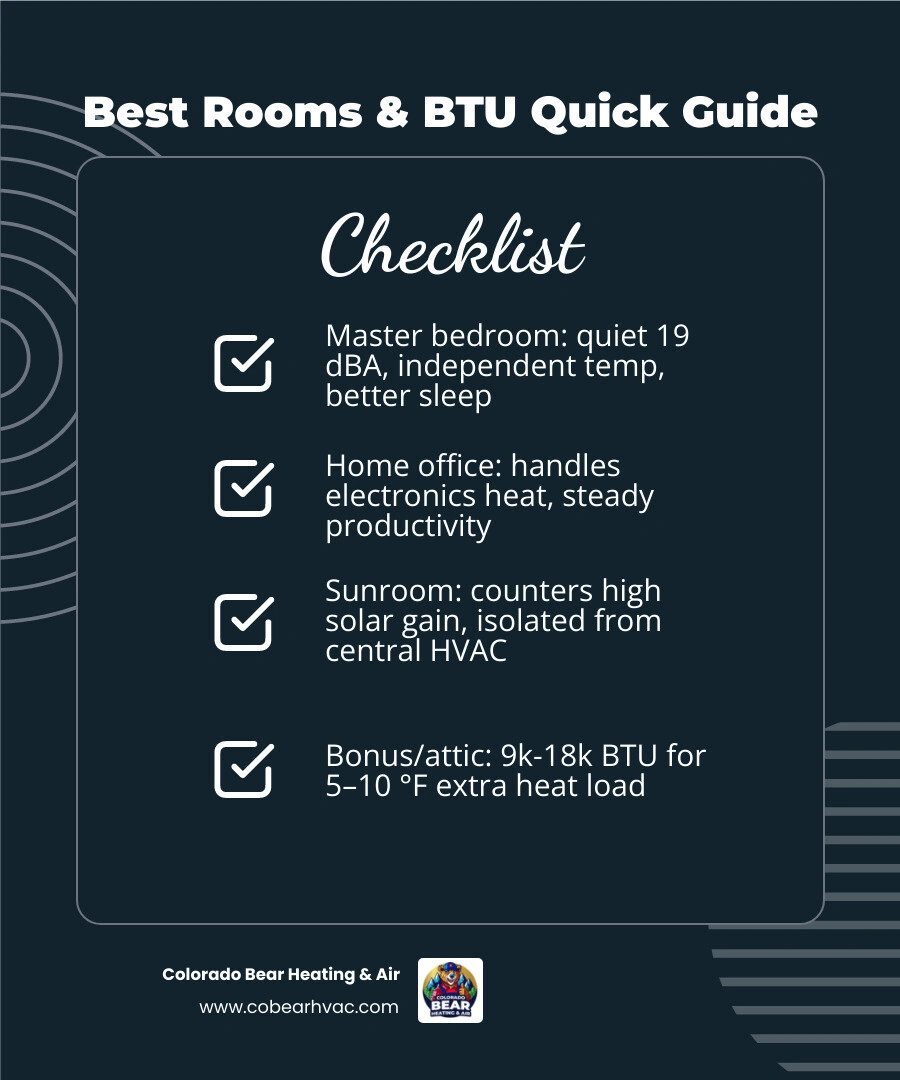
| Master bedroom | Quiet operation, independent temperature control, better sleep |
| Home office | Handles heat from electronics, boosts productivity |
| Sunroom | Manages high solar gain, independent from main HVAC |
| Garage conversion | No existing ductwork, on-demand conditioning |
| Finished basement | Controls humidity and temperature independently |
| Bonus room / attic space | Runs 5-10°F warmer than ground floor, hard to reach by ducts |
| Guest room | Cool only when occupied, saves energy |
Every home has at least one room that never feels quite right — too hot in summer, stuffy in the afternoon, or just disconnected from the rest of the house. For many Colorado homeowners, that room is a bonus space above the garage, a sun-drenched home office, or a master bedroom that stays warm long after sunset. Mini split systems solve this problem by delivering heating and cooling directly into a specific room without relying on ductwork — and because central air ductwork can lose roughly 30% of its energy to leaks and heat transfer, going ductless in the right rooms is a genuinely smart move.
Top Candidates: The Best Rooms for a Mini Split System
Choosing the best rooms for a mini split system isn't just about where you want air conditioning; it’s about where a ductless unit can provide the most value. In our experience serving the Denver Metro area, we’ve found that certain spaces are natural fits for this technology.
Master Suites and Bedrooms
Bedrooms are among the most popular choices for mini split installation. Many homeowners in Highlands Ranch and Castle Rock find that their upstairs bedrooms remain 5 to 10 degrees warmer than the ground floor. A dedicated indoor unit allows you to keep your sleeping area at a crisp 68°F while the rest of the house stays at a more energy-efficient 75°F.
Home Offices
With more of us working from home in May 2026, the home office has become a high-priority zone. Electronics like computers, monitors, and printers generate significant heat, often making the office the warmest room in the house during the workday. A mini split ensures you stay productive without having to crank down the central AC for the entire home.
Sunrooms and Home Additions
Sunrooms are beautiful, but they act like greenhouses. Because they are often added after the original HVAC system was designed, extending ductwork to them is frequently inefficient or physically impossible. Mini splits are the gold standard for these spaces, as they can handle the high solar gain independently. You can learn more about how Mini Split AC Placement Affects Home Comfort in these unique glass-filled environments.
Garage Conversions and Finished Basements
Whether you’ve turned your garage into a home gym or your basement into a media room, these areas often lack proper ventilation. A mini split provides both temperature control and dehumidification, which is essential for below-grade spaces. For residents looking for a Ductless Mini Split in Highlands Ranch, CO, these conversions are the perfect application for single-zone systems.
Guest Quarters and Bonus Rooms
Guest rooms are often unoccupied for weeks at a time. With a mini split, you can leave the unit off when the room is empty and cool it down in minutes once guests arrive. Bonus rooms over garages are also notorious "hot spots" because they are surrounded by unconditioned space on almost all sides; a ductless unit levels the playing field.
Why Bedrooms are the Best Rooms for a Mini Split System
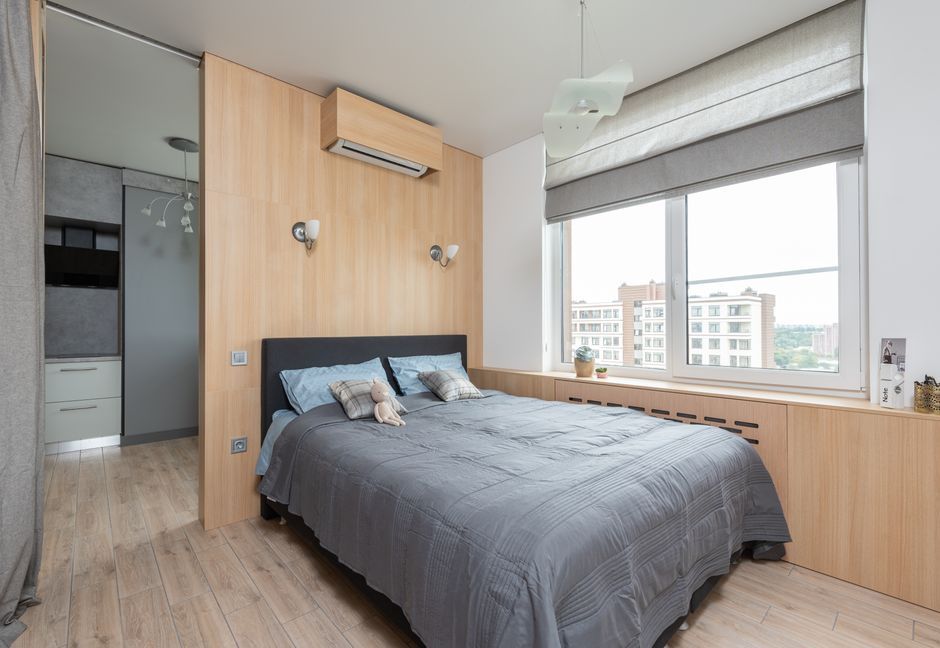
We spend nearly one-third of our lives sleeping, which makes the bedroom a prime candidate for a mini split. One of the biggest advantages is the whisper-quiet operation. Many premium units feature sound ratings as low as 19 dBA—that’s quieter than a soft rustle of leaves.
Beyond the silence, independent climate control is a game-changer for sleep quality. If you prefer a cold room but your partner likes it warmer, or if you simply don't want to pay to cool the entire living room and kitchen while you sleep, a mini split is the answer. This targeted approach is a major reason why these are the Best Rooms for Mini Split AC Installation.
Maximizing Productivity in Home Offices
A stuffy office is the enemy of focus. In a home office, a mini split does more than just move air; it manages the specific heat load created by your equipment. Modern inverter technology allows the system to adjust its speed continuously, maintaining a rock-steady temperature rather than the "blast and stop" cycle of older window units. This leads to consistent comfort and significant energy savings, which are among the many Advantages of a Ductless Mini Split System.
Strategic Placement for Maximum Efficiency and Performance
Once you've identified the best rooms for a mini split system, the next step is precise placement. Where you hang the indoor air handler is just as important as the unit itself.
The 6-Inch Rule and Mounting Height
For effective air circulation, wall-mounted indoor units should generally be positioned between 7 and 8 feet above the floor. We follow the "6-inch rule," which requires at least six inches of open space between the top of the unit and the ceiling. Since mini splits pull air in from the top, blocking this gap can reduce efficiency by as much as 30%.
Exterior Wall Preference
Whenever possible, we recommend mounting the indoor unit on a perimeter or exterior wall. This allows for a direct "back-to-back" installation where the refrigerant lines and condensate drain go straight through the wall to the outside. This simplifies the Mini Split AC Installation in Castle Rock, CO and usually eliminates the need for a condensate pump, which can be an extra source of noise.
Critical Factors for Indoor Unit Location
- Unobstructed Airflow: Ensure there is at least 6 feet of clear space in front of the unit. Avoid placing it behind tall furniture, shelving, or long curtains that could "trick" the sensors into thinking the room is cooler than it actually is.
- Maintenance Accessibility: You’ll need to flip up the front panel to clean the mesh filters every few weeks. Don’t mount the unit in a spot that requires a 10-foot ladder just to reach the filters.
- Remote Control Line-of-Sight: Most units use infrared remotes. Ensure the unit is visible from where you’ll most often be sitting or laying.
- Avoiding Direct Sunlight: Sunlight hitting the unit’s casing can interfere with its internal thermostat, causing it to run longer than necessary.
If you ever notice your unit isn't reaching the set temperature, it might be a placement issue or a need for Mini Split AC Repair in Castle Rock, CO.
Outdoor Unit Considerations for Colorado Homes
The outdoor condenser needs just as much love as the indoor handler. In our Colorado climate, we have to account for snow and wind.
- Shaded Locations: Placing the condenser on the north or east side of your home can prevent the sun from overheating the compressor, potentially saving 10% on energy usage.
- Airflow Clearance: The unit needs 1 to 3 feet of clearance on all sides to "breathe." Keep it away from dense shrubbery.
- Level Mounting Pads: We use stable concrete or composite pads with vibration-reduction feet to keep the unit quiet and prevent oil from settling unevenly in the compressor.
- Snow Accumulation: In areas like Monument or Larkspur, we often mount units on wall brackets or "snow stands" to keep them above the snow line. This ensures the system can continue to provide heat even during a heavy May 2026 spring blizzard. For more tips on keeping your system running in the cold, check out our Ductless AC Repair Guide for Castle Rock.
Locations to Avoid: Where Not to Install Your System
Knowing where not to put a mini split is just as vital as knowing the best rooms for a mini split system.
The Kitchen "Grease Trap"
We generally advise against installing a standard mini split directly in a kitchen. Cooking releases steam and airborne grease that can quickly clog the fine mesh filters and coat the internal cooling coils. This leads to unpleasant odors and frequent service calls. If you must have one in a kitchen area, place it as far from the stove as possible.
Bathrooms and High Humidity
High humidity can interfere with the sensitive electronics and sensors inside a mini split. Furthermore, bathrooms are typically too small for even the smallest 6,000 BTU unit, leading to "short-cycling" where the unit turns on and off too rapidly to actually dehumidify the space.
The Hallway "Ghost Trap"
A common mistake is trying to cool three bedrooms by putting one large mini split in the hallway. We call this the "Ghost Trap." Because cold air is heavy and sinks, it won't magically turn the corner into a bedroom with a closed door. You'll end up with a freezing hallway and three warm bedrooms. It’s always better to use a multi-zone system with smaller units in each room.
Why Kitchens and Bathrooms are Challenging
In these rooms, the maintenance frequency triples. Grease in the kitchen and hairspray or steam in the bathroom create a sticky film on the blower wheel. This reduces airflow and can eventually burn out the motor. When considering Mini Split Pros and Cons for Older Homes, while they are versatile, they aren't meant for every environment.
Sizing Your System for the Best Rooms for a Mini Split System
Size matters. If a unit is too small, it will run constantly and never get the room cool. If it’s too large, it will cool the room so fast that it fails to remove humidity, leaving you feeling "cold and clammy."
BTU Capacity Guide
| Square Footage | BTU Capacity | Common Room Type |
|---|---|---|
| 150 – 250 | 6,000 BTU | Small bedroom, nursery |
| 250 – 400 | 9,000 BTU | Standard bedroom, home office |
| 400 – 550 | 12,000 BTU | Master suite, small living room |
| 600 – 1,000 | 18,000 BTU | Great room, garage conversion |
| 1,000 – 1,500 | 24,000 BTU | Large open-concept area |
Choosing the Right Capacity
To find the perfect fit for the best rooms for a mini split system, we look at more than just square footage.
- Solar Gain: A 300-square-foot sunroom needs more cooling power than a 300-square-foot basement.
- Ceiling Height: If you have 12-foot vaulted ceilings, you have more air volume to condition than a room with 8-foot ceilings.
- Insulation Quality: Older homes in Sedalia or Elizabeth may have thinner wall insulation, requiring a slight "bump" in BTU capacity.
- Occupancy and Equipment: A home gym where two people are working out generates more heat than a guest room.
Frequently Asked Questions about Mini Split Placement
Can one indoor unit cool multiple rooms effectively?
Generally, no. Mini splits are designed for "zone" cooling. While some air may drift through an open doorway, it won't be enough to maintain a consistent temperature in a second room. For multiple rooms, a multi-zone outdoor condenser connected to several indoor air handlers is the most efficient solution.
How much clearance is required for the outdoor condenser?
You should aim for at least 12 inches of clearance on the back (intake) side and at least 24 to 36 inches on the front (discharge) side. This ensures the hot air being blown out doesn't get sucked back in, which would cause the compressor to overheat and lose efficiency.
Are mini splits better than window units for single-room cooling?
In almost every category: yes. Mini splits are more efficient (SEER2 ratings up to 42 vs. 10-12 for window units), much quieter, more secure (no open window), and they provide high-efficiency heating in the winter. While window units are cheaper upfront, a mini split can last 15 to 20 years and save you 30% or more on your energy bills.
Conclusion
Finding the best rooms for a mini split system is the first step toward a more comfortable, energy-efficient home. Whether you’re looking to fix a "hot" master bedroom in Highlands Ranch or condition a new sunroom in Castle Rock, these systems provide a level of customized comfort that central air simply can't match.
At Colorado Bear Heating & Air, we bring over 20 years of experience to every project. We pride ourselves on honest work, transparent communication, and a customer-first approach that ensures your system is sized correctly and placed perfectly the first time. From Centennial to Monument, we are here to help you navigate Ductless Mini Split Systems.
Ready to reclaim your home's comfort? Contact our team for fast, reliable service in Castle Rock, Littleton, and the surrounding Denver Metro area.