Latest Blogs
Stay updated with our latest blog posts.




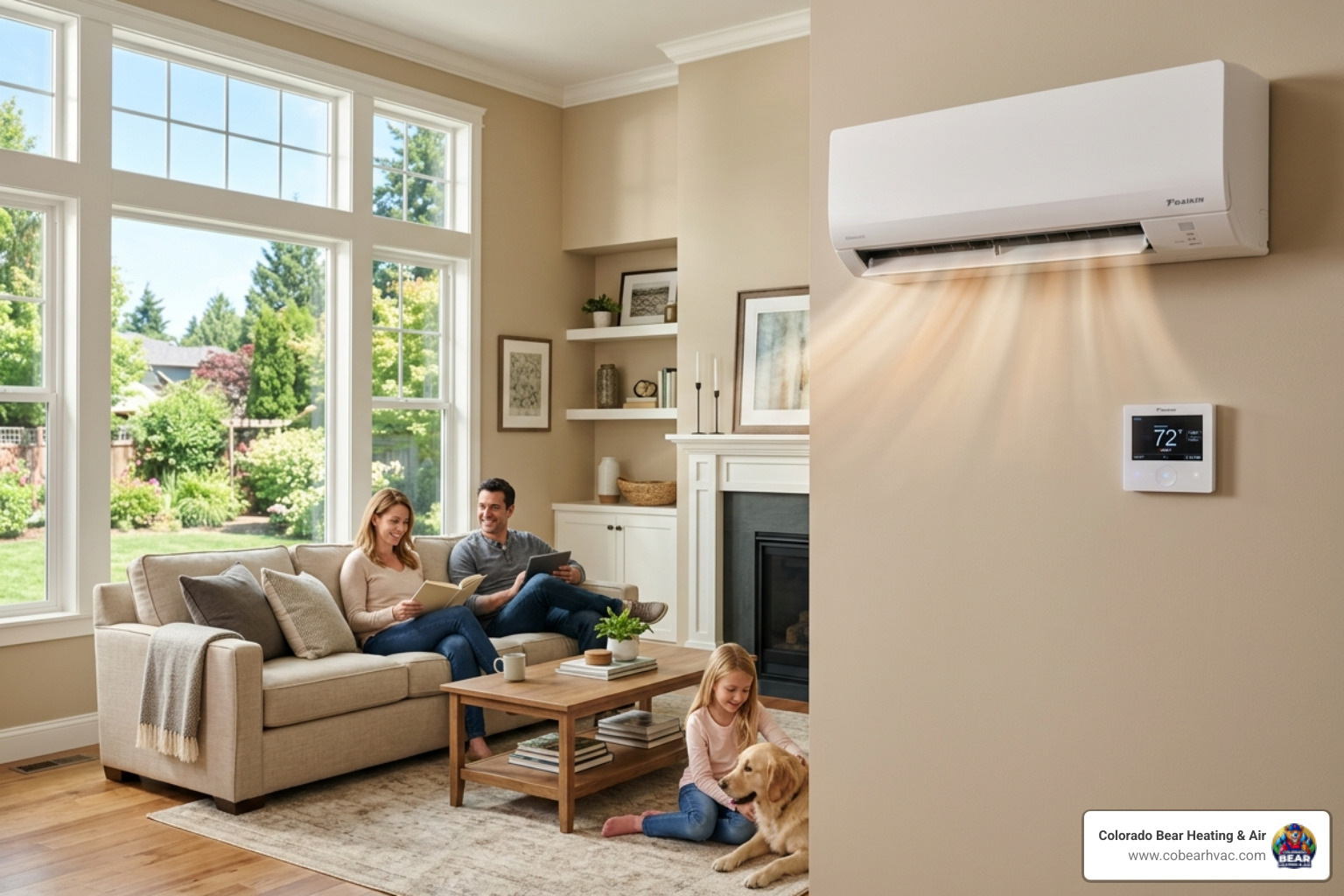
Choosing the right HVAC brand for Colorado is not as simple as picking a name you've seen in an ad. Colorado's climate throws a lot at your heating and cooling system — scorching, dry summers, brutal cold snaps, high altitude, intense UV exposure, and hail. Not every brand or system is built to handle all of that reliably.
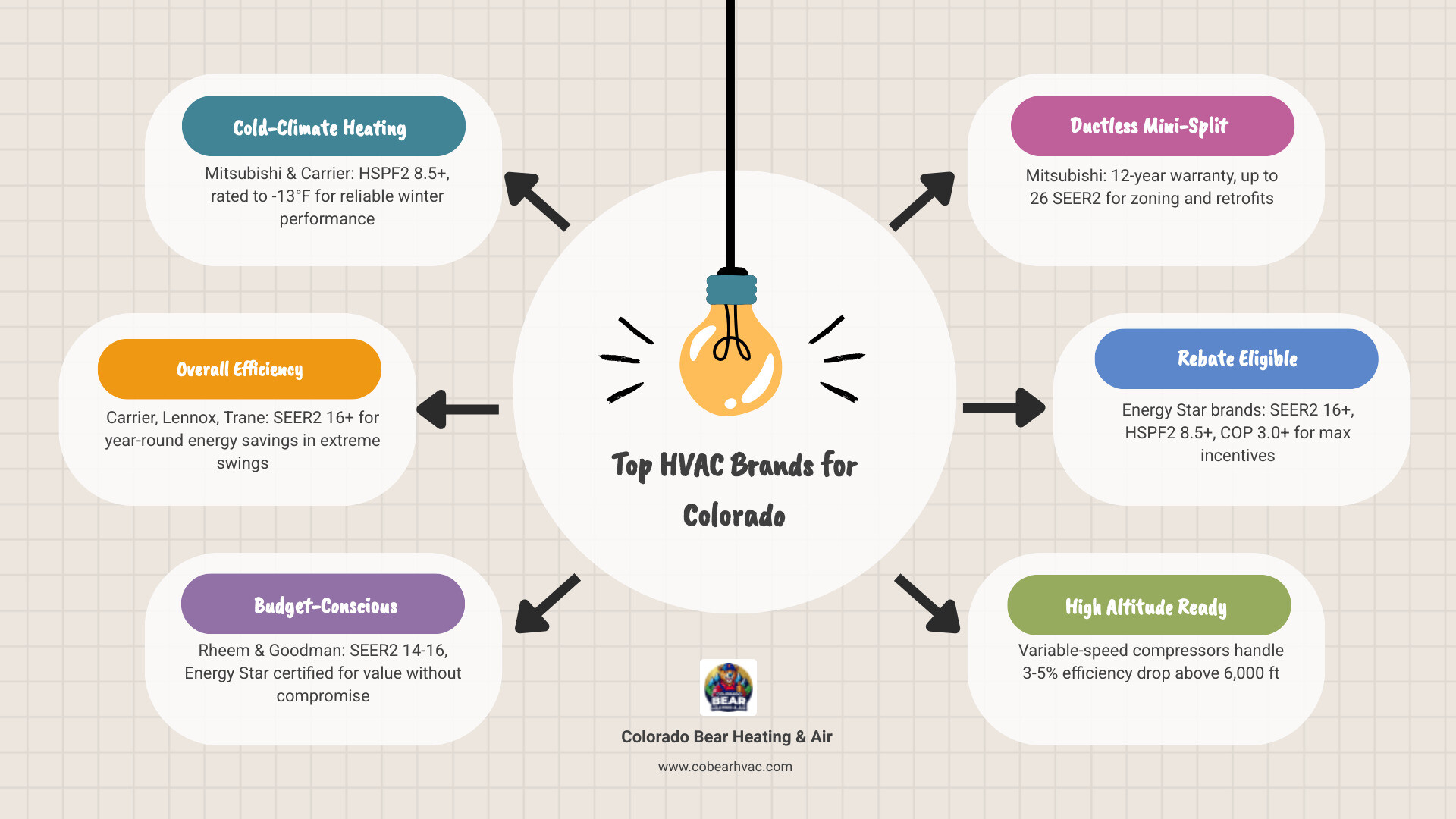
Here's a quick-reference summary to match your situation to the right direction:
| Your Priority | Best-Fit Brand Type | Key Rating to Look For |
|---|---|---|
| Cold-climate heating | Mitsubishi, Carrier | HSPF2 8.5+, rated to -13°F or below |
| Overall efficiency | Carrier, Lennox, Trane | SEER2 16+ |
| Value-focused | Rheem, Goodman | SEER2 14-16, Energy Star certified |
| Ductless / mini-split | Mitsubishi | 12-year warranty, up to 26 SEER2 |
| High rebate eligibility | Any Energy Star brand | SEER2 16+, HSPF2 8.5+, COP 3.0+ |
The short answer: For most Colorado homeowners in 2026, a cold-climate heat pump from Mitsubishi, Carrier, or a comparable premium brand — installed correctly by a licensed local technician — delivers the best combination of year-round performance, energy savings, and rebate eligibility. But your home's age, ductwork, elevation, and heating needs all matter too.
Colorado presents a uniquely demanding environment for HVAC equipment. At elevations above 6,000 feet — common across the Denver Metro and Castle Rock areas — heat pump efficiency drops by an estimated 3 to 5%. Some systems can't even be installed above 6,561 feet. On top of that, Colorado Springs and similar communities can see temperature swings of more than 80 degrees within a single year. Your system needs to perform whether it's 95°F in July or -10°F in January.
The brand you choose matters. But so does the system type, the efficiency ratings, how it's sized for your specific home, and who installs it. This guide walks you through all of it.
Living along the Front Range means dealing with weather that can change its mind three times before lunch. For homeowners in Castle Rock, Parker, or Highlands Ranch, our "thin air" isn't just a talking point for visiting athletes—it’s a physical challenge for your air conditioner and furnace.
Because the air is less dense at high altitudes, your HVAC system has to work harder to move the same amount of heat. This leads to a natural 3-5% reduction in efficiency compared to sea-level performance. If a brand isn't engineered with robust compressors and heat exchangers, that extra strain can lead to a shorter lifespan. Furthermore, our incredibly dry air can cause rubber seals and gaskets to become brittle and crack faster than they would in more humid climates.
Then there’s the UV exposure. At 6,000+ feet, the sun is more intense, which can degrade the insulation on your outdoor refrigerant lines and the plastic components of your unit. And we can't forget the "H" word: Hail. Colorado is in the heart of hail alley. Choosing a brand with a heavy-duty, louvered cabinet can be the difference between a system that survives a summer storm and one that needs a total coil replacement.
When you invest in HVAC Service Castle Rock CO, we look for systems that are specifically calibrated for these high-altitude conditions. This includes adjusting combustion for gas furnaces to ensure they aren't "running rich" and wasting fuel, as well as ensuring the refrigerant charge is precise for our specific atmospheric pressure.
In 2026, the market is dominated by a few major parent companies, but each brand brings something different to the table for Colorado homes. When choosing the right hvac brand for colorado, you generally find yourself looking at these top contenders:
We often recommend brands that utilize variable-speed compressors. Unlike older "single-stage" units that are either 100% on or 100% off, variable-speed systems can operate anywhere from 25% to 100% capacity. This is vital for HVAC Replacement Castle Rock CO because it allows the system to maintain a steady temperature despite the outdoor fluctuations, effectively "sipping" electricity rather than gulping it.
The biggest shift we’ve seen in 2026 is the move toward cold-climate heat pumps. Ten years ago, heat pumps were mostly for the South. Today, they are a primary heating solution for Colorado. Thanks to Inverter Technology Castle Rock CO, these systems can extract heat from the outdoor air even when it’s well below zero.
| Brand | Model Series | Cold Weather Limit | Max SEER2 |
|---|---|---|---|
| Mitsubishi | Hyper-Heat (H2i) | -13°F | 26 |
| Bosch | IDS Ultra | -13°F | 20 |
| Carrier | Infinity 24 | -15°F | 23 |
These brands are currently the heavy hitters for a few reasons. First, they qualify for the most significant financial incentives. Between available utility rebates and federal tax credits, the upfront investment for a premium heat pump is often comparable to a traditional furnace-and-AC combo.
For income-qualified households, the HEAR (Home Electrification and Appliance Rebates) program can provide significant instant rebates. When you factor in that air-source heat pumps are over three times more efficient than natural gas, the long-term value for a home in Monument or Sedalia is undeniable.
When evaluating efficiency, don't just look at the big numbers. You need to understand the "2" in SEER2 and HSPF2. These are the updated 2023 standards that more accurately reflect real-world performance with ductwork.
For a Colorado home to be truly efficient, we recommend:
Regular HVAC Maintenance Castle Rock CO is essential for these high-efficiency units. Because they use sophisticated sensors and inverter boards, keeping the coils clean and the filters fresh ensures the system doesn't have to overcompensate for restricted airflow.
One of the most common questions we get from homeowners in older parts of Littleton or when they are finishing a basement in Elizabeth is: "Do I have to run ductwork?"
Ducted Systems are the traditional choice. They are great for whole-home comfort if you already have a duct network in place. However, ducts can lose up to 20-30% of their energy through leaks or poor insulation in crawlspaces.
Ductless Mini-Splits are the rising stars of HVAC Service Highlands Ranch CO. These systems use an outdoor compressor connected to one or more indoor "heads" via small refrigerant lines.
They are ideal for:
When it comes to ductless, Mitsubishi is the undisputed leader. Their systems are incredibly quiet—often quieter than a human whisper—and their HyperHeat technology is specifically designed for climates like ours. They offer a 12-year manufacturer warranty on parts and the compressor when installed by a certified dealer, providing massive peace of mind for HVAC Service Littleton CO customers.
We could give you the most expensive, top-of-the-line Carrier or Trane system, but if it’s sized incorrectly, it will perform worse than a "budget" brand. This is where the Manual J Load Calculation comes in.
Many old-school contractors use a "rule of thumb" based on square footage. That doesn't work in Colorado. A Manual J calculation takes into account your home’s insulation levels, the direction your windows face (west-facing windows in Castle Rock get brutal afternoon sun!), ceiling height, and even the number of people living there.
An oversized system will "short cycle," turning on and off rapidly. This wears out the compressor, fails to remove humidity (making your home feel "sticky" in the summer), and spikes your energy bills. An undersized system will simply run all day and never reach your desired temperature.
Furthermore, proper HVAC Installation Castle Rock CO involves high-altitude calibration. This includes adjusting the gas pressure on furnaces and ensuring the airflow (measured in CFM) is sufficient for the thinner air. Most major manufacturers offer a 10-year parts warranty, but that usually requires registration within 60 days of installation. We handle that paperwork for our customers to ensure they are fully covered.
For the Denver Metro area, including HVAC Service Centennial CO, you should aim for a SEER2 of 16-18 for cooling and an HSPF2 of 8.5 or higher for heating. If you are sticking with a gas furnace, an AFUE (Annual Fuel Utilization Efficiency) of 95% or higher is the gold standard, meaning nearly all the fuel consumed is converted directly into heat for your home.
The "thin" air at our elevation reduces the heat-carrying capacity of the air. This means your system's blower motor and compressor have to work about 3-5% harder than they would at sea level. It’s vital to choose a brand known for robust build quality and to ensure your technician performs a high-altitude startup to adjust the system's internal settings. If your system is struggling, you may need HVAC Repair Castle Rock CO to check for premature wear caused by these stresses.
In 2026, the "dual-fuel" system is the most popular choice for Colorado. This pairs an electric heat pump with a high-efficiency gas furnace. The heat pump handles the cooling in the summer and the heating during our milder spring and fall days. When the temperature drops below -10°F or -15°F, the gas furnace kicks in as a reliable backup. This setup maximizes available utility rebates while ensuring you're never left in the cold. If your current system is failing, our team provides fast HVAC Repair Littleton CO to help you decide which path is right for your needs.
Choosing the right HVAC brand for Colorado is a significant investment in your home’s long-term comfort and value. Whether you’re looking at the unmatched cold-weather performance of a Mitsubishi heat pump or the rugged reliability of a Carrier central air system, the key is matching the equipment to our unique high-altitude climate.
At Colorado Bear Heating & Air, we bring over 20 years of experience to every home in Castle Rock, Denver, and the surrounding areas. We don't believe in high-pressure sales; we believe in "honest work done right the first time." From Centennial to Monument, we’re here to ensure your family stays cool in the summer and warm in the winter with transparent communication and expert installation.
Don't leave your comfort to chance or a "one-size-fits-all" brand. Request your free estimate on advanced inverter technology today and let us help you find the perfect HVAC solution for your Colorado home.

Get a decision in seconds with no impact to your credit score.


Colorado Bear HVAC is truly the best contractors I have experienced since I moved into my house 30 years ago. I have been dealing with Joe and his crew for over 11 years now. They are a trustworthy, respectful, experienced crew who works with you and gives you a fair value. They just completed a big job replacing my A/C, gas furnace and condenser. They did an excellent job, no short cuts, made sure everything was functional, and cleaned up the area nicely before they left. No pressure to perform unnecessary service. You know when the job is done, you have received top notch professional service at a fair price.


I used Colorado Bear Heating and Air to replace two furnaces in my home. Nate was exceptional to work with. His team did a great job educating me along the way. He provided competitive pricing with 10 year warranties. They installed quickly and were just super great to work with. I’d highly recommend them.

Nate and Sam have been great to work with getting my home humidifier installed in a difficult space in my 1940s house. Their prices were very fair and I would heartily recommend Colorado Bear to anyone looking for a solid HVAC company.
.avif)
Thank you Nate for the promptness you guys gave my parent. They are 93 and can't get around and always getting cold, and I was at work called Nate and he had one of his guys there in like 2 hours which was outstanding my dad was very impressed with the professional and how quick he had it fixed. These guys are great all my family said we found us a new heating and ac company. Colorado Bear Heating & Air you have customers for life!!!! Thank You Again
Carla and the Barnes Family
.avif)
Colorado Bear Heating & Air saved the day! This morning my family and I woke up to frigid outside temperatures(1 degree F)…and no heat! Nate was great over the phone to help me check our furnace, then he sent Sam over to help get us back to warmer temps. They were so quick and helpful. Fortunately I did not have to keep my toddlers inside the house wearing snow suits all day. We are warm now, and so thankful!
.avif)

If you’re in Colorado Springs, The Mountains, or nearby areas, call us to confirm availability for installations.
.avif)