How Many Mini Split Heads Do I Need? Here's Your Quick Answer
If you're wondering how many mini split heads do i need, the short answer depends on your home's layout, room count, and how many independent zones you want to control. Here's a simple starting point:
| Home Size | Typical Head Count |
|---|---|
| Under 600 sq ft (open plan) | 1 head |
| 600 – 1,200 sq ft | 2 – 3 heads |
| 1,200 – 2,000 sq ft | 3 – 4 heads |
| 2,000 – 3,000 sq ft | 4 – 5 heads |
| 3,000+ sq ft | 5 – 8 heads |
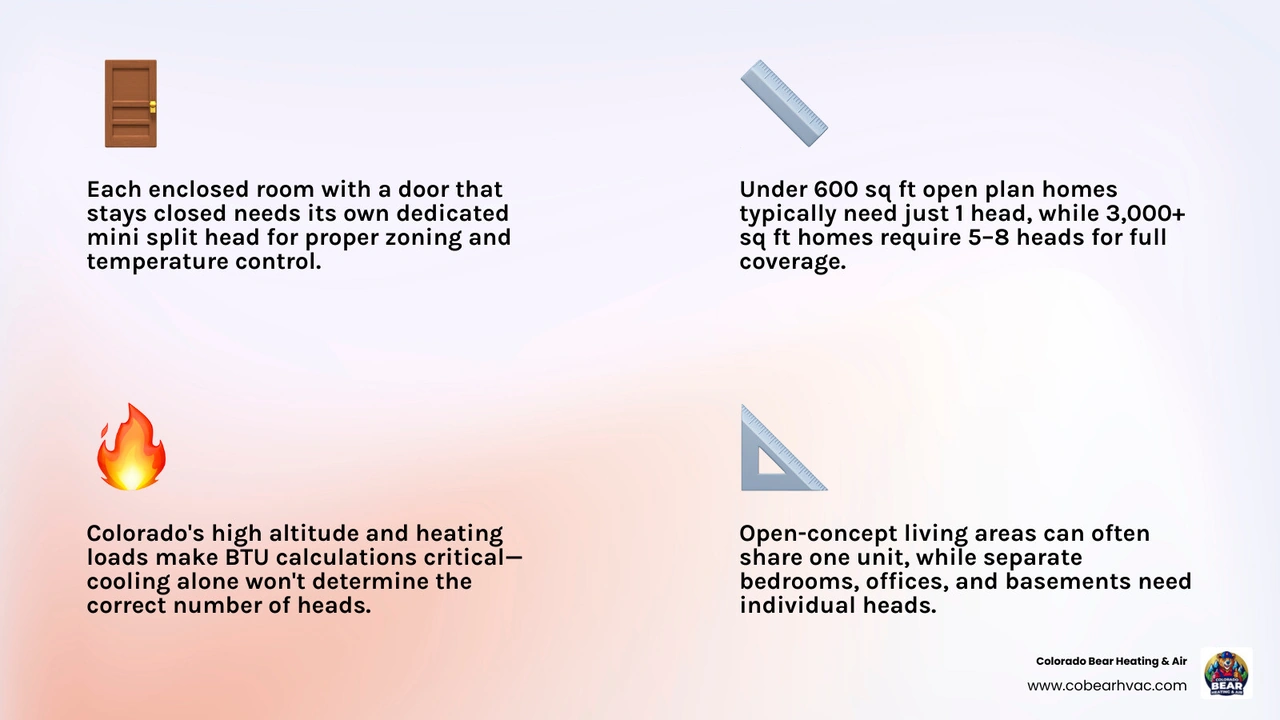
The basic rule: Each room separated by a door that stays closed generally needs its own head. Open-concept spaces like a combined kitchen, dining, and living area can often share a single unit.
Getting this right matters more than most homeowners realize. Too few heads and some rooms never reach a comfortable temperature. Too many and you've overspent on equipment you don't need. For Colorado homes specifically, sizing decisions are more complex because heating loads — not just cooling — drive the numbers, and Denver's altitude adds another variable most online calculators ignore.
Whether you're planning a new installation or upgrading an existing system, this guide walks you through exactly how to calculate the right number of indoor heads for your home, room by room.
Key terms for how many mini split heads do i need:
- mini split pros and cons for older homes
- what is a ductless mini split system
Single-Zone vs. Multi-Zone: How Many Mini Split Heads Do I Need?
When you begin planning your home's transition to ductless comfort, you must first decide between a single-zone and a multi-zone configuration. The choice directly dictates how many physical outdoor units you will have sitting in your yard and how many indoor air handlers will keep you cozy in the winter.
- Single-Zone Systems: These are a 1:1 match. One outdoor compressor connects to exactly one indoor air handler. If you are only trying to condition a newly finished basement in Castle Rock, a sunroom in Highlands Ranch, or a backyard workshop in Elizabeth, a single-zone system is the perfect fit.
- Multi-Zone Systems: Here, a single, high-capacity outdoor condenser powers multiple indoor air handlers (often up to five, and sometimes up to eight units on high-capacity residential systems). Each indoor head operates on its own thermostat. This means your teenager can keep their bedroom at a chilly 68°F while you keep your home office at a comfortable 72°F.
Choosing a multi-zone system is generally the most energy-efficient and visually clean way to condition multiple rooms because it avoids cluttering your home's exterior with several outdoor units. To learn more about how these systems optimize your comfort, read our guide on the Advantages of Ductless Mini Split System.
To help visualize the differences, here is a breakdown of how single-zone and multi-zone systems stack up:
| Feature | Single-Zone System | Multi-Zone System |
|---|---|---|
| Outdoor Units | 1 compressor per indoor head | 1 compressor for up to 8 indoor heads |
| Best For | Single rooms, additions, garages, or basements | Whole-house heating and cooling, multi-story homes |
| Zoning Control | Single thermostat control for one dedicated space | Independent thermostat control for each room |
| Installation Complexity | Very straightforward; quick single-day job | Requires strategic planning for linesets and drain lines |
| System Redundancy | If the outdoor unit fails, only one room is affected | If the outdoor unit fails, all connected zones lose climate control |
Key Factors That Determine Your Indoor Head Count
Determining the exact number of indoor heads is not a guessing game. It requires looking at how your family lives, how your home is laid out, and how air naturally moves (or doesn't move) through your living spaces.
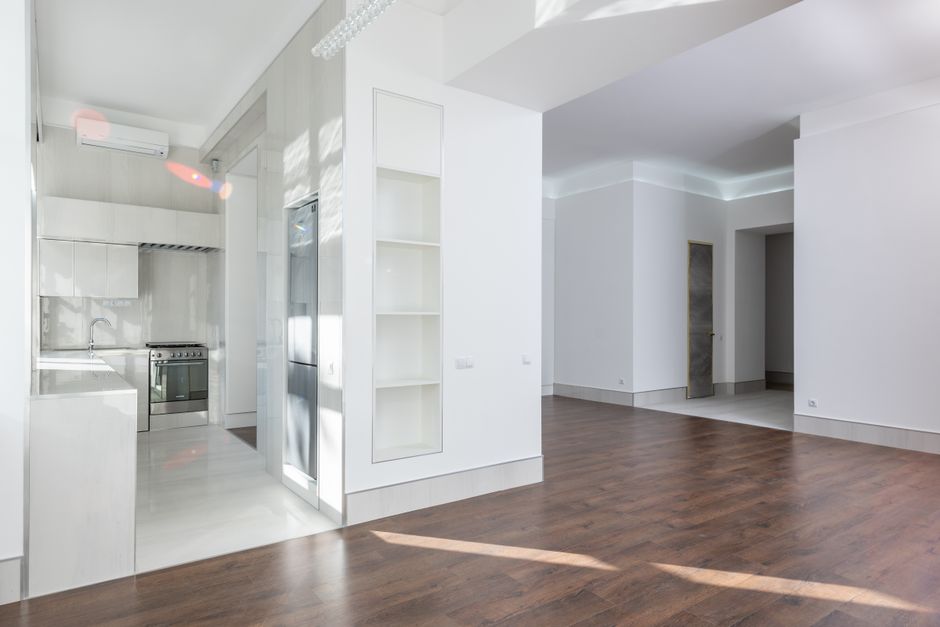
When we evaluate a home in Littleton or Lone Tree, we look at several core architectural layout factors:
- Number of Enclosed Rooms: Standard walls and doors are excellent for privacy, but they are terrible for airflow. If you have four bedrooms upstairs, you cannot expect one hallway unit to keep them all comfortable.
- Floor Count and Heat Stratification: Because hot air rises, a multi-story home in Centennial or Parker will almost always experience heat stratification. You will need at least one head per floor to manage this natural temperature divide.
- Daily Usage Patterns: If you have guest bedrooms that are only occupied a few weekends a year, you might choose to skip placing a permanent wall head there to keep your system design streamlined.
Before choosing where to place your equipment, check out our article on the Best Rooms for Mini Split AC Installation and learn about the physical limitations of the technology in our guide on Considerations Ductless Mini Split Installation.
How many mini split heads do I need based on the "Door Rule"?
In the HVAC world, we live by the "Door Rule." It is a simple, highly effective guideline for zoning: Any room separated from the rest of the house by a door that remains closed most of the time needs its own dedicated indoor head.
Air cannot move through solid wood or drywall. If you close your master bedroom door at night for privacy, the conditioned air from a unit in the living room or hallway will never reach you. This rule is especially critical in older, historic homes in Denver or Sedalia that feature highly compartmentalized layouts. If your home has a traditional layout with closed-off dining rooms, dens, and bedrooms, you will naturally require a higher head count to ensure even comfort.
How many mini split heads do I need for open-concept layouts?
If your home features a modern, open-concept layout where the kitchen, dining room, and living room flow freely into one another, you have a major advantage. You do not need a mini split head in every single one of those spaces.
Instead, open spaces can easily share a single, higher-capacity indoor head. However, you must keep the physical limitations of airflow in mind. Standard wall-mounted mini split heads only "throw" air effectively about 15 to 20 feet. If your open-concept area is exceptionally long or L-shaped, a single unit might leave the far kitchen corner feeling like a warm pocket. In those cases, installing two smaller heads at opposite ends of the space will provide much more balanced, draft-free comfort.
For homeowners who want to condition multiple adjacent rooms without cluttering every wall with a plastic unit, slim-ducted mini split systems are an incredible alternative. These compact units are hidden in an attic, crawlspace, or drop ceiling, using short, localized duct runs to quiet-cool two or three rooms at once. If you are comparing your options for ductless or ducted additions, take a look at our breakdown of Adding Cooling Without Ductwork Options Compared.
Calculating BTU Capacity and Sizing for Colorado Climates
Once you know how many heads you need, you have to determine how powerful each head should be. This power is measured in British Thermal Units (BTUs).
While a general rule of thumb is to allow roughly 20 to 25 BTUs per square foot for cooling, Colorado's unique climate turns standard calculations on their head. In places like Castle Rock, Monument, and Larkspur, our heating load is often significantly larger than our cooling load. Because we use these systems to keep us warm during freezing winter nights, we must size our mini splits for the heating load, which typically requires 30 to 40 BTUs per square foot.
Furthermore, Denver's high altitude (and surrounding communities) must be factored into the equation. At 5,280 feet above sea level, the air is about 17% less dense than at sea level. Because thin air carries less heat, mini split systems experience a slight reduction in performance. We must apply a 3% to 5% altitude derating adjustment to ensure your system has enough muscle to keep you warm when the snow starts falling.
For a complete look at how these systems handle both heating and cooling, check out our Ductless Mini Split System Complete Guide.
Sizing Adjustments for Insulation, Ceiling Height, and Sun Exposure
To get a truly accurate BTU calculation, you cannot rely on square footage alone. You must adjust your numbers based on the unique "personality" of each room:
- Ceiling Height: Standard calculations assume an 8-foot ceiling. If your living room in Castle Pines or Highlands Ranch features beautiful vaulted ceilings, you have more volume to heat and cool. Add 10% to your BTU requirement for every two feet of ceiling height above 8 feet.
- Solar Gain (Sun Exposure): If you have a south-facing home office with massive windows, that room acts like a greenhouse in the middle of summer. You will need to increase the cooling capacity of that specific head by 10% to 15% to combat the solar heat gain.
- Kitchen Heat: Kitchens are filled with heat-generating appliances like ovens, stoves, and dishwashers. Always add a flat 4,000 BTUs to any kitchen zone calculation.
- Insulation Quality: Older, drafty homes in historic Denver neighborhoods lose heat rapidly. Upgrading your wall and attic insulation before choosing your system size can actually allow you to install smaller, more efficient, and less expensive mini split heads.
- Cold-Climate Heat Pumps: Standard mini splits lose 40% to 60% of their heating capacity when temperatures drop to 5°F. For reliable year-round comfort in Colorado, we always recommend cold-climate certified units. These advanced systems utilize inverter-driven compressors to retain 75% to 85% (or more) of their heating capacity in sub-zero temperatures.
Planning for Future Expansion vs. Installing All Heads Now
A common question we hear from homeowners in Franktown and Parker is: "Can I install a couple of heads now and add more later when my budget allows?"
The answer is yes, but only if you plan for it from day one.
When you install a multi-zone mini split system, the outdoor condenser is the heart of the operation. It has a fixed number of refrigerant line ports and a maximum BTU capacity. If you install a 2-zone outdoor compressor with two indoor heads today, you cannot simply plug in a third head next year. To expand, you would have to completely replace the outdoor unit.
If you think you might want to add climate control to an attic or guest room down the road, it is highly recommended to install a larger outdoor condenser with extra "expansion ports" now. You can run the system with empty ports today and easily hook up additional indoor heads in the future.
This is where understanding "Load Diversity" becomes highly valuable. In a multi-zone system, you rarely run every single indoor head at maximum capacity at the exact same time. During the day, you are using the living room and home office heads; at night, you are running the bedroom heads. Because of this, manufacturers allow the total combined BTU capacity of your indoor heads to exceed the outdoor condenser's capacity by up to 130%. This "load diversity" allows you to install a highly responsive, multi-head system without needing a massive, energy-hogging outdoor unit.
Curious about how this compares to traditional whole-home systems? Read our Central AC vs Ductless Mini Split Comparison to see which approach fits your long-term goals.
Common Mistakes to Avoid When Sizing and Placing Heads
Because ductless systems are so customizable, there are a few common design pitfalls that can lead to drafty rooms, high energy bills, or noisy equipment.
- The Hallway Trap: Many homeowners try to save money by installing one large, high-capacity head in a central hallway, hoping it will cool three adjacent bedrooms. This almost never works. Because the hallway is a tight, enclosed space, the cold air quickly pools around the unit. The thermostat senses the hallway is cool and shuts the system down before any of that conditioned air can make its way into the bedrooms. You end up with a freezing hallway and stuffy, uncomfortable bedrooms.
- Oversizing and Short-Cycling: It is easy to think "bigger is better," but an oversized mini split head is a recipe for discomfort. If you put a 12,000 BTU head in a tiny 150-square-foot bedroom, the unit will blast the room with cold air, satisfy the thermostat in minutes, and shut off. This rapid turning on and off is called short-cycling. It prevents the system from running long enough to remove humidity from the air, leaving your room feeling cold, damp, and clammy.
- Undersizing: Conversely, if you put a tiny 6,000 BTU head in a large, drafty sunroom, the unit will run constantly at maximum speed. It will struggle to keep up, wear out prematurely, and spike your monthly energy usage.
- Poor Head Placement: Avoid mounting indoor heads directly over beds, tight in corners, or directly above electronic equipment. Heads should be centered on the longest wall of a room whenever possible to allow the air to throw evenly across the entire space.
To learn more about the long-term efficiency and performance benefits of avoiding these mistakes, explore our Mini Split vs Central AC Cost Comparison.
Frequently Asked Questions About Sizing Ductless Systems
Designing a custom comfort system naturally comes with plenty of questions. Here are some of the most common things homeowners ask our team during consultations.
Can one outdoor unit support my entire home?
Yes, absolutely. Most residential multi-zone outdoor condensers can easily support two to five indoor heads, and some high-capacity models can handle up to eight zones. For exceptionally large or multi-story homes in Aurora or Littleton, we often recommend installing two separate, smaller outdoor units instead of one massive one. This keeps your refrigerant line runs shorter, improves system efficiency, and provides built-in redundancy so you are never completely without heating or cooling if one unit needs maintenance.
Do bathrooms require their own dedicated mini split head?
Generally, no. Bathrooms do not need their own mini split heads. The natural airflow from adjacent bedrooms or hallways is usually more than enough to keep a bathroom comfortable. Furthermore, the high moisture and steam from showers can interfere with the delicate temperature and humidity sensors inside a mini split head, leading to improper operation. Standard mechanical bathroom exhaust ventilation is the best way to handle bathroom climate needs.
Can I mix different styles of indoor heads on one system?
Yes! This is one of the coolest features of modern multi-zone technology. You do not have to use standard high-wall mounted units in every room. You can mix and match a high-wall head in the master bedroom, a sleek ceiling cassette (which sits flush with the ceiling) in the living room, and a floor console (which sits low on the wall like a traditional radiator) in a drafty home office. All of these different styles can connect to the exact same outdoor compressor.
Conclusion
Determining how many mini split heads do i need is the crucial first step toward transforming your home's comfort. By applying the "Door Rule," mapping out your open-concept spaces, and calculating your local heating and cooling loads, you can design a system that delivers perfect, customized comfort to every corner of your home.
Because Colorado's high altitude and freezing winters require precise, professional calculations, you should never rely on generic online calculators to design your system. At Colorado Bear Heating & Air, our licensed and factory-certified technicians have over 20 years of experience serving Castle Rock, Littleton, Highlands Ranch, Centennial, and the surrounding Denver Metro communities. We pride ourselves on honest work, transparent communication, and doing the job right the first time.
Ready to stop the thermostat wars and start enjoying personalized comfort in every room? Let us perform a professional, altitude-adjusted load calculation for your home. Explore our Ductless services online to schedule your fast, reliable comfort consultation!