How Colorado Storms Affect Your HVAC System — And What You Can Do About It
How colorado storms affect your hvac system is something every Colorado homeowner needs to understand before the next wave of hail, high winds, or lightning rolls across the Front Range.
Here's a quick look at the most common storm-related HVAC threats:
| Storm Type | Primary HVAC Risk |
|---|---|
| Hail | Bent condenser fins, damaged cabinet, moisture intrusion |
| High Winds | Debris in coils, fan blade damage, refrigerant line stress |
| Lightning / Power Surges | Fried control boards, compressor burnout, capacitor failure |
| Brownouts | Motor overheating, premature wear on electrical components |
| Rapid Temperature Swings | Thermal stress, cracked heat exchangers, short-cycling |
| Heavy Rain / Snow | Drainage clogs, frozen coils, condensate line damage |
Colorado's weather is in a league of its own. Temperatures can swing 40 to 50 degrees Fahrenheit within a single day — especially during spring and fall. Chinook winds can push temperatures up by 30 degrees in just a few hours. And along the Front Range, intense hailstorms can go from clear skies to golf-ball-sized ice in minutes. For your HVAC system — sitting outside, year-round, exposed to all of it — that kind of punishment adds up fast.
In Castle Rock, Littleton, Highlands Ranch, and across the Denver Metro, Colorado Bear Heating & Air sees what these storms do to heating and cooling equipment. The damage isn't always obvious right away, which makes it even more important to know what to look for and how to stay ahead of it.
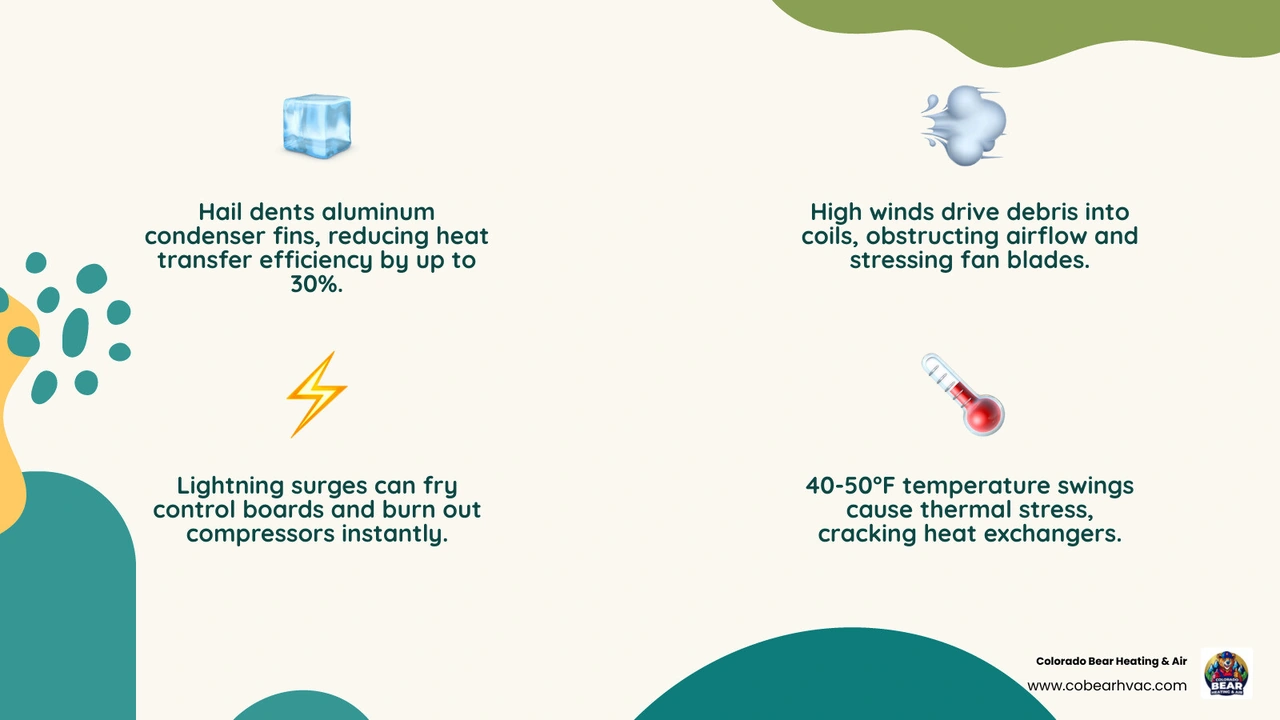
How Colorado Storms Affect Your HVAC System
When we talk about how colorado storms affect your hvac system, we aren't just talking about a single afternoon of bad weather. We’re talking about a cumulative "stress test" that happens every time a front moves over the Rockies. Whether it’s a mid-summer thunderstorm in Parker or a late-season blizzard in Castle Rock, the physical and mechanical components of your system are on the front lines.
Wind-Driven Debris and Airflow Obstruction
High winds are a staple of the Colorado Front Range, often gusting over 50 mph during seasonal transitions. These winds don't just rattle your windows; they turn your backyard into a debris field. Leaves, twigs, pine needles, and even loose patio furniture can be sucked into or slammed against your outdoor condenser unit.
When debris gets trapped in the condenser coils, it acts like a blanket, choking off the airflow your system needs to release heat. This forces the compressor to work twice as hard, leading to reduced efficiency and a shorter lifespan for the unit. In extreme cases, high winds can actually displace the unit on its pad or put significant stress on refrigerant lines, leading to leaks that require professional repair.
Physical Damage from Hail and Heavy Precipitation
Hail is perhaps the most visible enemy of Colorado HVAC systems. The delicate aluminum fins on your AC unit or heat pump are designed to maximize surface area for heat exchange, but they are incredibly soft. Even small hail can "mash" these fins flat, effectively sealing the unit and preventing air from passing through the coils.
Beyond the fins, heavy precipitation can lead to moisture intrusion in the electrical cabinet. If the seals on your unit have become brittle due to our low humidity (often dropping below 20% in winter), water can seep into control boards. Furthermore, heavy snow or rain can lead to drainage clogs. If the condensate line or the area around the base of the unit isn't clear, water can back up, freeze, and cause the system to shut down entirely. To keep your system running smoothly through the warmer months, check out our guide on Protecting Heat Pump from Summer Storm Damage.
Electrical Hazards: Power Surges and Brownouts
While physical damage is easy to spot, the electrical impact of a storm is often the "silent killer" of HVAC systems in the Denver Metro area. Lightning doesn't even have to strike your home directly to cause a catastrophe; a nearby strike can send a massive surge through the grid.
Protecting Sensitive Electronics from Grid Instability
Modern HVAC systems, like the high-efficiency Daikin units we often install, rely on sophisticated control boards and sensors. These components are extremely sensitive to voltage fluctuations. A power surge can fry a control board instantly, while "brownouts"—sudden drops in voltage—can be just as damaging.
During a brownout, your HVAC motors (like the compressor and blower motor) struggle to maintain speed with less power. This causes them to pull more current, leading to overheating and eventually "burning out" the internal windings. Installing whole-home surge protection or AC-specific surge guards is a smart way to mitigate this risk. For more ways to keep your system efficient during the stormy season, see our Summer Energy Saving Tips for Colorado.
The Danger of Short-Cycling During Storm Events
Have you ever noticed your lights flickering during a storm? Every time the power blips, your HVAC system may attempt to restart. This is called short-cycling. Rapidly turning a compressor on and off creates immense heat and friction. It can also cause thermostat glitches, where the digital brain of your system gets "confused," leading to erratic behavior or a total system lockout.
The Hidden Toll of Thermal Cycling and High Altitude
Colorado’s unique geography creates HVAC challenges that homeowners in more stable climates never have to worry about. The most prominent of these is "thermal cycling."
Why High Altitude Compounds Storm Stress
At elevations between 5,000 and 9,000 feet, the air is approximately 20% less dense than at sea level. This means there is less oxygen for your furnace to burn and less "air mass" for your AC to move. Your system already has to work harder just to function here.
When a storm brings a 40-degree temperature drop in a matter of hours, the metal components in your furnace—specifically the heat exchanger—expand and contract rapidly. This is thermal cycling. Over time, this constant "stretching" of the metal leads to microscopic stress fractures. In the Denver area, we often see heat exchangers fail years earlier than manufacturer predictions because of these extreme Colorado swings. You can learn more about how equipment handles these specific stresses in our article on How Daikin Systems Perform in Colorado Climate.
Brittle Components and Low Humidity
Our dry air (often staying below 20% humidity in the winter) takes a toll on the "soft" parts of your HVAC system. Rubber seals, gaskets, and plastic condensate lines become brittle over time. When a storm hits and the temperature fluctuates around the freezing point, the resulting freeze-thaw cycle can easily crack these brittle components. We frequently see PVC drain lines and pump housings fail during the "shoulder" seasons of spring and fall because of this exact phenomenon.
How to Protect Your System Before and After a Storm
Preparation is the best defense against Colorado's unpredictable weather. By taking a few proactive steps, you can save yourself the headache of an emergency mid-storm breakdown.
| Pre-Storm Preparation | Post-Storm Inspection |
|---|---|
| Install a surge protector for the outdoor unit | Check for hail dents on the condenser fins |
| Trim branches within 2-3 feet of the unit | Clear away leaves, twigs, and trash from the base |
| Ensure the unit is securely anchored to its pad | Listen for new grinding, buzzing, or hissing sounds |
| Clear the area of loose toys or patio furniture | Check the thermostat for "error" or "lockout" codes |
| Schedule a seasonal maintenance tune-up | Inspect the furnace vent pipe for obstructions |
Immediate Steps to Take After a Colorado Storm
Once the clouds clear, it’s time for a quick "walk-around." Here is how colorado storms affect your hvac system recovery:
- Visual Inspection: Look at the outdoor unit. Are the fins straight? Is the fan clear of debris?
- Debris Removal: Gently remove any sticks or leaves that have accumulated around the base. Do not use a high-pressure hose on the fins, as this can bend them further.
- Listen closely: Turn the system on and listen. If you hear new noises—like a fan blade hitting a twig or a buzzing electrical sound—turn it off immediately.
- Monitor the Thermostat: Ensure the system is actually reaching the set temperature. If it's running constantly but the house isn't getting cooler (or warmer), you may have a refrigerant leak or a damaged component.
Professional Inspection After a Colorado Storm
Sometimes the damage isn't visible to the naked eye. After a particularly severe event, such as a major hailstorm or a lightning strike on your block, it’s worth calling in the pros. We use specialized tools to check for:
- Refrigerant Leaks: High winds and vibration can create tiny cracks in the lines.
- Electrical Integrity: We test capacitors and contactors to ensure they haven't been weakened by power surges.
- Heat Exchanger Safety: We inspect for those "hidden" stress fractures that could leak carbon monoxide into your home.
- Performance Calibration: We ensure your system is still optimized for our high-altitude air density.
Frequently Asked Questions about Colorado Storms and HVAC
How do I know if hail damaged my outdoor unit?
Look at the "grill" or the mesh of silver fins on the sides of your unit. If you see areas that look like they've been hit with a hammer, or if the fins are flattened in "spots," that's hail damage. Even if the unit is still running, this damage reduces efficiency and can eventually lead to a compressor failure.
Should I turn off my HVAC system during a lightning storm?
If a severe thunderstorm is directly overhead, the safest move is to turn the system off at the thermostat. This prevents the system from being "active" during a power surge, which can help protect the compressor and the control board.
Can high winds cause my furnace to stop working?
Yes. High winds can sometimes cause "pressure switch" errors in your furnace. Additionally, if wind-blown debris or heavy snow blocks the exhaust vent (the white PVC pipe usually sticking out the side of your house), the furnace will shut down as a safety precaution to prevent carbon monoxide buildup.
Conclusion
Living in the Front Range means accepting that the weather is always in charge. However, understanding how colorado storms affect your hvac system gives you the power to protect your investment. From the "hidden" stress of thermal cycling to the blunt force of a hailstorm, your heating and cooling system goes through a lot to keep you comfortable.
At Colorado Bear Heating & Air, we have over 20 years of experience helping our neighbors in Castle Rock, Parker, and the surrounding Denver Metro area navigate these exact challenges. We pride ourselves on honesty and "honest work done right the first time." Don't wait for a total system failure to find out what the last storm did to your equipment.
Contact us today to schedule a post-storm safety inspection. We’re here to ensure you stay comfortable, no matter what the Colorado sky throws your way.