Why Colorado Summers Make Lowering Your AC Bills So Challenging
How to lower AC bills during Colorado summer is one of the most common questions homeowners across the Denver Metro and Castle Rock areas ask when the season's first big energy bill arrives. And it's no wonder — Colorado's summers combine intense high-altitude sun, dry heat, and dramatic day-to-night temperature swings that push cooling systems harder than many homeowners expect.
Here's a quick overview of the most effective ways to cut your cooling costs this summer:
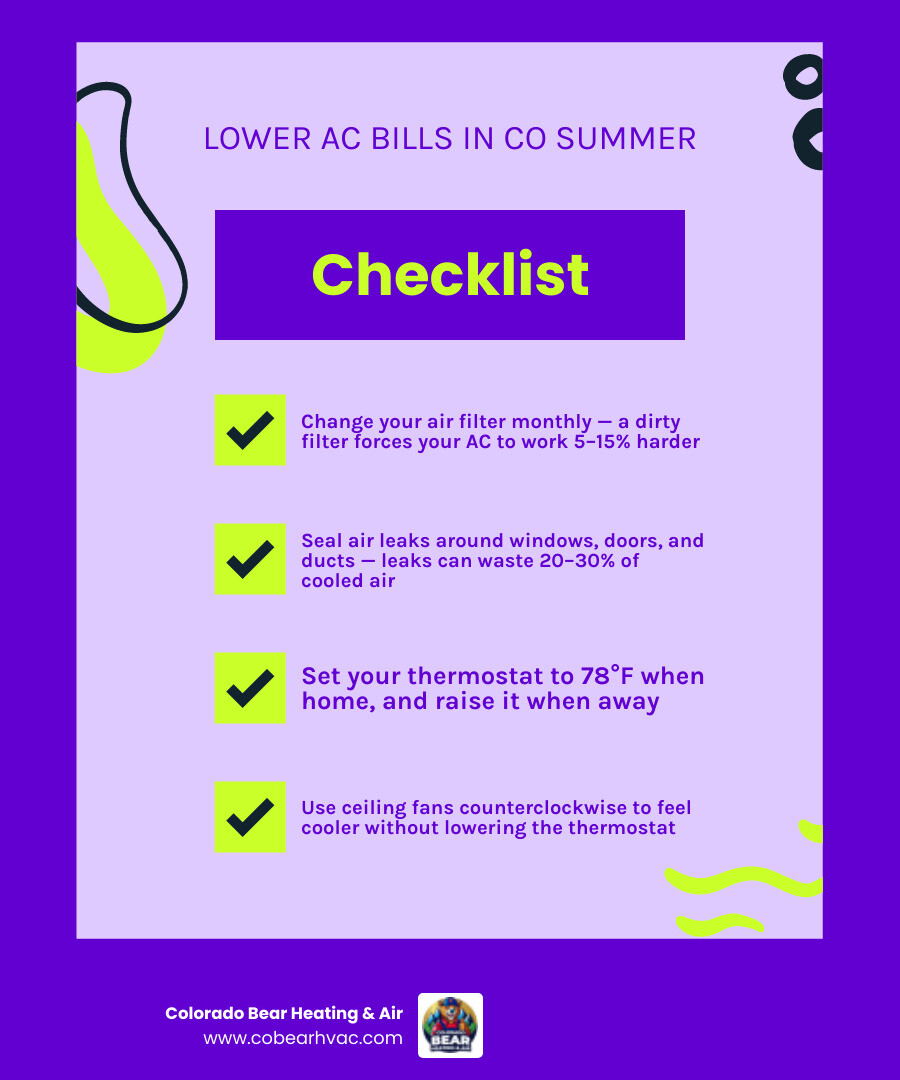
- Change your air filter monthly — a dirty filter forces your AC to work 5–15% harder
- Seal air leaks around windows, doors, and ducts — leaks can waste 20–30% of cooled air
- Set your thermostat to 78°F when home, and raise it when away
- Use ceiling fans counterclockwise to feel cooler without lowering the thermostat
- Close blinds and curtains on south- and west-facing windows during peak sun hours
- Leverage Colorado's cool nights by ventilating in the evening and sealing up in the morning
- Schedule an annual AC tune-up to keep your system running at peak efficiency
- Upgrade to a smart thermostat for automatic temperature setbacks that save roughly 10% annually
- Improve attic and wall insulation to reduce heat gain by up to 15%
- Take advantage of Xcel Energy rebates and programs to offset upgrade costs
Home cooling can account for roughly half of a household's summertime electricity bill. In Colorado, that challenge is made even steeper by the state's unique climate conditions. At Denver's elevation of 5,280 feet, air is about 17% less dense than at sea level — which means your AC blower has to work harder to move the same cooling effect through your home. Add Colorado's famously intense sun and the fact that dry air heats indoor spaces quickly, and it's clear why a standard approach to energy savings often falls short here.
The good news? A combination of smart habits, targeted maintenance, and a few well-chosen upgrades can make a real dent in your summer cooling costs — without sacrificing comfort.
How to Lower AC Bills During Colorado Summer Through System Maintenance
When we talk about how to lower ac bills during colorado summer, the conversation always begins with the health of your HVAC system. Think of your air conditioner like a high-performance vehicle; it cannot deliver peak mileage if the filters are clogged or the engine is neglected. In our dry, dusty Front Range environment, maintenance isn't just a suggestion—it’s a financial necessity.
The single most impactful DIY task you can perform is managing your air filters. According to energy experts, replacing a dirty air filter can lower your air conditioner’s energy consumption by 5% to 15%. Because Colorado air carries significant dust and pollen, we recommend following our AC Filter Replacement Guide for Homeowners to ensure you aren't accidentally choking your system.
Professional care is the other half of the equation. A comprehensive AC Service Checklist Summer includes cleaning the outdoor condenser unit. When dirt and debris (like cottonwood seeds or grass clippings) coat those outdoor coils, the heat exchange process slows down, forcing the unit to run longer. By keeping the unit clean and ensuring there are at least two feet of clear space around it, you ensure the heat from your home has somewhere to go.
Furthermore, checking for refrigerant leaks is vital. Refrigerant is not "fuel" that gets used up; if it's low, there is a leak. Running a system with low refrigerant levels is one of the fastest ways to spike your bill and burn out your compressor. Our AC Maintenance Castle Rock CO Guide highlights how regular professional inspections catch these small leaks before they become catastrophic failures.
Identifying Performance Red Flags
Your AC often tries to tell you when it’s struggling. Knowing How to Tell When Need AC Repair can save you from a mid-July breakdown. Listen for unusual noises like banging, whistling, or hissing—these often point to mechanical issues or refrigerant leaks.
Another red flag is "short cycling," where the unit turns on and off every few minutes. This is incredibly hard on your electrical bill and the equipment. If you've ever wondered about the Top 5 Reasons that Your AC is Always Running, it often comes down to airflow restrictions or thermostat errors. If you see ice forming on the copper lines or the indoor evaporator coil, turn the system off immediately and call us; this usually indicates a severe lack of airflow or a refrigerant issue that requires professional attention.
Optimizing Your Home’s Envelope and Airflow
If your home is "leaky," your AC is essentially trying to cool the entire neighborhood. Colorado's intense sun can heat up your interior surfaces quickly, making your AC work overtime just to keep up.
Properly managed windows can reduce heat gain by up to 77% during peak summer temperatures. In cities like Littleton and Highlands Ranch, where western-facing windows catch the full brunt of the afternoon sun, using blackout curtains or cellular shades is a game-changer. By blocking the sun before it hits your carpet and furniture, you stop the "greenhouse effect" in its tracks.
Don't ignore the cracks. Sealing leaks around doors and windows with simple caulk or weatherstripping can save up to 20% on your cooling costs. These small gaps allow the expensive, conditioned air you’ve paid for to escape while inviting hot, dry air inside. For more detailed steps, check out our Preventive AC Maintenance Tips.
Finally, look up. Proper attic insulation can reduce cooling costs by up to 15%. In many older homes in Centennial or Denver, insulation has settled over the decades. Adding fresh insulation acts as a thermal barrier, preventing the 150-degree heat in your attic from radiating down into your living space.
How to Lower AC Bills During Colorado Summer Using Natural Ventilation
One of the best things about living in Colorado is our diurnal temperature swing. Even after a 95-degree day, our evenings often drop into the 50s or 60s. This provides "free" cooling if you use it correctly.
When the sun goes down and the outside air is cooler than your indoor air, open your windows to create a cross-breeze. This flushes out the accumulated heat from the day. Just remember to seal the house back up early in the morning—around 7:00 or 8:00 AM—to "trap" that cool air inside before the sun gets high.
To help circulate this air, use your ceiling fans. In the summer, fans should rotate counter-clockwise to push a cool breeze directly downward. While fans don't actually lower the room temperature, the wind-chill effect on your skin allows you to raise the thermostat by about 4 degrees without losing comfort. If you feel like your home has "dead zones" where air doesn't move, you might be dealing with Common AC Airflow Problems like blocked vents or undersized returns.
Leveraging Smart Technology and Colorado’s Climate
In 2026, we have more tools than ever to manage energy use. For those of us in the Denver Metro area, understanding how Xcel Energy manages the grid can lead to significant savings. Programs like the "Saver’s Switch" or "AC Rewards" allow the utility to occasionally cycle your AC during peak demand days in exchange for bill credits.
We also need to discuss Time-of-Use (TOU) rates. During peak hours (typically 3:00 PM to 7:00 PM), electricity is significantly more expensive. A "pre-cooling" strategy involves setting your AC a few degrees lower in the morning and early afternoon while rates are low, then letting the temperature rise slightly during the expensive peak window. This shifts your energy consumption to the cheapest parts of the day.
While you're sealing your home for efficiency, don't forget that Why Your Indoor Air Quality Matters even more when the windows are shut. Proper filtration and humidity control (aiming for 30-50% humidity) make the air feel cooler and more comfortable, preventing that "sticky" feeling that often leads people to crank the AC lower than necessary.
How to Lower AC Bills During Colorado Summer with Smart Thermostats
Upgrading to a smart programmable thermostat can save you up to 10% on your annual heating and cooling costs. The beauty of these devices is that they take the "memory" out of the equation. You can learn more about Save Energy and Money Why a Programmable Thermostat Matters on our blog.
The Department of Energy recommends a setting of 78°F when you are at home. Every degree you raise the temperature above that can save you roughly 3% on your cooling costs. With Smart Thermostat Integration with New AC System, the device can use "geofencing" to realize you've left the house and automatically raise the temperature to a "setback" level, ensuring you aren't paying to cool an empty living room.
Professional Solutions for Long-Term Efficiency
Sometimes, the best way to lower your bills is to admit that your current system is the problem. If your AC is more than 10–15 years old, it likely has a SEER (Seasonal Energy Efficiency Ratio) rating of 10 or 12. Modern high-efficiency systems can reach SEER ratings of 18 or higher, using significantly less electricity to produce the same amount of cooling.
When Choosing Right AC System Home, we often discuss heat pumps as a fantastic option for Colorado's climate. Modern cold-climate heat pumps are incredibly efficient at both cooling and heating, and they often qualify for substantial federal tax credits and local utility rebates.
Investing in a Timely AC Installation Save Money strategy means replacing an aging unit on your terms, rather than waiting for an emergency breakdown in the middle of a heatwave. Professional energy audits are also a great tool; they use infrared cameras and blower door tests to find exactly where your home is losing money. Understanding the AC Maintenance Key Benefits helps you see that professional service is an investment that pays for itself through lower monthly bills.
Maximizing System Lifespan and Reliability
We want your system to last as long as possible. Consistent AC Maintenance Extend Lifespan is the only way to ensure you get 15+ years out of your equipment. When parts are clean and lubricated, they don't experience the friction and heat that lead to premature failure.
Routine HVAC Repair Saves Money Long-Term. Fixing a small capacitor or a worn fan belt today is much cheaper than replacing a seized compressor tomorrow. We believe that Timely AC Service Crucial Optimal Performance is the secret to a stress-free Colorado summer.
Frequently Asked Questions about Colorado Cooling
How does Colorado’s altitude affect my AC?
At 5,000+ feet, the air is about 17% less dense than at sea level. This means there are fewer air molecules for your AC fan to "grab" and move across the cooling coils. As a result, your system has to run slightly longer to achieve the same cooling effect. This makes filter maintenance absolutely critical—a clogged filter at high altitude puts significantly more strain on the blower motor than it would at sea level.
Is it better to leave the AC on all day or turn it off?
It is generally better to leave the AC on but use a "setback" temperature of 7–10 degrees higher when you are away. Because homes in Colorado have "thermal mass" (the heat stored in your walls, furniture, and flooring), turning the AC completely off allows the house to heat up deeply. It can take hours for a system to "recover" and remove that heat. Keeping it at a moderate 82°F or 85°F while away prevents the home from becoming a "sweltering pressure cooker."
How often should I change my filters in the Denver Metro area?
In our dusty climate, you should check your filter every month. If you have pets, allergies, or live near a construction site (common in growing areas like Parker or Castle Rock), you will likely need to replace it every 30 to 60 days. For homes with no pets and high-quality pleated filters, you might get away with every 90 days. Refer to our AC Filter Replacement Guide for Homeowners for more specifics.
Conclusion
At Colorado Bear Heating & Air, we've spent over 20 years helping our neighbors across Castle Rock, Denver, Littleton, Highlands Ranch, and Centennial stay comfortable and efficient. We know that how to lower ac bills during colorado summer isn't just about one single trick; it's about a comprehensive approach to maintenance, home sealing, and smart habits.
Our customer-first approach means we provide honest, transparent advice on whether a simple tune-up will do the trick or if it's time to consider a more efficient upgrade. We are proud to serve communities from Monument to Aurora with the integrity and expertise you deserve.
Ready to stop dreading your energy bill? Request your professional cooling service today to keep your home cool and your bills low all summer long!