Thinking About Replacing Your HVAC System Before Selling in Castle Rock or Littleton?
How a new HVAC system increases home value is one of the most practical questions a Colorado homeowner can ask before listing a property.
Here’s the short version:
- A new HVAC system can make a home feel more move-in ready
- Updated heating and cooling often improve buyer confidence
- Energy-efficient equipment can help lower monthly utility bills
- New systems may help reduce inspection-related concerns
- Buyers often view updated HVAC as a sign of good home maintenance
- Reliable heating and cooling matter even more in Colorado’s changing seasons
Think of your HVAC system the way many buyers think about a roof. It may not be the flashiest feature in the house, but an aging system can quickly become a concern during showings, inspections, and negotiations.
For homeowners in Castle Rock, Littleton, Highlands Ranch, and across the Denver Metro area, where summers are hot and winters are genuinely cold, a reliable heating and cooling system is a baseline expectation. That makes HVAC upgrades especially meaningful here.
Whether you are planning to sell soon or simply want more reliable comfort, a modern, energy-efficient HVAC system can support both everyday performance and long-term home appeal.
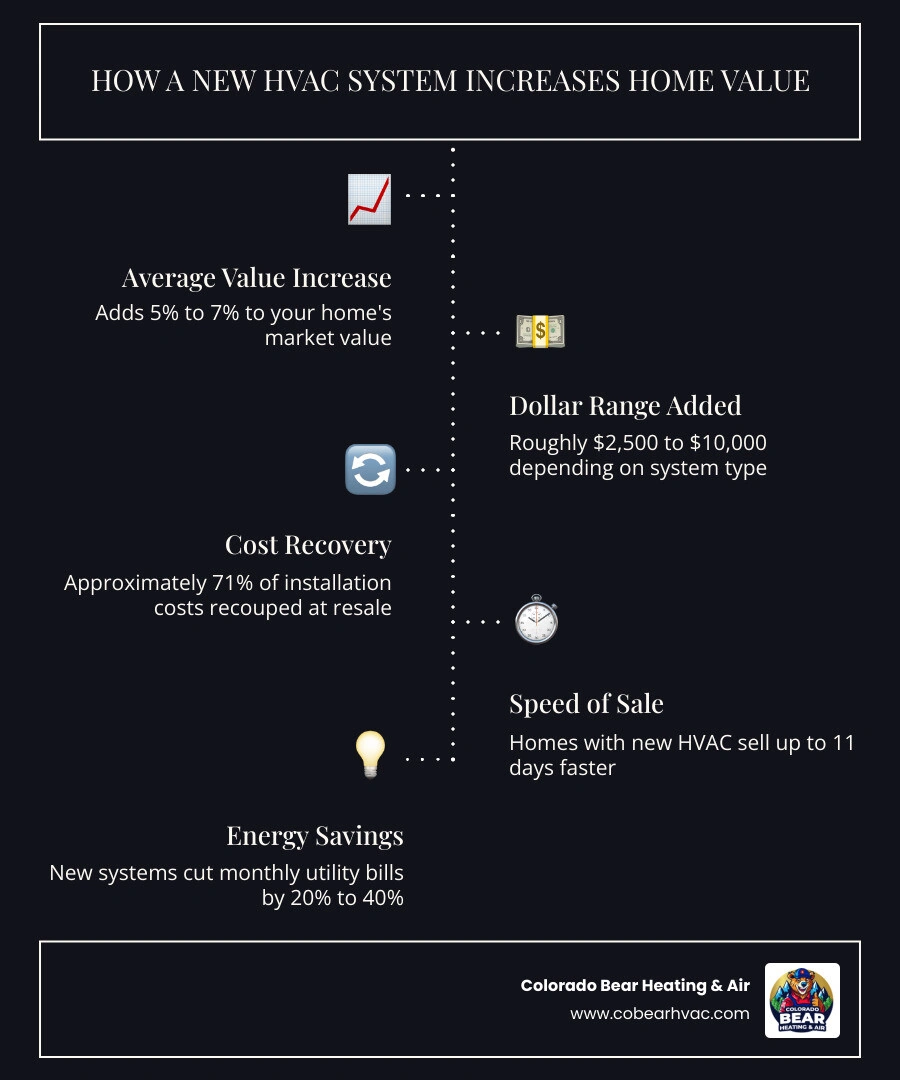
How a New HVAC System Supports Home Value and Resale Appeal
A new HVAC system usually helps in three ways at once:
- It improves the home's overall condition
- It lowers the buyer's concern about future repairs
- It helps the home feel more move-in ready
That combination matters. Buyers in the Denver Metro and Castle Rock area are not just looking at finishes and curb appeal. They are also asking, "Will I need to deal with the furnace or AC right after closing?" If the answer looks uncertain, it can affect buyer confidence.
Here is why updated HVAC tends to support resale value:
- Better energy efficiency and lower monthly operating costs
- Fewer inspection concerns
- Stronger listing appeal as a turnkey home
- More confidence that the house has been well maintained
- Less friction during negotiations
The bigger win is often protecting your asking price from being chipped away by concerns about older mechanical systems.
That is why HVAC is sometimes called an "invisible upgrade." Buyers may not walk in and focus on the equipment right away, but they absolutely notice when the mechanical systems look old, noisy, or near the end of their lifespan.
For many homes, especially those with systems over 15 years old, replacing HVAC before listing can:
- Help support a stronger asking price
- Attract more confident buyers
- Reduce inspection-related stress
- Shorten time on market
- Make the home compare better against nearby listings
In short, new HVAC improves marketability as much as it improves comfort. And in a market where buyers want fewer surprises after move-in, removing a major repair concern can be a real advantage.
Maximizing ROI with Energy-Efficient SEER2 Ratings and Modern Technology
Modern HVAC value is not just about "new." It is also about "efficient."
As of 2026, buyers are increasingly aware of energy standards, refrigerant changes, and smart-home features. They may not all know what SEER2 stands for, but they understand lower utility bills and newer technology.
SEER2 is the current efficiency standard used for air conditioning and heat pump performance. Compared to older units, many newer systems operate far more efficiently, especially if the existing equipment is from the early 2000s or earlier. Research commonly shows energy use reductions of 20% to 40% when outdated equipment is replaced with properly matched modern systems.
That matters in Colorado because we ask a lot from HVAC systems. We need cooling during hot summer afternoons and dependable heating through freezing winter nights. Efficient equipment can reduce energy waste in both seasons.
Modern value-boosting features include:
- Higher SEER2-rated cooling performance
- ENERGY STAR qualified equipment
- Smart thermostats
- Zoned comfort control
- Variable-speed operation
- Improved humidity and airflow management
- Newer refrigerants that align with current standards
Another buyer-friendly detail is future-proofing. Older systems that rely on outdated refrigerants can become more expensive and harder to repair over time. Newer equipment using current refrigerant standards can look more attractive because buyers know they are less likely to inherit an obsolete setup.
Smart thermostats also deserve a quick shoutout. They are the sensible shoes of home upgrades: not glamorous, but surprisingly impressive once you live with them. They help buyers picture better scheduling, zoning, and energy management from day one.
How a new hvac system increases home value through energy efficiency
Energy efficiency affects value in two main ways: monthly savings and buyer psychology.
First, lower utility bills improve affordability. If a buyer sees a home that costs less to heat and cool, that can support a stronger perception of value. In some cases, sellers can even reinforce this with recent utility statements and maintenance records.
Second, efficient systems fit what buyers want in 2026. Sustainability, lower operating costs, and updated equipment are all part of the appeal. In many households, efficiency is the new luxury.
Here is how that plays out:
- A high-efficiency system reduces monthly heating and cooling costs
- Lower energy use makes the home more attractive to budget-conscious buyers
- Modern equipment suggests fewer repairs in the near future
- Smart controls and zoning improve comfort in everyday use
- Efficient systems can help a home feel more current and less functionally outdated
To maximize ROI, we generally recommend choosing a properly sized, professionally installed system rather than simply the biggest model available. Oversized equipment can short-cycle, waste energy, and manage humidity poorly. In resale terms, "new but wrong" is not nearly as valuable as "new and correctly designed."
Why Home Appraisers and Buyers Prioritize Updated Climate Control
Appraisers and buyers both care about HVAC, but they look at it a little differently.
Appraisers consider the system as part of the home's overall condition, effective age, and functional utility. If two similar homes are being compared and one has a brand-new heating and cooling system while the other has aging equipment, the newer system can support a positive adjustment.
This is especially true when the old system contributes to what appraisers call functional obsolescence. In plain English, that means a feature is outdated enough to hurt desirability or performance. A worn-out furnace or struggling AC can absolutely fit that description.
Buyers, meanwhile, care about peace of mind. They want to know:
- Will the house stay comfortable year-round?
- Will I need to replace a major system soon?
- Will the inspection uncover a problem I cannot ignore?
- Will the home feel truly move-in ready?
A functioning, updated HVAC system helps answer those questions in the right direction.
It also supports the all-important move-in-ready label. Buyers often respond well to homes that do not come with an immediate to-do list. A new HVAC system can help your property feel finished, reliable, and easier to say yes to.
How a new hvac system increases home value during buyer negotiations
This is where HVAC often earns its keep.
An older system gives buyers leverage. During inspection, they may ask for:
- Repairs before closing
- Seller concessions
- A home warranty
- Additional evaluations
Even if the system still runs, age alone can become a negotiation tool.
A newer system changes that dynamic. It can:
- Reduce inspection objections
- Support a firmer asking price
- Limit seller concessions
- Reassure nervous buyers
- Keep the sale process smoother
Transferable warranties and clear documentation help too. We always like the idea of keeping a simple home file with installation paperwork, maintenance history, and warranty details. It shows buyers the system was installed and cared for properly.
That small stack of paperwork can do a lot of heavy lifting in negotiations.
Comparing Heat Pumps, Central AC, and Ductless Systems for Resale Value
Not every HVAC upgrade affects value the same way. The best option depends on the home, the layout, and the local climate.
For Castle Rock, Parker, Littleton, Highlands Ranch, Centennial, Aurora, Denver, and surrounding communities, the strongest resale performers are usually the systems that best match Colorado's year-round comfort needs.
| System type | Best fit | Value impact | Buyer appeal notes |
|---|---|---|---|
| Heat pump | Homes wanting efficient heating and cooling in one system | Strong | Seen as efficient and forward-looking in 2026, especially with available incentives in some cases |
| Central AC | Homes with existing ductwork and no modern cooling | Strong in hot summer markets | Often viewed as a baseline expectation rather than a bonus |
| Ductless mini-split | Older homes, additions, finished garages, rooms without ducts | Moderate to strong | Great for zoning and adding conditioned space where ducts are impractical |
| Geothermal | Long-term, high-efficiency applications | High but niche | Can add meaningful value, but appeal depends on buyer education and home type |
A few specific takeaways:
Heat pumps
Heat pumps are gaining attention because they provide both heating and cooling with excellent efficiency. In 2026, many buyers view them as future-friendly systems. For Colorado homes, they can be especially appealing when paired with the right cold-weather design and backup heating strategy.
Central AC
In many Denver Metro neighborhoods, central air is no longer a luxury feature. It is an expectation. Homes without it may feel behind the market, especially during summer selling season. Replacing outdated central AC with a high-efficiency model can improve both comfort and resale appeal.
Ductless mini-splits
Ductless systems shine in homes with additions, remodeled basements, bonus rooms, garages, or areas with uneven temperatures. They also bring strong zoning benefits. In some cases, they help buyers see usable, conditioned square footage where comfort was previously a problem.
Geothermal
Geothermal can add substantial value in the right property, but it is not the most common choice for typical suburban resale in our service area. It tends to be more niche, with value depending heavily on buyer awareness and the home's overall price point.
The key is choosing the right system for the house, not just the fanciest one. Buyers respond best when the upgrade feels logical, efficient, and professionally integrated into the home.
Frequently Asked Questions About HVAC and Property Value
When is the best time to replace an HVAC system before selling?
Usually before the system becomes a listing liability.
If your HVAC is over 10 to 15 years old, needs frequent repairs, uses outdated refrigerant, short-cycles, heats or cools unevenly, or makes unusual noises, it is worth seriously evaluating before you list. In buyer-friendly or balanced markets, replacing ahead of time often gives sellers more control than waiting for the inspection report to force the issue.
For Colorado homeowners, planning replacement before peak heating or cooling season can also make the process smoother. The main goal is simple: avoid having your buyer's inspector become your unofficial negotiator.
Does a heat pump add more value than a traditional furnace in 2026?
It can, depending on the home and buyer.
Heat pumps have strong appeal in 2026 because they are efficient, modern, and increasingly familiar to buyers. They also align with the shift toward electrification and updated energy standards. That said, a high-efficiency furnace can still add meaningful value in Colorado, especially where buyers are focused on reliable winter heating.
If the home already has ductwork and the existing setup supports a well-designed heat pump solution, that may create excellent resale appeal. If not, a new high-efficiency furnace and AC combination may still be the best fit. The winner is usually the system that matches the home's needs and local climate best.
Should I replace my HVAC before selling or wait for the buyer to decide?
It depends on the age and condition of the system, but replacing often gives you more control.
Waiting can create uncertainty. Buyers may assume the replacement will be more complicated than it really is, or they may worry about hidden issues with ductwork, sizing, or overall system performance. A completed replacement removes many of those questions.
Replacing before sale is often the better move when:
- The system is near the end of its life
- The equipment uses obsolete refrigerant
- You want stronger marketing as a move-in ready home
- You want to reduce inspection-related bargaining
- You want the upgrade to support appraisal and buyer confidence
If your goal is a smoother sale and stronger buyer confidence, a professionally installed new system is often the cleaner story.
Conclusion
A new HVAC system will not magically make buyers overlook every other part of a home, but it can absolutely improve value, marketability, and negotiating strength. In many cases, it helps support resale appeal directly. In almost every case, it removes a major objection.
That is the real takeaway behind how a new HVAC system increases home value: it improves efficiency, supports better buyer confidence, reduces anxiety about future repairs, and helps your home compete as a turnkey property in the Denver Metro market.
If you are in Castle Rock, Littleton, Highlands Ranch, Centennial, or nearby communities and wondering whether your current system is helping or hurting your resale potential, Colorado Bear Heating & Air is here to help. We provide fast, reliable comfort service with honest work done right the first time, backed by more than 20 years of experience, licensed and factory-certified technicians, transparent communication, and customer-first care.
From air conditioning replacement and furnace installation to heat pumps, ductless mini-splits, water heaters, humidification, and indoor air quality solutions, our team helps homeowners enjoy lasting comfort and healthier air across the Denver Metro and Castle Rock areas.
Proudly serving Castle Rock, Littleton & Highlands Ranch. Request your professional HVAC consultation for fast service.