Latest Blogs
Stay updated with our latest blog posts.


The average lifespan of an hvac system in colorado is shorter than most homeowners expect — and shorter than national averages suggest. Here's a quick breakdown by system type:
| System Type | National Average | Colorado Estimate |
|---|---|---|
| Gas Furnace | 15–20 years | 15–22 years (Denver); 10–15 years (Colorado Springs) |
| Central Air Conditioner | 15–20 years | 13–18 years |
| Heat Pump | 15–20 years | 12–17 years |
| Electric Furnace | 20–30 years | 20–30 years |
| Boiler | 25–35 years | 22–32 years |
| Ductless Mini-Split | 15–20 years | 14–20 years |
Colorado's high altitude, dry air, wide temperature swings, and long heating seasons all place extra stress on HVAC equipment that manufacturer warranties and national benchmarks simply don't account for. A gas furnace that lasts 20 years in a mild Midwestern climate may start showing serious wear after 15 years in Denver — or as few as 10–12 years in Colorado Springs, where heating seasons are longer and altitude effects are even more pronounced.
Whether your system is aging, struggling to keep up, or you just want to know what to plan for, understanding Colorado-specific HVAC longevity is one of the smartest things a homeowner can do.
When we talk about the average lifespan of an hvac system in colorado, we aren't just looking at when the machine stops turning on. In home comfort, "lifespan" refers to the period during which a unit delivers its rated performance at an acceptable level of efficiency. Once a system begins to cost more in repairs and energy bills than a new unit would, its economic life has effectively ended.
In the Denver Metro Area and Castle Rock, we see a wide variety of systems. Gas furnaces are the workhorses of the Front Range, often lasting 15 to 22 years, though high-efficiency condensing models often reach the upper end of that range if they are meticulously maintained. Central air conditioners typically provide 13 to 18 years of service. While they don't run as long as our furnaces do, the intense summer sun and high-altitude operation can wear down compressors faster than in sea-level states.
If you are noticing that your heating bills are climbing or your home feels drafty, it might be time to look into Furnace Replacement to restore your comfort and peace of mind.
Heating is serious business in Colorado. Forced-air gas furnaces are the most common, and their longevity depends heavily on the type of draft they use. Natural draft furnaces are older tech and often last 10–12 years, while modern forced-draft and condensing furnaces can push toward 20 years.
Boilers, especially cast iron or steam models, are the marathon runners of the HVAC world, sometimes reaching 30 or even 50 years in ideal conditions. However, modern high-efficiency condensing boilers usually aim for a 20-year window. There are many Reasons to Consider Furnace Replacement, but the most common in our area is the simple "fatigue" of the metal components after decades of heavy winter use.
Our cooling season might be shorter than Arizona's, but it is intense. Central AC units in the Denver area often face issues with evaporator coils and refrigerant leaks as they age. Most units will serve a home well for about 15 years. If your unit is pushing 18 years, you are likely living on borrowed time. Recognizing the Signs AC System Needs Replacement—such as frequent cycling or the use of phased-out R-22 refrigerant—can help you avoid a mid-July breakdown.
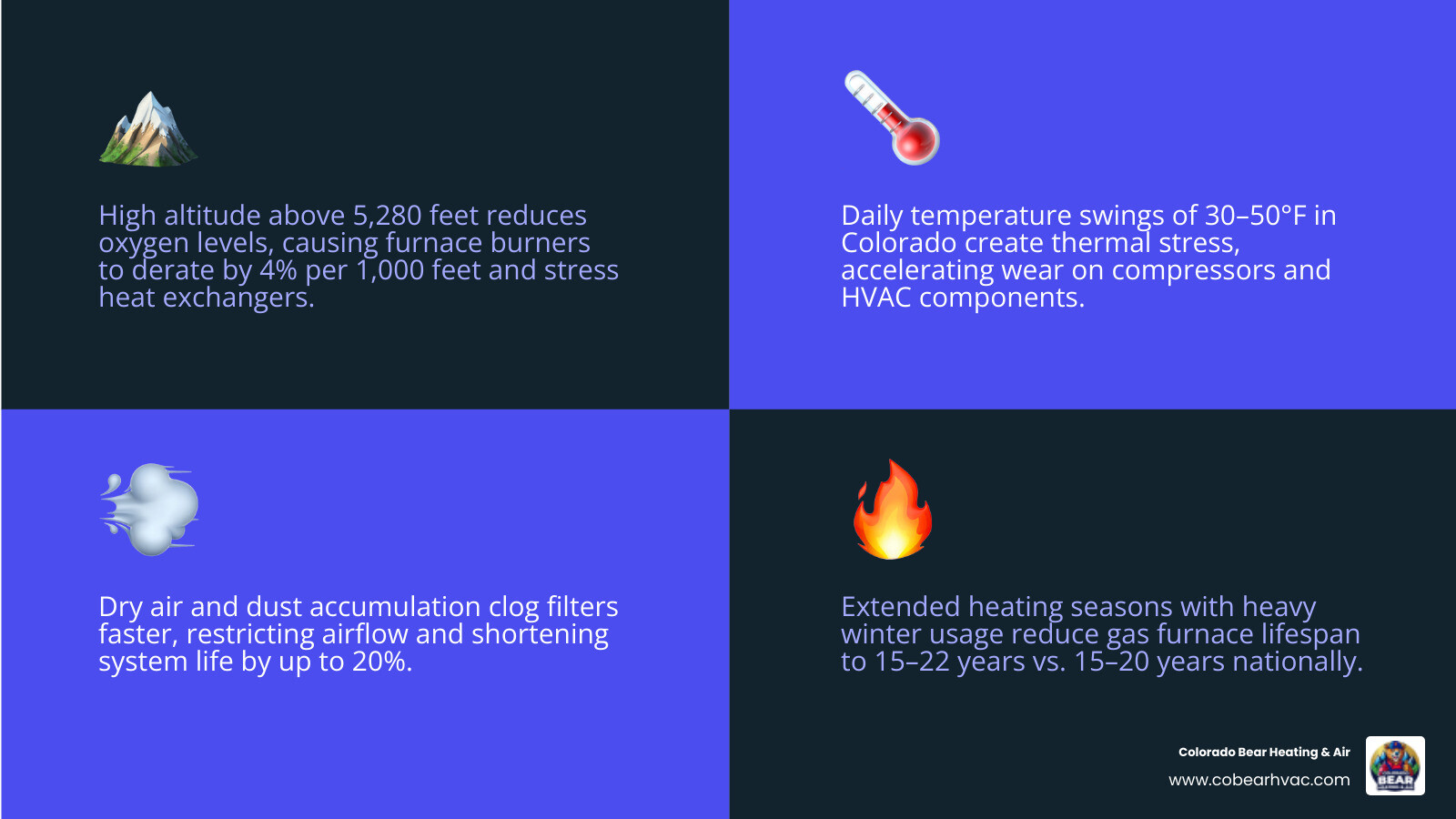
If you’ve lived in Castle Rock or Denver for a full year, you know the weather can change 40 degrees in a single afternoon. This "climate amplitude" is a major reason why the average lifespan of an hvac system in colorado tends to be lower than the national median.
Our air is thin, dry, and dusty. These aren't just minor inconveniences for us; they are mechanical hurdles for your equipment. Dust coats blower motors and clogs delicate internal components, while the dry air can cause seals to brittle and crack over time. We always remind our neighbors that Routine HVAC Repair Saves Money Long-Term because it addresses these environmental stressors before they cause a total system failure.
Altitude is the "silent killer" of HVAC efficiency. At 5,280 feet (and even higher in Castle Rock and Monument), there is less oxygen available for combustion. According to NFPA 54 standards, gas appliances must be "derated"—usually about 4% for every 1,000 feet of elevation.
This means your furnace has to work harder and run longer to produce the same amount of heat as a unit in Florida. This constant strain leads to hotter burner flames and increased stress on the heat exchanger, which can lead to premature cracking.
While Denver is the "Mile High City," many of our service areas like Castle Pines, Larkspur, and Elizabeth sit even higher. These regions experience even more dramatic diurnal cycles (the difference between day and night temperatures).
In these higher elevations, the heating season starts earlier in the fall and lasts longer into the spring. This extended usage means your furnace might log 20% more "run hours" per year than a unit in a lower-elevation suburb. Knowing When Is Time for Furnace Replacement becomes vital when your system is carrying that extra workload year after year.
Your HVAC system usually won't go quietly. It will give you hints that it's tired. One of the most common signs we see in the Denver Metro area is "short cycling," where the system turns on and off frequently without ever truly reaching the temperature set on the thermostat.
You should also keep an ear out for strange noises. A rattling sound might mean a loose panel, but a persistent squealing or banging often points to a failing motor or a cracked belt. Even more concerning are odors. A brief "dusty" smell when you first turn the heat on in October is normal, but a persistent burning smell requires immediate professional attention. We’ve compiled a list of Signs Furnace Needs Immediate Replacement to help you stay safe.
If you have a gas furnace, take a peek at the pilot light or burner flame. It should be a crisp, steady blue. A flickering yellow or orange flame is a major red flag; it indicates incomplete combustion and the potential presence of carbon monoxide.
Other physical signs include visible rust on the unit or moisture pooling around the base of your AC or furnace. These are Top Signs You Need Furnace Replacement that shouldn't be ignored, as they often signal that the internal integrity of the system has been compromised.
As systems age, they lose their "oomph." You might notice that some rooms stay chilly while others are boiling, or that the airflow coming from your vents feels weak. When you find yourself calling us for repairs more than once a season, you’ve entered the "diminishing returns" phase. Deciding on Furnace Repair and Replacement is a balance between the cost of the fix and the long-term savings of a new, high-efficiency system.
While the Colorado climate is tough, you aren't powerless. The single most effective thing you can do is change your air filters. In our dry, dusty climate—especially during wildfire season—filters can clog in as little as 30 days. A clogged filter makes your blower motor work twice as hard, which is a fast track to a burnout.
We recommend using filters with an appropriate MERV rating for your specific system. Too low, and dust gets into the machinery; too high, and you might actually restrict airflow. For more tips on keeping your system running smoothly, check out our HVAC Services and Maintenance Guide.
Think of a professional tune-up like an oil change for your car. During a seasonal inspection, we clean the burners, lubricate moving parts, check refrigerant levels, and inspect the heat exchanger for safety.
Annual maintenance can actually extend the average lifespan of an hvac system in colorado by 20% to 30%. It catches the small, $100 problems before they turn into $2,000 disasters. Plus, most manufacturer warranties require proof of professional maintenance to remain valid. Again, Routine HVAC Repair Saves Money Long-Term because it keeps the system running at peak efficiency.
At Colorado Bear Heating & Air, we want to make sure you’re making a smart financial decision. A great rule of thumb used in the industry is to evaluate the age of your system against the frequency and nature of repairs.
If your system is nearing the end of its expected lifespan and requires a major fix, it’s often more practical to invest in a replacement. Beyond the logic of age, consider the technology. Modern systems use SEER2 and AFUE standards that are significantly higher than units from just 10 years ago. Upgrading can often slash your utility bills significantly. Furthermore, if your old AC still uses R-22 refrigerant (Freon), repairs will only get more expensive as that substance is phased out. Deciding on Furnace Repair and Replacement often comes down to looking at these long-term operational costs.
Yes. Because the air is thinner, the furnace has to move more air to achieve the same heating effect, and the combustion process is less efficient. This leads to higher internal temperatures and more wear on the heat exchanger. Proper "derating" and professional calibration are essential for systems operating above 5,000 feet.
In the Denver Metro area, we recommend checking your filters every month. If you have pets, live near a construction site, or during periods of high wind and dust, you’ll likely need to change them every 30 to 60 days. In the "cleaner" months, you might get away with every 90 days.
Usually, yes. Replacing them together allows for "matched systems," ensuring that the indoor blower motor and the outdoor condenser are perfectly synced for efficiency. It also saves you money on labor and ensures that your entire home comfort system is under a fresh warranty at the same time.
Navigating the average lifespan of an hvac system in colorado doesn't have to be a guessing game. While our high-altitude environment and extreme weather certainly keep our equipment busy, proactive care and honest professional advice can keep your home comfortable for decades.
At Colorado Bear Heating & Air, we bring over 20 years of experience to every home in Castle Rock, Denver, and the surrounding communities from Aurora to Littleton. We pride ourselves on a customer-first approach, transparent communication, and "honest work done right the first time." Whether you need a quick repair in Centennial or a full system upgrade in Highlands Ranch, our licensed technicians are ready to help.
Don't wait for the next cold snap or heat wave to find out your system is at the end of its rope. Request your free estimate today for a reliable HVAC system upgrade and ensure your family stays comfortable all year long.

Get a decision in seconds with no impact to your credit score.


Colorado Bear HVAC is truly the best contractors I have experienced since I moved into my house 30 years ago. I have been dealing with Joe and his crew for over 11 years now. They are a trustworthy, respectful, experienced crew who works with you and gives you a fair value. They just completed a big job replacing my A/C, gas furnace and condenser. They did an excellent job, no short cuts, made sure everything was functional, and cleaned up the area nicely before they left. No pressure to perform unnecessary service. You know when the job is done, you have received top notch professional service at a fair price.


I used Colorado Bear Heating and Air to replace two furnaces in my home. Nate was exceptional to work with. His team did a great job educating me along the way. He provided competitive pricing with 10 year warranties. They installed quickly and were just super great to work with. I’d highly recommend them.

Nate and Sam have been great to work with getting my home humidifier installed in a difficult space in my 1940s house. Their prices were very fair and I would heartily recommend Colorado Bear to anyone looking for a solid HVAC company.
.avif)
Thank you Nate for the promptness you guys gave my parent. They are 93 and can't get around and always getting cold, and I was at work called Nate and he had one of his guys there in like 2 hours which was outstanding my dad was very impressed with the professional and how quick he had it fixed. These guys are great all my family said we found us a new heating and ac company. Colorado Bear Heating & Air you have customers for life!!!! Thank You Again
Carla and the Barnes Family
.avif)
Colorado Bear Heating & Air saved the day! This morning my family and I woke up to frigid outside temperatures(1 degree F)…and no heat! Nate was great over the phone to help me check our furnace, then he sent Sam over to help get us back to warmer temps. They were so quick and helpful. Fortunately I did not have to keep my toddlers inside the house wearing snow suits all day. We are warm now, and so thankful!
.avif)

If you’re in Colorado Springs, The Mountains, or nearby areas, call us to confirm availability for installations.
.avif)