Latest Blogs
Stay updated with our latest blog posts.




Adding cooling without ductwork options compared side by side is the fastest way to find the right fit for your home — here's a quick breakdown:
| Option | Best For | Efficiency | Installation |
|---|---|---|---|
| Ductless mini-split | Whole rooms, long-term use | Highest (up to 35 SEER2) | Professional, minimal wall penetration |
| Window AC | Single rooms, renters, low budget | Moderate (10–15 EER) | DIY-friendly |
| Portable AC | Temporary or windowless rooms | Lowest (8–12 EER) | No installation needed |
| Through-the-wall / PTAC | Permanent single-room solution | Moderate (EER 10–13) | Requires wall sleeve |
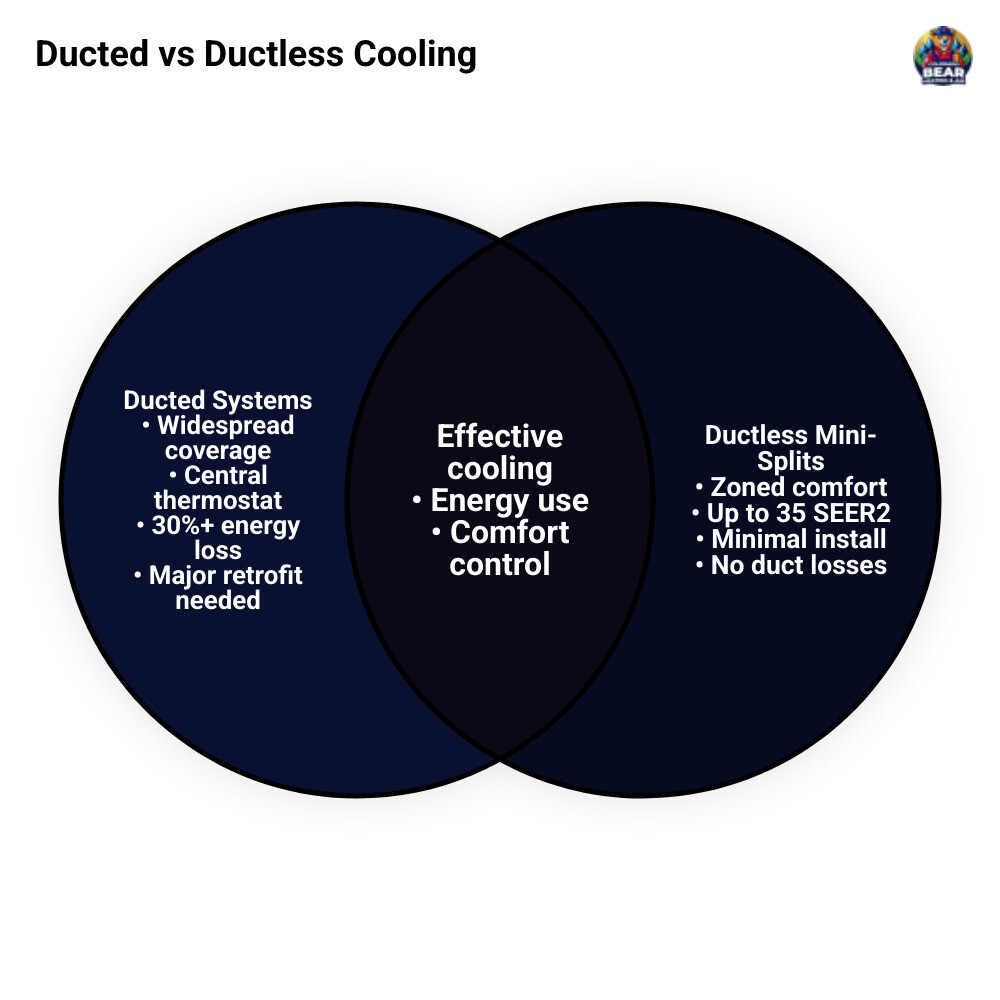
Many Colorado homes — especially older ones in Castle Rock, Littleton, and the Denver Metro area — were built long before central air was standard. Retrofitting ductwork into those homes can mean tearing into walls, ceilings, and finished spaces. That's a big disruption, and it still leaves you with a system that can lose more than 30% of its cooling energy through leaky or poorly insulated ducts.
So homeowners are increasingly asking a smart question: what are the real options for staying cool without adding ductwork at all?
The answers range from plug-in window units to high-efficiency ductless mini-splits that can heat and cool an entire home, zone by zone. Each has its place — but the differences in efficiency, comfort, noise, and long-term value are significant enough to make the choice matter a lot.
This guide walks you through every major no-duct cooling option so you can make a confident decision for your home and Colorado climate.
When we look at the landscape of cooling in 2026, the variety of choices can be overwhelming. However, most homeowners find themselves choosing between four primary categories. Understanding how these adding cooling without ductwork options compared stack up is the first step toward a comfortable summer.
Window units are the most common "quick fix." They are relatively inexpensive upfront and can be installed by most homeowners without professional help. However, they come with significant drawbacks for Colorado residents. They block your view, compromise home security by leaving a window partially open, and are notoriously noisy—often reaching 50–60 decibels. In terms of efficiency, they usually hover around 10–15 EER, which is significantly lower than modern permanent solutions.
Portable units sit on the floor and vent through a hose out of a window. While they are the ultimate "no-install" option, they are generally the least efficient choice. Single-hose models actually create negative pressure, pulling warm outdoor air into your home through cracks and gaps. Research shows these units can be 40–50% less effective than their rated BTU capacity suggests. We typically recommend these only for temporary situations or renters who cannot make any modifications to their space.
Packaged Terminal Air Conditioners (PTACs) are the units you often see in hotels. They are permanent, powerful, and often include heating. Through-the-wall units are similar but smaller. Both require cutting a significant hole in your exterior wall to install a sleeve. While they provide better security and aesthetics than window units, they are still louder and less efficient than a Mini Split system.
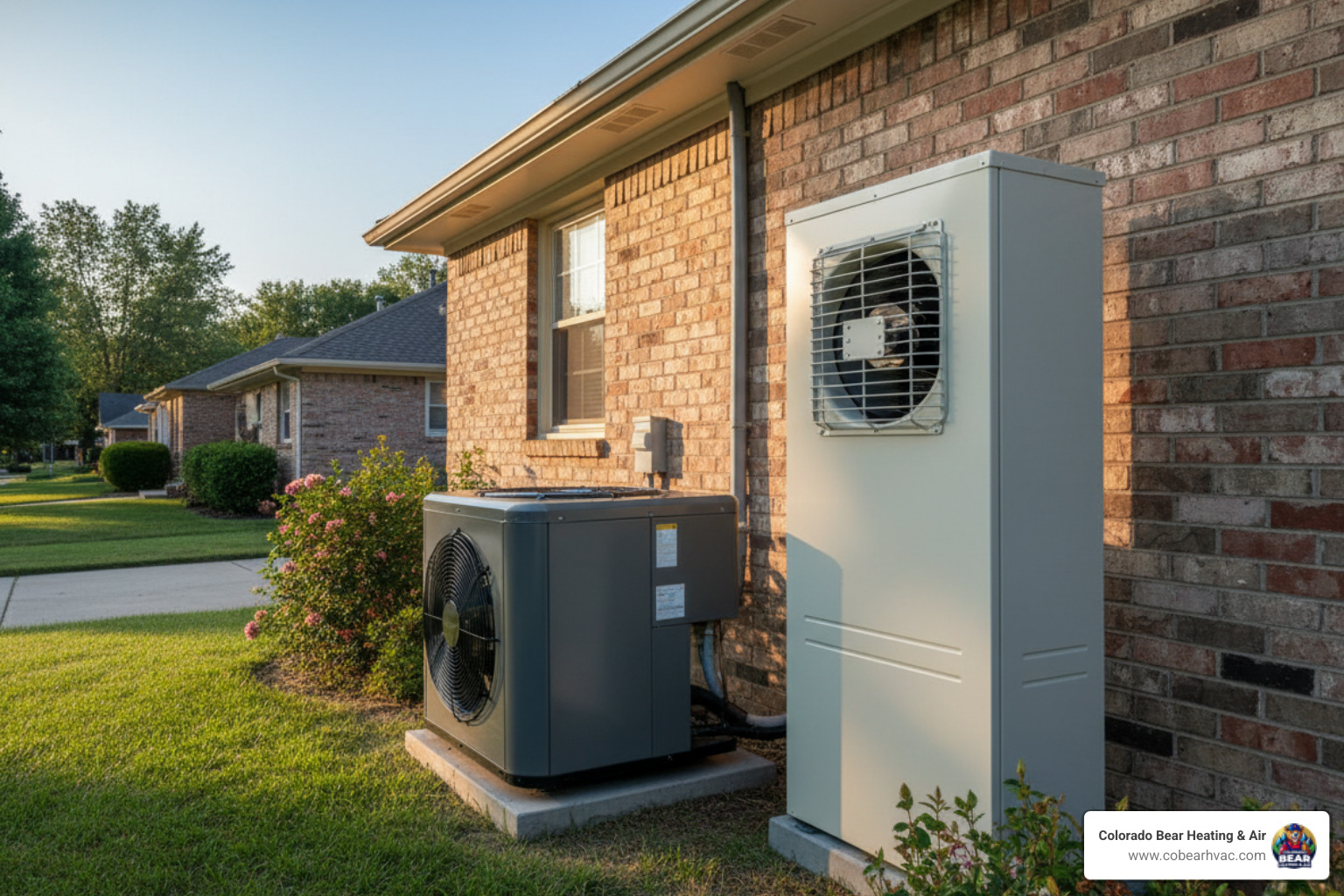
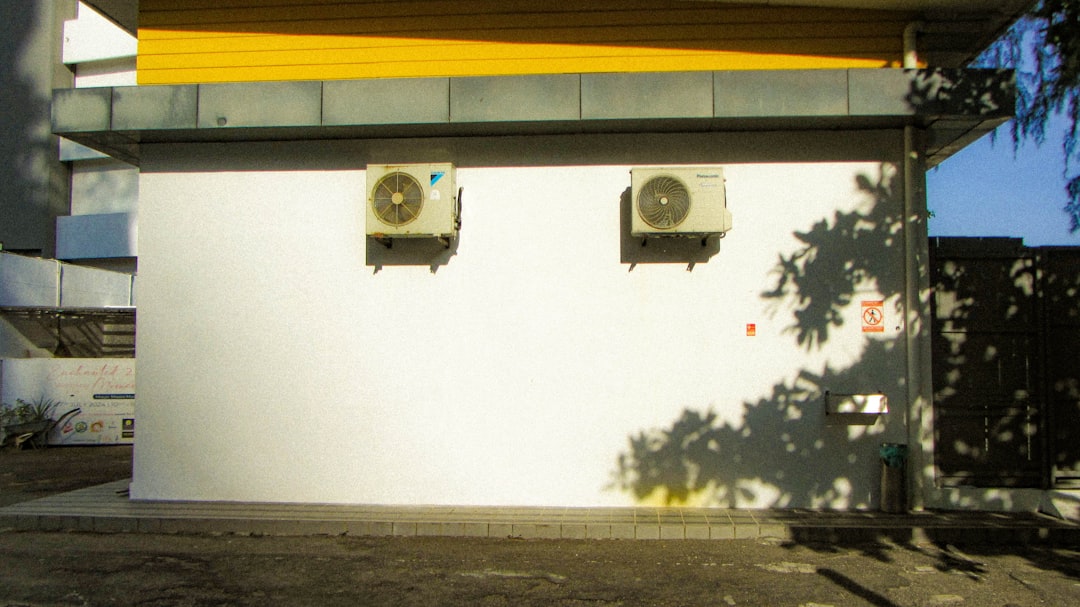
The "gold standard" for homes without ducts is the ductless mini-split. These systems consist of an outdoor compressor connected to one or more indoor air handlers via a small, three-inch conduit. They offer the highest efficiency (up to 35 SEER2) and the quietest operation (as low as 25 decibels—barely a whisper). Because they don't rely on bulky ducts, they avoid the 30% energy loss associated with traditional central air.
In areas like Castle Rock and the historic neighborhoods of Denver, preserving the architectural integrity of an older home is a top priority. Traditional central AC often requires dropping ceilings or building "soffits" to hide ductwork, which can ruin the charm of a vintage interior.
Ductless systems are a game-changer for these properties. The installation is non-invasive, requiring only a tiny hole for the refrigerant lines. This makes them the perfect choice for:
One of the biggest technical advantages is inverter technology. Traditional AC units are either "on" or "off," which leads to uncomfortable temperature swings. Inverter-driven mini-splits adjust their speed dynamically, providing a steady flow of cool air and using only the precise amount of energy needed. To see where these units fit best in your floor plan, check out our guide on the Best Rooms for Mini Split AC Installation.
Choosing the right system isn't just about picking a brand; it's about the layout. When we sit down with homeowners in Centennial or Highlands Ranch, we look at several Considerations Ductless Mini Split Installation to ensure the system performs perfectly.
Energy efficiency is where ductless systems truly leave the competition behind. In a traditional central AC system, the Department of Energy notes that duct losses can account for more than 30% of energy consumption, especially if those ducts run through a hot attic.
When adding cooling without ductwork options compared for efficiency, mini-splits can achieve SEER2 ratings between 15.2 and 35. For comparison, most window units struggle to reach the equivalent of a 14 SEER. By delivering conditioned air directly into the living space, you eliminate the middleman (the ducts) and the waste that comes with them. Many of these systems are ENERGY STAR certified, meaning they meet strict federal standards for reduced power consumption. For a professional setup that maximizes these savings, a Ductless Installation by a certified team is essential.
Every room in your Colorado home has a different "personality." A south-facing sunroom in Parker needs a different cooling approach than a shaded bedroom in Littleton.
If you're looking for targeted comfort in specific areas, our team specializing in Mini Split AC Installation Highlands Ranch CO can help you design a layout that matches your lifestyle.
While a window unit is a DIY project, a ductless mini-split requires professional expertise. The process involves drilling a small three-inch hole in the exterior wall to run refrigerant lines, power cables, and a condensate drain. The lines must be vacuum-sealed and tested for leaks to ensure the system operates at peak efficiency for its 15–20 year lifespan.
Maintenance is straightforward but vital. Homeowners should rinse the reusable filters every month during the heavy cooling season. Beyond that, we recommend an annual professional tune-up. During this service, we check refrigerant levels, clean the outdoor coils, and ensure the condensate line is clear of debris. Regular Ductless Maintenance Centennial CO prevents unexpected breakdowns and keeps your utility bills low.
Yes! Most modern ductless systems are actually heat pumps. They use a reverse cycle to extract heat from the outdoor air and move it indoors during the winter. Even in our cold Colorado winters, many specialized "cold climate" models can provide efficient heating down to -13°F or lower. This makes a Mini Split Heat Pump Castle Rock CO a fantastic year-round solution for additions or homes that currently rely on expensive electric baseboard heat.
There is truly no comparison. Window units house the compressor—the loudest part of the system—right in your window frame, vibrating against the glass. Ductless systems keep the compressor outside, often up to 50 feet away. The indoor air handler only contains a quiet fan and cooling coils. While a window unit might roar at 60 decibels, a mini-split typically operates between 20 and 30 decibels. If your unit ever starts making unusual noises, it's a sign you may need Ductless AC Repair Centennial CO to check the fan motor or mounting.
Absolutely. Because mini-splits are so efficient, they often qualify for federal tax credits under the Inflation Reduction Act, which can cover up to 30% of the project cost (up to a certain limit). Additionally, many local utility companies in the Denver Metro area offer rebates for switching to high-efficiency heat pump technology. If you are considering a Ductless Replacement Littleton CO, we can help you identify which current models qualify for the biggest incentives.
Staying cool in Colorado shouldn't require a major home renovation. When adding cooling without ductwork options compared, it becomes clear that while window and portable units offer a temporary fix, the ductless mini-split is the superior long-term investment for comfort, quiet, and savings.
At Colorado Bear Heating & Air, we bring over 20 years of experience to every home we visit. Whether you're in Castle Rock, Littleton, Highlands Ranch, or Centennial, we believe in honest work done right the first time. We take a customer-first approach, offering transparent communication and expert installation to ensure your home remains a sanctuary all year long.
Don't spend another summer sweating through the night or struggling with noisy window units. Request your free estimate today to talk with a local expert about the best ductless solution for your home.

Get a decision in seconds with no impact to your credit score.


Colorado Bear HVAC is truly the best contractors I have experienced since I moved into my house 30 years ago. I have been dealing with Joe and his crew for over 11 years now. They are a trustworthy, respectful, experienced crew who works with you and gives you a fair value. They just completed a big job replacing my A/C, gas furnace and condenser. They did an excellent job, no short cuts, made sure everything was functional, and cleaned up the area nicely before they left. No pressure to perform unnecessary service. You know when the job is done, you have received top notch professional service at a fair price.


I used Colorado Bear Heating and Air to replace two furnaces in my home. Nate was exceptional to work with. His team did a great job educating me along the way. He provided competitive pricing with 10 year warranties. They installed quickly and were just super great to work with. I’d highly recommend them.

Nate and Sam have been great to work with getting my home humidifier installed in a difficult space in my 1940s house. Their prices were very fair and I would heartily recommend Colorado Bear to anyone looking for a solid HVAC company.
.avif)
Thank you Nate for the promptness you guys gave my parent. They are 93 and can't get around and always getting cold, and I was at work called Nate and he had one of his guys there in like 2 hours which was outstanding my dad was very impressed with the professional and how quick he had it fixed. These guys are great all my family said we found us a new heating and ac company. Colorado Bear Heating & Air you have customers for life!!!! Thank You Again
Carla and the Barnes Family
.avif)
Colorado Bear Heating & Air saved the day! This morning my family and I woke up to frigid outside temperatures(1 degree F)…and no heat! Nate was great over the phone to help me check our furnace, then he sent Sam over to help get us back to warmer temps. They were so quick and helpful. Fortunately I did not have to keep my toddlers inside the house wearing snow suits all day. We are warm now, and so thankful!
.avif)

If you’re in Colorado Springs, The Mountains, or nearby areas, call us to confirm availability for installations.
.avif)