Latest Blogs
Stay updated with our latest blog posts.




The central ac vs ductless mini split comparison is one of the most common questions Colorado homeowners face when it's time to upgrade or replace their cooling system — and the answer isn't the same for everyone.
Here's a quick breakdown to help you decide:
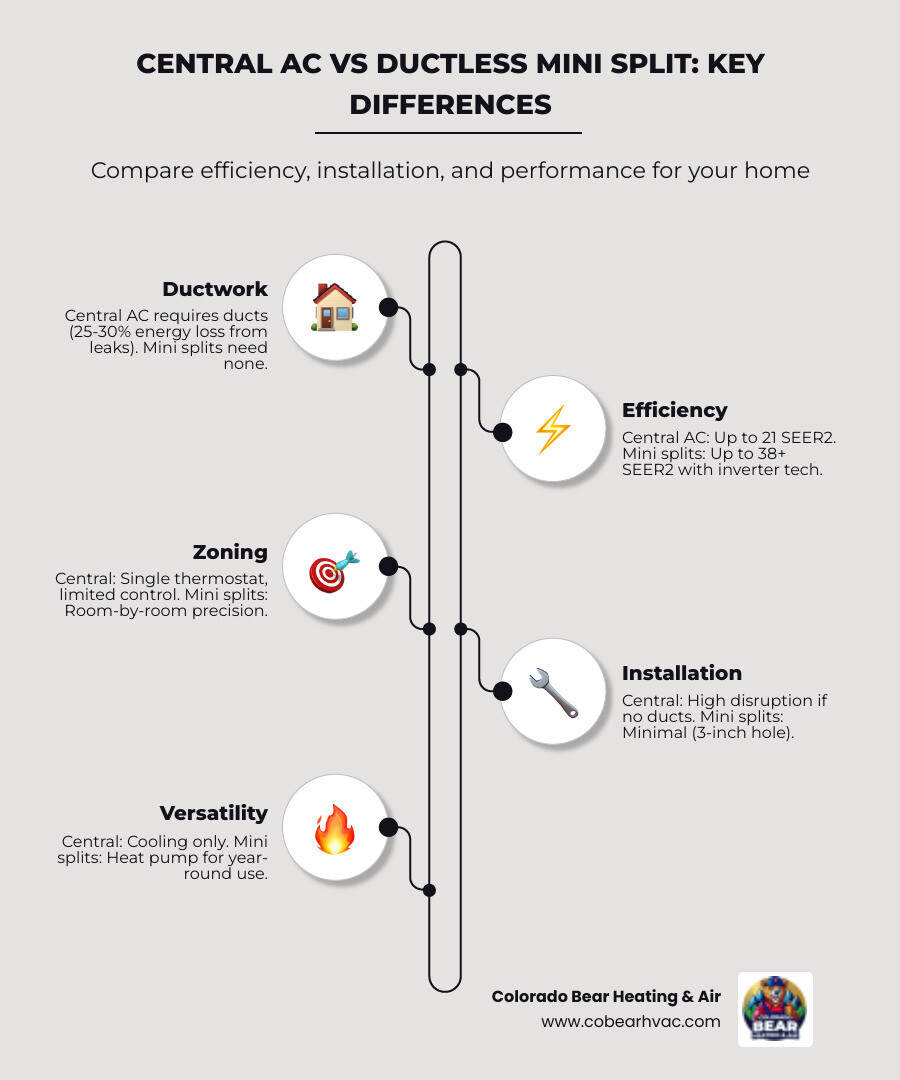
| Factor | Central AC | Ductless Mini Split |
|---|---|---|
| Requires ductwork? | Yes | No |
| Best for home size | 2,500+ sq ft | Up to 2,000 sq ft |
| Efficiency (SEER2) | Up to 21+ | Up to 38+ |
| Zoning capability | Limited (costly to add) | Built-in, room-by-room |
| Indoor unit visibility | Hidden in vents | Wall-mounted units |
| Typical lifespan | 15-20 years | 15-20+ years |
| Heating capability | Cooling only (needs furnace) | Most include heat pump |
| Installation disruption | High if no ducts exist | Minimal (3-inch wall hole) |
The single biggest factor in this decision? Whether your home already has ductwork — and how well it's working.
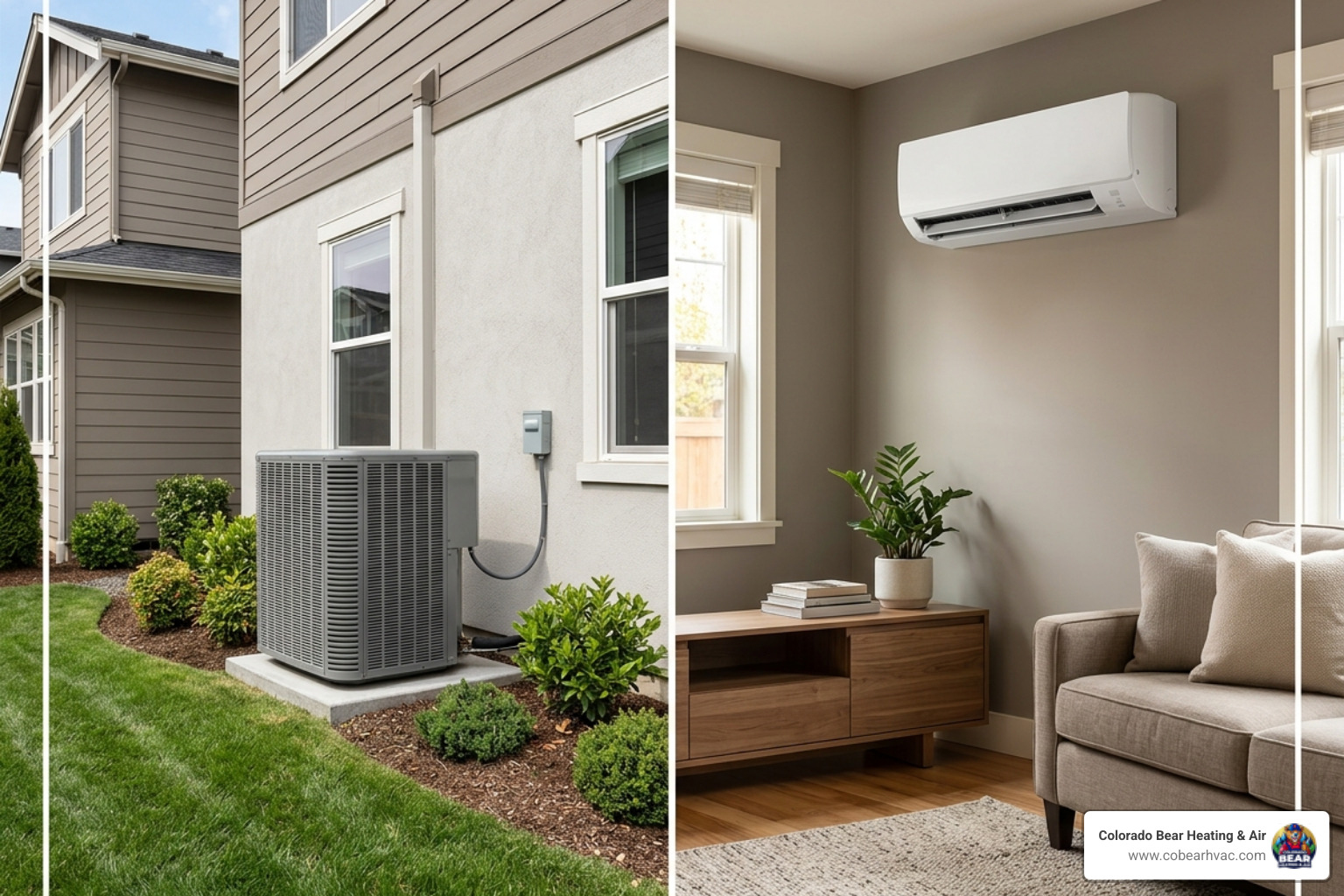
Central AC systems can lose 25% to 30% of cooled air through leaky or poorly insulated ducts before it ever reaches your living space. That's wasted energy every month. Ductless mini splits bypass that problem entirely by delivering conditioned air directly into each room through wall-mounted units connected to an outdoor compressor via a small refrigerant line.
For Castle Rock and Denver Metro homeowners, the choice between these two systems comes down to your home's layout, your existing infrastructure, how you use your space, and your long-term comfort goals. This guide walks you through every key factor so you can make a confident, informed decision.
When we sit down with homeowners in Parker or Castle Pines to discuss a new Air Conditioning installation, we start with the basics of how these systems move heat. Whether you choose a traditional ducted setup or a modern ductless one, the physics remains the same: the system absorbs heat from inside your home and rejects it outdoors.
In a traditional HVAC setup, a large outdoor condenser unit works in tandem with an indoor evaporator coil, usually located in your furnace or air handler. Refrigerant lines connect these two components, carrying the "coolth" (or rather, removing the heat) back and forth. The primary difference lies in how that cooled air reaches your family.
A Mini Split system consists of one outdoor compressor linked to one or more indoor air handlers. These indoor units are typically mounted high on a wall, though floor-mounted and ceiling-cassette options exist. Because there are no ducts, the air is conditioned and distributed right there in the room.
One of the most significant technological leaps in the central ac vs ductless mini split comparison is inverter technology. While many older central units are "all or nothing"—meaning they blast at 100% capacity until the thermostat is satisfied and then shut off—Ductless systems use variable-speed compressors. They can slow down or speed up to maintain a perfectly steady temperature, much like a car on cruise control. This prevents the "start-stop" energy spikes that drive up utility bills.
Central air is the "gold standard" for whole-home uniformity. It uses a network of supply and return ducts to move a large volume of air through every room simultaneously. This is managed by a single thermostat, usually located in a central hallway.
For homes in Highlands Ranch or Lone Tree that were built with existing ductwork, AC Service and replacement often favor central systems because the infrastructure is already there. It’s a "set it and forget it" approach that treats the entire house as a single climate zone. However, this simplicity can lead to "thermostat wars" if one family member likes the bedroom at 68 degrees while another prefers the living room at 72.
Efficiency is where the central ac vs ductless mini split comparison gets really interesting. In 2026, we look closely at SEER2 ratings, which measure seasonal energy efficiency under more realistic conditions than the older SEER standard.
| System Type | Typical SEER2 Range | Max Potential SEER2 |
|---|---|---|
| Central AC (Standard) | 13 - 17 | 26 |
| Ductless Mini Split | 18 - 30 | 42 |
As you can see, the best ductless systems can achieve a SEER2 nearly double that of a standard central unit. But the efficiency story doesn't end with the equipment itself. We also have to talk about "duct loss."
In a typical Colorado home, the Department of Energy estimates that leaky ducts can waste 20% to 30% of the energy used to cool the air. This happens through actual holes in the metal, poor insulation in unconditioned spaces like attics, or "thermal bypass" where heat from the attic warms up the cool air inside the duct before it reaches your bedroom. By eliminating ducts, mini splits eliminate this waste entirely. This is one of the primary Advantages of Ductless Mini-Split System that homeowners notice on their monthly energy statements.
Do you have that one room that never seems to get cool enough? Or perhaps a finished basement in Centennial that stays chilly while the upstairs swelters? This is where the ductless system shines.
With a multi-zone mini split, each indoor unit has its own thermostat. You only cool the rooms you are actually using. If you spend your day in a home office in Aurora, you can keep that room crisp while letting the rest of the house stay a few degrees warmer. This level of precision helps solve Uneven Cooling Issues with Ductless System and puts an end to Temperature Fluctuations in Ductless Mini-Split units that sometimes struggle with airflow in large, ducted homes.
The age and structure of your home often dictate the winner of the central ac vs ductless mini split comparison.
For new construction or homes with healthy, existing ducts, central AC is often the most straightforward path. However, for our neighbors in older homes in areas like Denver or Littleton that were built before central air was common, installing new ductwork can be a massive undertaking. It involves cutting into walls, dropping ceilings, and losing closet space.
In these scenarios, a mini split is a "game-changer." Installation is minimally invasive; we only need to drill a small, three-inch hole in the exterior wall to run the refrigerant and electrical lines. This makes them the Best Rooms for Mini-Split AC Installation targets for:
Before you decide, there are several Considerations Ductless Mini-Split Installation experts like us will evaluate, including the placement of the outdoor unit and the drainage path for condensation.
Aesthetics are subjective. Some homeowners prefer central AC because the only visible parts are the floor or ceiling registers. Others find the sleek, modern look of a wall-mounted mini split to be quite high-tech and attractive. For those who want the benefits of ductless without the wall unit, we can often install "ceiling cassettes" or "slim duct" units that remain virtually hidden.
When it comes to noise, the mini split is the clear victor. Most indoor units operate between 19 and 26 decibels. To put that in perspective, a whisper is about 30 decibels. You can sleep or watch TV right next to a mini split and barely know it's running. Central systems, while much quieter than they were a decade ago, still have the audible "whoosh" of air moving through the vents and the sound of the large air handler starting up.
To keep things looking sharp on the outside, we always use "line hides"—decorative covers for the refrigerant lines that can be painted to match your home’s siding. This prevents the "industrial" look of exposed pipes running down your house.
Both systems require regular care to reach their full 15-to-20-year lifespan. However, the maintenance schedules differ.
Central AC systems rely on a large filter, usually located at the furnace. These typically need to be replaced every 30 to 90 days. Because they can accommodate high-MERV filters or even whole-home air purifiers, central systems are often superior for families with severe allergies or those concerned about fine particulate matter.
Ductless units have smaller, reusable filters that need to be rinsed under a tap every 2 to 4 weeks. Because the air is cooled right in the room, there are no dusty ducts to worry about. However, if you notice a musty smell or reduced airflow, these are Signs Ductless Mini-Split Needs Professional Cleaning. A deep cleaning by a Certified Ductless Mini-Split Technician in Aurora CO ensures the indoor coils stay free of mold and debris.
As we navigate the central ac vs ductless mini split comparison, several specific questions tend to pop up from homeowners in Centennial and Monument.
Absolutely! This is what we call a "hybrid" or "supplemental" approach. Many Colorado homes have a central AC system that works perfectly for the main floor but leaves the upstairs guest room or the master suite too hot. In these cases, we leave the central system in place and add a single-zone mini split to the "problem room." This gives you targeted comfort where you need it most without the need to overhaul your entire HVAC setup.
If silence is your priority, the ductless mini split is the way to go. Its library-quiet operation and variable-speed fan make it ideal for home offices where you're on Zoom calls, or for light sleepers who are easily disturbed by the cycling of a traditional furnace and AC.
Most ductless mini splits are actually "heat pumps." This means they can reverse their operation to pull heat from the outside air and move it indoors. Modern cold-climate heat pumps are remarkably effective, even when temperatures drop well below freezing.
When Comparing Furnace vs Heat Pump Make the Best Choice Today, many people find that a mini split heat pump is a fantastic way to supplement their gas furnace, especially during the "shoulder seasons" of spring and fall when you only need a little bit of warmth to take the chill off.
At Colorado Bear Heating & Air, we know that there is no "one-size-fits-all" answer to the central ac vs ductless mini split comparison. Your home in Castle Rock or Highlands Ranch is unique, and your cooling system should be too.
Whether you need the whole-home power of a central AC system or the precision and efficiency of a ductless mini split, we are here to help. With over 20 years of experience serving the Denver Metro area, we pride ourselves on honest work, transparent communication, and a customer-first approach. We don't just sell boxes; we design comfort solutions that fit your lifestyle.
If you’re ready to experience a more comfortable home, we invite you to reach out. We serve a wide range of communities, including:
Don't let another hot Colorado summer catch you off guard. Contact us for fast service and let’s find the perfect cooling solution for your home together.

Get a decision in seconds with no impact to your credit score.


Colorado Bear HVAC is truly the best contractors I have experienced since I moved into my house 30 years ago. I have been dealing with Joe and his crew for over 11 years now. They are a trustworthy, respectful, experienced crew who works with you and gives you a fair value. They just completed a big job replacing my A/C, gas furnace and condenser. They did an excellent job, no short cuts, made sure everything was functional, and cleaned up the area nicely before they left. No pressure to perform unnecessary service. You know when the job is done, you have received top notch professional service at a fair price.


I used Colorado Bear Heating and Air to replace two furnaces in my home. Nate was exceptional to work with. His team did a great job educating me along the way. He provided competitive pricing with 10 year warranties. They installed quickly and were just super great to work with. I’d highly recommend them.

Nate and Sam have been great to work with getting my home humidifier installed in a difficult space in my 1940s house. Their prices were very fair and I would heartily recommend Colorado Bear to anyone looking for a solid HVAC company.
.avif)
Thank you Nate for the promptness you guys gave my parent. They are 93 and can't get around and always getting cold, and I was at work called Nate and he had one of his guys there in like 2 hours which was outstanding my dad was very impressed with the professional and how quick he had it fixed. These guys are great all my family said we found us a new heating and ac company. Colorado Bear Heating & Air you have customers for life!!!! Thank You Again
Carla and the Barnes Family
.avif)
Colorado Bear Heating & Air saved the day! This morning my family and I woke up to frigid outside temperatures(1 degree F)…and no heat! Nate was great over the phone to help me check our furnace, then he sent Sam over to help get us back to warmer temps. They were so quick and helpful. Fortunately I did not have to keep my toddlers inside the house wearing snow suits all day. We are warm now, and so thankful!
.avif)

If you’re in Colorado Springs, The Mountains, or nearby areas, call us to confirm availability for installations.
.avif)