Latest Blogs
Stay updated with our latest blog posts.



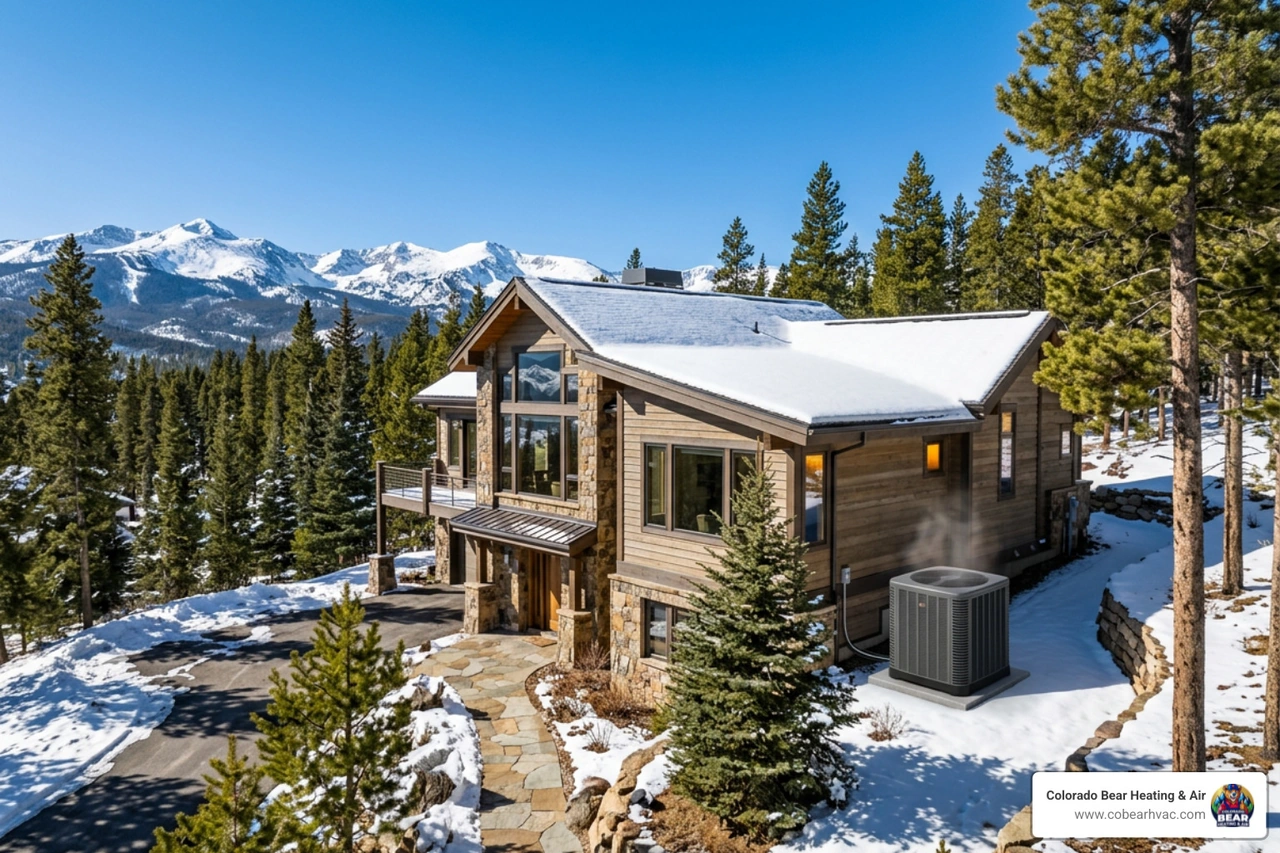

Does altitude make cooling more expensive? Yes — and if you live in Castle Rock, Highlands Ranch, or anywhere along Colorado's Front Range, it affects your home more than you might expect.
Here's the short answer:
Colorado Springs sits at 6,035 feet. Castle Rock is around 6,200 feet. At those elevations, the air is thinner, the sun is stronger, and your air conditioner is working harder than it was ever designed to — especially if it was sized using standard sea-level math.
This guide breaks down exactly why altitude drives up cooling costs, what it means for your home, and what you can do about it.
When we talk about high-altitude living, we usually focus on the breathtaking mountain views, the dry climate, and how quickly we get winded walking up a flight of stairs. But your air conditioner experiences its own version of altitude sickness.
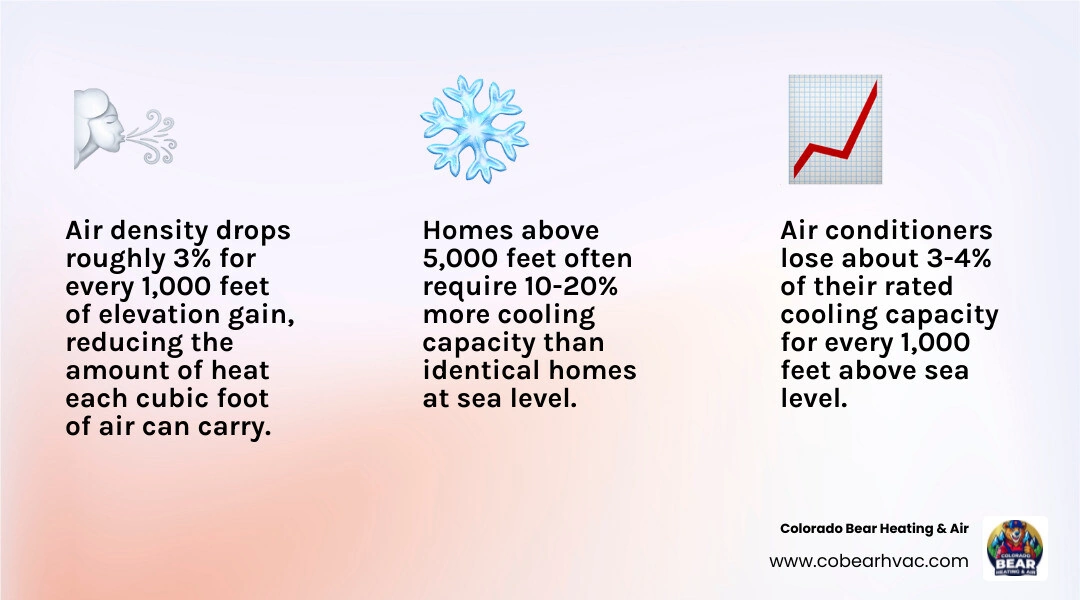
Air conditioners do not actually "create" cold air. Instead, they work by extracting heat from inside your home and rejecting it outdoors. This heat transfer process relies heavily on air density. At sea level, the air is packed tight with molecules that easily absorb and carry heat away. Up here along the Front Range, the atmospheric pressure is significantly lower, which means those heat-carrying air molecules are spread much further apart.
Because the air is thinner, your air conditioner has a much harder time dumping heat outside. This forces the compressor — the heart of your AC system — to work under much higher strain and run for longer periods to achieve the same cooling effect. To understand how this directly impacts your utility bills, it helps to look at How Altitude Affects Your HVAC System.
The simple answer is yes. Because the air density is lower, your indoor blower fan has to move a much larger volume of air to transfer the same amount of heat mass. At sea level, a standard blower fan might move about 90,000 pounds of air per hour. At 6,000 feet, that same fan moves only about 72,000 pounds of air mass per hour.
This reduction in air mass directly limits the heat-carrying capacity of your system. To make up for this physical limitation, your air conditioner must run longer cycles. High-altitude homes require 5-15% more energy for cooling solely because of this reduced heat transfer efficiency. Those longer runtimes directly translate to higher energy consumption and increased utility bills during our hot Colorado summers.
The thin air challenge is twofold: it affects both the indoor evaporator coil (which absorbs heat from your home) and the outdoor condenser coil (which releases that heat into the atmosphere).
To navigate these unique regional challenges, we always recommend consulting a localized resource like our Colorado Climate HVAC Guide 2026 to see how our local environment dictates equipment performance.
One of the biggest mistakes we see in the Denver Metro Area is the installation of "sea-level" air conditioners. Most HVAC equipment is designed, tested, and rated in laboratory conditions at or near sea level. If an installer simply looks at your home's square footage and buys a standard system off the shelf, you are going to end up with a system that struggles to keep you cool.
To prevent this, professional HVAC technicians must use altitude-adjusted load calculations. This involves utilizing standard industry protocols like ACCA Manual J (for calculating a home’s heat load) and Manual S (for selecting the right equipment), but applying mandatory derating factors. For every 1,000 feet of elevation above sea level, an AC unit loses roughly 3-4% of its cooling capacity. To see how these calculations are adapted specifically for our region, check out HVAC Adjustments Needed for Colorado Elevation.
When standard calculations are performed without altitude adjustments, the resulting systems are almost always sized incorrectly. This leads to two major issues:
Additionally, high-altitude systems suffer efficiency losses of 5-15% from dirty filters and coils much faster than sea-level systems do, making correct sizing and regular maintenance absolutely critical.
Standard calculators assume an atmospheric pressure of 14.7 PSI (pounds per square inch). But in places like Parker, Castle Rock, and Centennial, the atmospheric pressure is closer to 12 PSI.
Once you cross the 5,000-foot threshold, standard equipment behavior changes drastically. This is why manufacturers require mandatory equipment derating for high-altitude installations. If you are shopping for a new system, it is important to understand how these ratings translate to real-world performance. You can read more about selecting the right efficiency ratings in our guide on What SEER2 Rating Should I Buy in Colorado.
While the physics of thin air plays a massive role in your energy bills, Colorado’s unique weather patterns also have a major say in how much you spend on cooling.
Our high-altitude environment features:
To explore how these combined factors impact your monthly utility statements, take a look at our article on How Does Altitude Affect Your Heating and Cooling Costs.
For every 1,000 feet of elevation you gain, UV radiation increases by about 4%. At 6,000 feet, your home is subjected to roughly 24% more intense solar radiation than a home on the coast.
This intense sunlight streams through your windows and bakes your roof, dramatically increasing your home’s solar heat gain. If your home features a high window-to-wall ratio or beautiful vaulted ceilings — which are incredibly popular in modern Colorado mountain and foothill architecture — your cooling load can increase by 25-40%. Your AC has to run longer and harder just to offset the heat generated by the sun beaming through your glass.
Our dry air is a double-edged sword. On one hand, low humidity aids in natural evaporative cooling; sweat evaporates off your skin quickly, making a 75-degree day feel incredibly comfortable. On the other hand, extremely dry indoor air can cause a host of issues.
When indoor humidity drops below 20%, moisture evaporates from your skin so rapidly that you can feel chilly even when the thermostat says 72 degrees. This often prompts homeowners to turn up the heat in the winter, but in the summer, dry air can make temperature regulation unpredictable. Furthermore, dry air contributes to static electricity, dry skin, and respiratory discomfort. Managing this balance is key to home comfort, which is why we've compiled specialized HVAC Tips for Homes Above 5000 Feet.
Fortunately, modern HVAC technology has evolved to handle the rigors of high-altitude performance. You do not have to accept sky-high energy bills as a tax for living in our beautiful state.
One of the most effective solutions is upgrading to variable-speed technology. Unlike traditional single-stage air conditioners that run at either 100% capacity or 0%, variable-speed compressors can adjust their output in tiny increments (often down to 25% capacity). This allows them to run continuously at lower, highly efficient speeds, perfectly matching the reduced heat transfer capabilities of thin air without wasting energy.
When installing a system at altitude, we must also adjust the refrigerant charge and blower fan speeds according to altitude-specific charging charts rather than standard sea-level manuals. If you are wondering whether a high-efficiency upgrade is financially practical for your home, read more about it here: Is a Higher SEER Rating Worth the Extra Cost.
Heat pumps are an increasingly popular choice for Front Range homeowners because they provide both heating and cooling in a single, highly efficient system. However, altitude affects heat pumps in very specific ways.
Because a heat pump relies on transferring heat from the outdoor air, its Coefficient of Performance (COP) can drop at higher elevations. For example, a heat pump might boast an impressive COP of 3.7 at 47°F, but that efficiency can drop to approximately 1.5 at 17°F as the thin air holds less heat mass.
To combat this, we recommend:
To see if this technology is right for your mountain or foothill home, check out our analysis: Are Heat Pumps Efficient in High Altitude Climates.
Because thin air requires your system to move more volume to achieve the same cooling mass, your ductwork must be up to the task. If your ducts are undersized, restricted, or poorly sealed, your system will face high static pressure, forcing the blower motor to work harder, consume more electricity, and fail prematurely.
Ensuring your ducts are professionally sealed and insulated prevents cool air from escaping into unconditioned spaces like your attic or crawlspace. Combined with proper home insulation, high-quality ductwork design can drastically lower your cooling costs. For more practical ways to keep your home efficient, read our Summer Energy Saving Tips for Colorado.
To help summarize how altitude changes the cooling game, let’s look at a quick comparison of standard cooling performance at sea level versus our typical local elevation:
| Performance Metric | Sea Level (0 feet) | High Elevation (6,000 feet) | Impact on Your Home |
|---|---|---|---|
| Atmospheric Pressure | 14.7 PSI | ~11.8 PSI | Thinner air carries less heat mass |
| AC Cooling Capacity | 100% (Full Rated) | ~76% to 82% of Rated | System must be upsized or derated |
| Blower Fan Air Mass | ~90,000 lbs/hour | ~72,000 lbs/hour | Blower must run longer to move heat |
| UV Radiation Intensity | Baseline (100%) | ~24% Higher | Higher solar heat gain through windows |
| Average Relative Humidity | Varies (often high) | Arid (often < 20-30%) | Rapid evaporation, high sensible load |
In most cases, yes. Because an air conditioner loses roughly 3% to 4% of its capacity for every 1,000 feet of elevation, a unit rated for 36,000 BTUs (3 tons) at sea level will only deliver about 28,000 to 31,000 BTUs of actual cooling in towns like Castle Rock or Parker.
To prevent your system from running constantly and spiking your energy bills, we must perform an altitude-adjusted Manual J calculation to ensure your new system is sized to meet your home's actual derated cooling needs.
We recommend checking your air filters every 30 days.
Because our Colorado air is notoriously dry and dusty, and because wildfire season can bring heavy particulate matter into our communities, filters clog much faster here than in humid, sea-level regions. A dirty filter restricts airflow, which is already compromised by the lower air density. This restriction increases static pressure, strains your blower motor, and can cause your cooling coils to freeze up, leading to expensive repairs.
Dry air accelerates evaporative cooling on your skin, which generally makes your home feel cooler than the actual thermostat reading. While this is highly beneficial in the summer because it allows you to set your thermostat a few degrees higher, it can make your home feel chilly in the winter. Keeping your indoor humidity balanced between 30% and 50% using a whole-home humidification system is the best way to maintain consistent, comfortable perceived temperatures year-round.
Living at high altitude is a privilege, but it does mean our home comfort systems have to play by a different set of physical rules. Does altitude make cooling more expensive? Without the right equipment, proper sizing, and professional calibration, it absolutely does. Thinner air, intense UV rays, and dry conditions force standard cooling systems to work overtime, resulting in higher utility bills and premature system wear.
At Colorado Bear Heating & Air, we have over 20 years of honest, hands-on experience serving homeowners throughout Castle Rock, Denver, Monument, Parker, Highlands Ranch, and the surrounding areas. We know Colorado’s climate inside and out, and we specialize in tailoring high-altitude AC installations, heat pumps, and indoor air quality solutions to keep your home comfortable.
If you are ready to stop fighting high energy bills and want to ensure your cooling system is perfectly calibrated for our beautiful mountain elevation, we are here to help.
Request your service online today. For more tips on keeping your summer utility bills in check, be sure to read our local guide on How to Lower AC Bills During Colorado Summer.

Get a decision in seconds with no impact to your credit score.


Colorado Bear HVAC is truly the best contractors I have experienced since I moved into my house 30 years ago. I have been dealing with Joe and his crew for over 11 years now. They are a trustworthy, respectful, experienced crew who works with you and gives you a fair value. They just completed a big job replacing my A/C, gas furnace and condenser. They did an excellent job, no short cuts, made sure everything was functional, and cleaned up the area nicely before they left. No pressure to perform unnecessary service. You know when the job is done, you have received top notch professional service at a fair price.


I used Colorado Bear Heating and Air to replace two furnaces in my home. Nate was exceptional to work with. His team did a great job educating me along the way. He provided competitive pricing with 10 year warranties. They installed quickly and were just super great to work with. I’d highly recommend them.

Nate and Sam have been great to work with getting my home humidifier installed in a difficult space in my 1940s house. Their prices were very fair and I would heartily recommend Colorado Bear to anyone looking for a solid HVAC company.
.avif)
Thank you Nate for the promptness you guys gave my parent. They are 93 and can't get around and always getting cold, and I was at work called Nate and he had one of his guys there in like 2 hours which was outstanding my dad was very impressed with the professional and how quick he had it fixed. These guys are great all my family said we found us a new heating and ac company. Colorado Bear Heating & Air you have customers for life!!!! Thank You Again
Carla and the Barnes Family
.avif)
Colorado Bear Heating & Air saved the day! This morning my family and I woke up to frigid outside temperatures(1 degree F)…and no heat! Nate was great over the phone to help me check our furnace, then he sent Sam over to help get us back to warmer temps. They were so quick and helpful. Fortunately I did not have to keep my toddlers inside the house wearing snow suits all day. We are warm now, and so thankful!
.avif)

If you’re in Colorado Springs, The Mountains, or nearby areas, call us to confirm availability for installations.
.avif)