Latest Blogs
Stay updated with our latest blog posts.



How dry cold winters stress your furnace is something every Colorado homeowner should understand before the season's worst weather hits. In the Denver Metro and Castle Rock areas, winter doesn't just bring freezing temperatures — it brings extremely low humidity, high altitude, and long cold snaps that push heating systems to their limits.
Here's a quick breakdown of the main ways dry, cold winters stress your furnace:
Colorado's winters are uniquely demanding. Outdoor humidity in the state routinely drops below 15% — drier than the average Sahara Desert day. At elevations of 5,000 feet and above, furnaces also lose roughly 4% of their heating capacity per 1,000 feet of elevation. Add weeks of subfreezing temperatures and rapid temperature swings, and your heating system is working harder than almost anywhere else in the country.
Most homeowners only discover a problem on the coldest night of the year — when a neglected furnace finally gives out. This guide walks you through exactly what's happening inside your system, what warning signs to watch for, and what you can do to protect your home's comfort all season long.
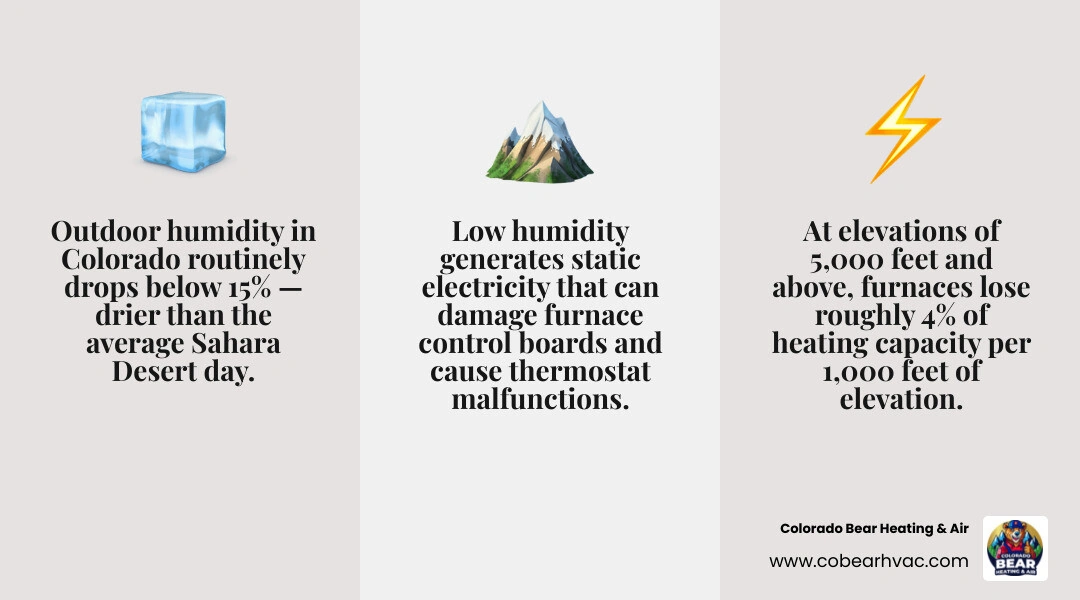
Quick look at how dry cold winters stress your furnace:
When the mercury drops across the Front Range, our heating systems transition from casual, intermittent use to marathon runtime sessions. This shift marks the beginning of a highly demanding period for your heating equipment. Understanding how dry cold winters stress your furnace requires looking at the combined forces of plummeting outdoor temperatures, thin high-altitude air, and a total lack of atmospheric moisture.
At high elevations, such as in Castle Rock, Parker, or Denver, the air density is about 20% lower than at sea level. This thin air naturally contains less oxygen, which directly impacts the combustion process inside a gas furnace. Because the air is less dense, the furnace must work significantly harder to draw in enough oxygen to support a clean, efficient burn. To understand how altitude compounds these cold-weather issues, read our detailed guide on How High Altitude Affects Furnace Combustion.
Beyond altitude, the sheer duration of winter cold snaps creates mechanical fatigue. Unlike milder climates where a furnace might cycle on and off a few times an hour, a Front Range cold snap forces continuous runtime. The constant starting and stopping, combined with hours of uninterrupted operation, causes rapid thermal cycling. The internal metal components heat up to hundreds of degrees and then cool down rapidly to a cold baseline. This continuous expansion and contraction puts immense physical stress on the structural integrity of your system.
One of the most surprising ways dry winter air affects your heating system is through what HVAC professionals call the "dust cycle." In humid environments, moisture in the air binds to dust particles, heavy allergens, and pet dander, causing them to settle quickly onto floors and furniture. In Colorado’s ultra-dry winter climate, however, there is no moisture to weigh these particles down.
As a result, dust remains suspended in the indoor air far longer. Every time your furnace blower kicks on, it pulls this floating debris directly into your return vents. This accelerated accumulation means your air filter becomes heavily loaded in a fraction of the time it would during the humid summer months.
When a filter becomes clogged with dry-weather dust, it creates a massive restriction in airflow. Your blower motor must spin faster and work harder to pull air through the blocked barrier. This restricted airflow can reduce your heating system's overall operating efficiency by up to 30% during extended cold periods. It also starves the heat exchanger of the cool air it needs to keep from overheating, which can trigger safety limit switches and cause the system to shut down entirely. To protect your system from this dusty bottleneck, explore our Essential Furnace Maintenance Tips for a Cozy Winter.
Extremely dry air is a perfect insulator for electrical charges, meaning static electricity builds up rapidly and has nowhere to go. In a home with low indoor humidity, walking across a carpet can generate thousands of volts of static electricity. While a quick shock to your fingertip is merely annoying, static discharge can be devastating to modern heating systems.
Today's high-efficiency furnaces function as sophisticated, high-powered computers. They rely on delicate electronic control boards, integrated circuitry, and sensitive microprocessors to manage everything from gas valve timing to variable-speed blower adjustments. If a static charge discharges near your thermostat or travels through the metal ductwork to the main control board, it can easily fry sensitive micro-components. This can cause:
While a cold, dry winter strains your entire HVAC system, certain internal components bear the brunt of the mechanical workload. When we perform professional Furnace Maintenance, we pay extra attention to these high-wear areas to prevent mid-winter breakdowns.
To illustrate how dry, cold conditions accelerate wear compared to a standard humid winter environment, consider the following component breakdown:
| Furnace Component | Wear in Humid Cold (Standard Winter) | Wear in Dry Cold (Colorado Winter) | Primary Stress Mechanism |
|---|---|---|---|
| Heat Exchanger | Moderate expansion/contraction cycles. | Severe thermal shock and rapid micro-stress cracking. | Extreme temperature differentials from a colder baseline. |
| Blower Motor | Standard operation; normal dust collection. | High friction, thickened lubricants, and heavy dust loading. | Airborne dust cycle and low-temperature lubrication breakdown. |
| Control Board | Low risk of electrical interference. | High risk of static discharge and sensor communication failure. | Electrostatic buildup due to single-digit relative humidity. |
| Air Filters | Requires replacement every 90 days. | Requires inspection/replacement every 30 to 60 days. | Suspended airborne particles that do not settle out of dry air. |
The heat exchanger is the heart of your furnace. It consists of a series of metal tubes or chambers that contain the hot combustion gases, transferring heat to your home's air as it passes over the outside of the metal. Because the air entering the furnace during a Colorado cold snap is incredibly cold and dry, the temperature differential across the metal walls of the heat exchanger is extreme.
When the furnace ignites, the metal expands rapidly from a cold baseline. When the cycle ends, it contracts quickly. This extreme thermal cycling causes micro-stress in the metal. Over time, this metal fatigue can lead to small hairline fractures or structural cracks.
A cracked heat exchanger is a severe safety hazard. It can allow toxic combustion byproducts, including carbon monoxide, to escape the sealed combustion chamber and mix directly with the breathing air circulating through your home. Because carbon monoxide is odorless and colorless, detecting these cracks through regular professional inspections is vital for your family's safety.
The blower motor is responsible for pushing heated air throughout your home's ductwork. During prolonged cold snaps, this motor runs almost continuously.
Cold temperatures can cause the specialized lubricants inside the motor’s bearings to thicken, increasing internal friction. When you combine thickened lubricant with the extra resistance created by a dusty, clogged air filter, the blower motor must draw significantly more electrical current to spin. This increased electrical load generates excess internal heat, accelerating the breakdown of the motor’s winding insulation and eventually leading to motor burnout.
Have you ever noticed that a home set to 72 degrees in the middle of a dry Colorado winter can still feel drafty and chilly, while the same temperature feels perfectly comfortable in the autumn? This phenomenon is known as the "comfort gap," and it plays a massive role in how much wear and tear your furnace experiences.
When indoor relative humidity drops below 30% (and especially when it hovers around 15% in unhumidified Denver Metro homes), the air is incredibly thirsty for moisture. It actively pulls water away from any available source, including your skin, houseplants, and wood furniture. This dry environment forces your furnace to run longer, harder cycles just to keep you comfortable. If you're experiencing uneven heating or drafts during these dry spells, our Furnace Repair Highlands Ranch Guide offers excellent insights into restoring system balance.
The human body regulates its temperature primarily through the evaporation of moisture from the skin. In a highly humid environment, evaporation slows down, making us feel warmer. In an extremely dry environment, the moisture on your skin evaporates almost instantly.
This rapid evaporation creates a distinct cooling effect on your skin. Even if your room air is technically 72 degrees, the evaporative cooling effect can make you feel up to 4 degrees colder. This dry-air chill forces most homeowners to engage in "thermostat creep" — continually turning the thermostat up to 74, 75, or even 76 degrees just to stop shivering.
Thermostat creep isn't just a comfort issue; it directly impacts your household budget and your furnace's lifespan. Every single degree you raise your thermostat increases your heating bill by approximately 3%.
Furthermore, because dry air doesn't hold heat nearly as well as properly humidified air, your home loses its warmth much faster. This rapid heat loss causes your furnace to cycle on more frequently and run for longer periods.
This issue is often worsened by leaky ductwork. In many homes, leaky ducts can lose up to 30% of their heated air to unconditioned spaces like attics or crawlspaces before it ever reaches your living rooms. When your furnace is already struggling against dry air and altitude, losing nearly a third of its output through duct leaks forces it into a state of constant, exhausting operation.
Because how dry cold winters stress your furnace happens incrementally, the early warning signs of system strain can be easy to miss. Paying close attention to your heating system during extreme cold snaps can help you catch minor issues before they turn into costly emergency repairs.
Keep an eye and an ear out for these common warning signs of furnace stress:
If you notice any of these red flags during a freezing stretch of winter weather, do not wait for the system to fail completely. Review our guide on the Signs You Need Emergency Furnace Repair in Cold Weather to determine if you need to call in a professional immediately.
Yes, absolutely. Because dry air accelerates the rate of evaporation from your skin, you will feel significantly colder at a standard room temperature of 70 or 72 degrees. This perceived chill leads to "thermostat creep," where homeowners set their thermostats several degrees higher to stay warm. Furthermore, dry air has a lower heat capacity than humidified air, meaning it loses warmth quickly and requires your furnace to run longer, more frequent cycles to maintain the set temperature.
During a dry Front Range winter, you should inspect your furnace filter every 2 to 3 weeks. Because dry air keeps dust, pet dander, and other airborne particles suspended in the air longer, your filter will collect debris much faster than it does in more humid seasons. For optimal performance and to prevent restricted airflow, plan to replace standard 1-inch filters every 30 to 60 days during peak heating season.
Yes, a whole-home humidifier is one of the most effective upgrades you can make for winter comfort and furnace protection in Colorado. By integrating directly into your heating system's ductwork, a whole-home humidifier maintains a stable, healthy indoor humidity level (ideally between 30% and 45%). This consistent moisture:
Colorado's dry, high-altitude winters present a unique set of challenges for residential heating systems. From dust-loaded filters and static-frazzled control boards to the physical strain of thermal cycling on your heat exchanger, your furnace undergoes an incredible amount of stress to keep your home warm.
Understanding how dry cold winters stress your furnace is the first step toward preventing unexpected mid-winter breakdowns. By staying on top of simple tasks like monthly filter checks and managing your indoor humidity, you can significantly reduce the strain on your system, lower your monthly energy bills, and extend the lifespan of your equipment.
At Colorado Bear Heating & Air, we bring over 20 years of local experience to keeping families comfortable across Castle Rock, Denver, Littleton, Highlands Ranch, and the surrounding communities. We believe in honest work, transparent pricing, and customer-first service. Whether you need a routine safety inspection, an indoor air quality upgrade like a whole-home humidifier, or fast, reliable repairs, our factory-certified technicians are here to help.
Don't wait for the next major cold snap to test your furnace's limits. Contact us today to schedule your professional furnace inspection, or visit our HVAC Services Page to learn more about how we can help you stay cozy all winter long!

Get a decision in seconds with no impact to your credit score.


Colorado Bear HVAC is truly the best contractors I have experienced since I moved into my house 30 years ago. I have been dealing with Joe and his crew for over 11 years now. They are a trustworthy, respectful, experienced crew who works with you and gives you a fair value. They just completed a big job replacing my A/C, gas furnace and condenser. They did an excellent job, no short cuts, made sure everything was functional, and cleaned up the area nicely before they left. No pressure to perform unnecessary service. You know when the job is done, you have received top notch professional service at a fair price.


I used Colorado Bear Heating and Air to replace two furnaces in my home. Nate was exceptional to work with. His team did a great job educating me along the way. He provided competitive pricing with 10 year warranties. They installed quickly and were just super great to work with. I’d highly recommend them.

Nate and Sam have been great to work with getting my home humidifier installed in a difficult space in my 1940s house. Their prices were very fair and I would heartily recommend Colorado Bear to anyone looking for a solid HVAC company.
.avif)
Thank you Nate for the promptness you guys gave my parent. They are 93 and can't get around and always getting cold, and I was at work called Nate and he had one of his guys there in like 2 hours which was outstanding my dad was very impressed with the professional and how quick he had it fixed. These guys are great all my family said we found us a new heating and ac company. Colorado Bear Heating & Air you have customers for life!!!! Thank You Again
Carla and the Barnes Family
.avif)
Colorado Bear Heating & Air saved the day! This morning my family and I woke up to frigid outside temperatures(1 degree F)…and no heat! Nate was great over the phone to help me check our furnace, then he sent Sam over to help get us back to warmer temps. They were so quick and helpful. Fortunately I did not have to keep my toddlers inside the house wearing snow suits all day. We are warm now, and so thankful!
.avif)

If you’re in Colorado Springs, The Mountains, or nearby areas, call us to confirm availability for installations.
.avif)