Latest Blogs
Stay updated with our latest blog posts.



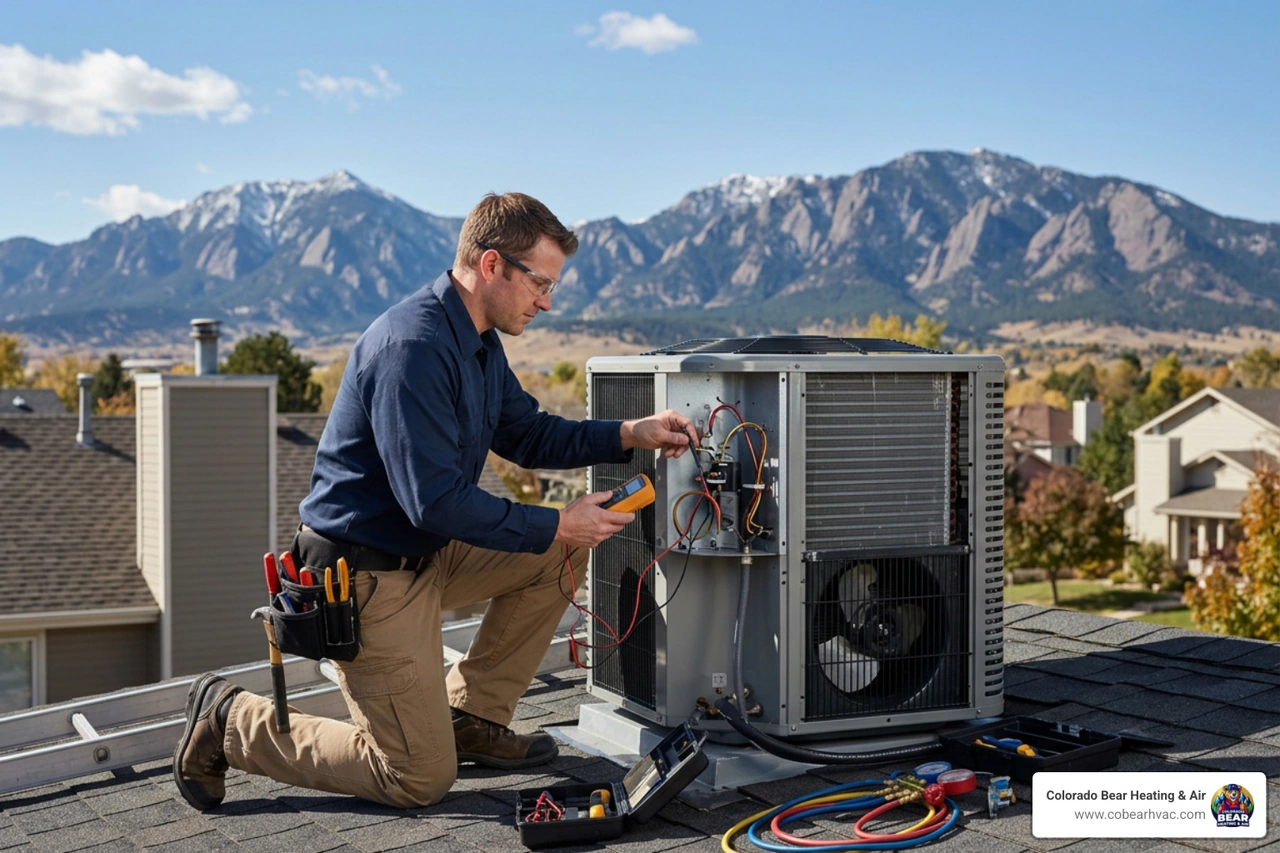

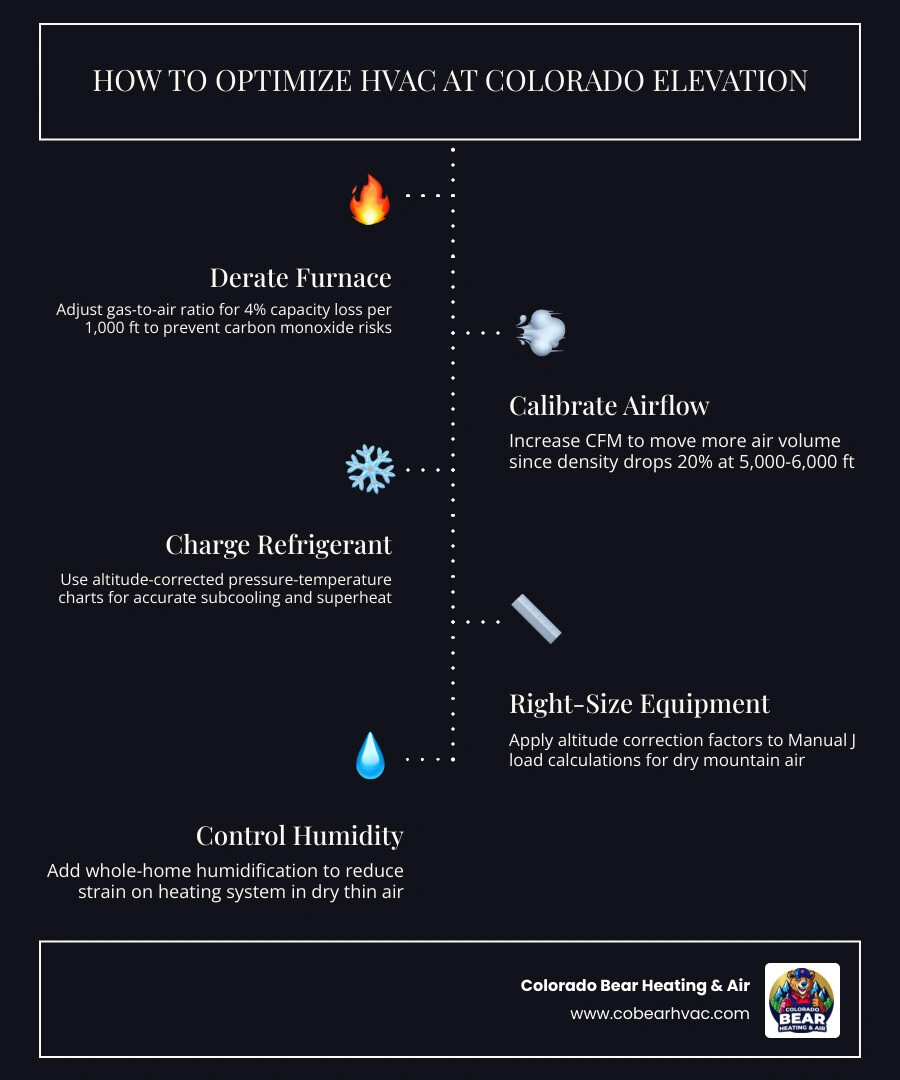
If you want to know how to optimize your HVAC for Colorado elevation, here's a quick summary:
Denver is famously known as the Mile High City — and that one mile of extra elevation changes everything about how your heating and cooling system performs. Across the Denver Metro area, Castle Rock, Highlands Ranch, and surrounding communities, homeowners often notice their furnace struggling to keep up in winter, their AC running constantly in summer, or energy bills creeping higher without any obvious explanation. The culprit isn't always aging equipment or a bad installation. More often than not, it's the thin air.
At 5,000 to 6,000+ feet above sea level, the air is roughly 20% less dense than at sea level. That single fact affects nearly every part of your HVAC system — from how efficiently your furnace burns gas, to how well your air conditioner moves heat outdoors, to how hard your blower motor has to work just to circulate air through your home. Most HVAC systems are designed and rated under sea-level lab conditions. When they're installed in Colorado without proper adjustments, they're already working at a disadvantage before the first cold snap hits.
At Colorado Bear Heating & Air, we work with homeowners across Castle Rock, Littleton, Centennial, and the broader Denver Metro area every day — and altitude-related HVAC issues are among the most common (and most misunderstood) problems we see. This guide walks you through exactly what's happening inside your system at elevation, and what you can do about it.
Quick how to optimize your hvac for colorado elevation definitions:
To understand why your heating and cooling systems struggle at 5,000 to 6,000+ feet, we have to look at the physics of thin air. At sea level, atmospheric pressure is approximately 14.7 pounds per square inch (psi). As you climb higher into the Colorado sky, there is less atmosphere pressing down from above. For every 1,000 feet of elevation gain, atmospheric pressure drops by roughly 1 psi. By the time you reach Castle Rock or Highlands Ranch, the air pressure is only about 12 psi.
This drop in pressure means the air is far less dense. It is like asking your HVAC system to swim in a pool that is only 82% full—technically possible, but every single stroke requires more effort. In thinner air, there are fewer molecules packed into each cubic foot. This atmospheric reality triggers three major challenges for residential HVAC systems:
Understanding How Altitude Affects Your HVAC System is the first step toward reclaiming comfort. When systems are left unadjusted, these physical limitations lead to higher utility bills, uneven indoor temperatures, and premature component failures.
To visualize this impact, consider how standard sea-level specifications compare to real-world performance at Colorado elevation:
| Parameter | Sea-Level Baseline | High-Altitude Reality (5,000–6,000+ ft) | Direct Impact on Your Home |
|---|---|---|---|
| Atmospheric Pressure | ~14.7 psi | ~12.0 psi | Alters refrigerant boiling points and pressure readings |
| Air Density | 100% | ~80% to 82% | Reduces heat-carrying capacity of circulating air |
| Oxygen Content | Standard | ~20% lower per cubic volume | Leads to incomplete furnace combustion if unadjusted |
| Furnace Heat Output | 100% of Rated BTUs | 80% to 85% of Rated BTUs | Undersized heating if altitude derating isn't calculated |
| AC Cooling Capacity | 100% of Rated SEER | 5% to 20% performance drop | Longer run cycles and higher energy consumption in summer |
| Fan Mass Flow | 90,000 lbs/hour | 72,000 lbs/hour | Blower motor must work harder to distribute same thermal load |
These drops in performance can directly impact your wallet. If you are wondering How Does Altitude Affect Your Heating and Cooling Costs, the reality is that an unadjusted system can increase your annual energy bills by 20% to 30%, adding hundreds of dollars in unnecessary utility expenses every year.
When a standard gas furnace is shipped from the factory, it is set up to run at sea level. If you install that furnace directly into a home in Parker, Littleton, or Centennial without making physical adjustments, you are setting yourself up for serious comfort and safety issues.
Because high-altitude air contains less oxygen, a furnace running on factory settings will have a fuel-to-air mixture that is far too "rich" in gas. This fuel-heavy mixture prevents complete combustion. Instead of a clean, hot, blue flame, you end up with a cooler, yellow flame that produces heavy soot buildup. Over time, this soot coats the burners and the heat exchanger, restricting airflow and dramatically lowering the system's lifespan.
Even worse, incomplete combustion produces high levels of carbon monoxide (CO), a dangerous, odorless gas. To keep your home safe and warm, professional furnace adjustments are absolutely essential.
To optimize a gas furnace for Colorado's elevation, a NATE-certified technician must perform two critical tasks during installation or a seasonal tune-up:
To verify that these adjustments are correct, we always perform a professional combustion analysis. By inserting a specialized probe into the furnace's exhaust flue, we can measure the exact levels of oxygen, carbon monoxide, and carbon dioxide in the exhaust gases. This is the only way to prove your furnace is running safely and extracting every possible bit of heat from the fuel.
To learn more about this chemistry, check out our detailed guide on How High Altitude Affects Furnace Combustion.
The formal process of adjusting your furnace's fuel input for elevation is called derating. Because there is less oxygen available to burn the fuel, we must intentionally reduce the BTU (British Thermal Unit) input of the furnace.
The industry standard derating factor is a 4% capacity drop for every 1,000 feet of elevation above sea level (or above 2,000 feet, depending on the manufacturer's specific guidelines). Let's look at how this math plays out in our local communities:
If your installer fails to calculate this derating factor, they will install a furnace that is physically incapable of heating your home on the coldest winter nights. The unit will run constantly, struggling to reach the temperature set on your thermostat.
Furthermore, unadjusted combustion puts extreme stress on the heat exchanger. This can lead to micro-cracks over time, which can leak carbon monoxide into your indoor air. Properly derating your system is not just an efficiency upgrade; it is a critical safety measure for your family.
For a deeper dive into how this affects your monthly utility bills, read about How Thin Air Impacts Furnace Efficiency and Fuel Use.
While furnaces face combustion challenges, air conditioners and heat pumps face a heat transfer crisis. These systems do not actually "create" cold air; they are heat movers. In the summer, your air conditioner absorbs heat from inside your home and pumps it outside, releasing it into the outdoor air through the condenser coils.
But at high altitudes, there are fewer air molecules surrounding those outdoor coils. With less air mass available to carry the heat away, the condenser struggles to dissipate thermal energy. As a result, cooling coils can lose up to 14% of their rated capacity above 5,500 feet. Your compressor has to work much harder and run for longer cycles to cool your home, leading to accelerated wear and tear and higher electricity bills.
To combat this capacity loss, modern HVAC technology offers incredible solutions. One of the best upgrades for Colorado homes is variable-speed technology:
If you are considering heating alternatives, you might wonder: Are Heat Pumps Efficient in High Altitude Climates? The answer is a resounding yes. Modern cold-climate heat pumps are exceptionally efficient at elevation. Because they use advanced, variable-speed inverter compressors, they can extract heat from the outdoor air even when temperatures drop below zero.
When paired with a gas furnace in a "dual-fuel" configuration, you get the ultimate Best HVAC Setup for Colorado Weather. The heat pump handles the heating during our typical sunny winter days, and the furnace kicks in only during extreme deep freezes.
Simply buying high-efficiency equipment is not enough; it must be calibrated specifically for our altitude. Two critical adjustments are required during installation and maintenance:
To get it right, we must use altitude-corrected pressure-temperature (PT) charts. We measure the exact "subcooling" (for systems with TXV valves) or "superheat" (for systems with piston orifices) to ensure the refrigerant charge is perfect for our local atmospheric pressure.
For a complete breakdown of these technical requirements, see our guide on HVAC Adjustments Needed for Colorado Elevation.
One of the most common reasons HVAC systems fail in the Colorado High Country is improper sizing. Many contractors use generic, online sizing calculators or basic "rule of thumb" formulas (like 1 ton of AC capacity per 500 square feet). At 5,000 to 6,000+ feet, these sea-level formulas fail completely, often resulting in systems that are undersized by up to 25%.
To size a system correctly, we must use a professional Manual J load calculation that is adjusted with specific altitude correction factors. This calculation takes into account several unique Colorado climate realities:
To optimize your system, we perform a comprehensive home analysis. We inspect your insulation, assess your window orientations, seal duct leaks, and ensure your ductwork is sized to handle the increased airflow volume required at altitude.
For practical steps on managing these unique high-country challenges, read our HVAC Tips for Homes Above 5000 Feet.
You do not necessarily need to buy a completely different, highly specialized brand of HVAC equipment, but you do need to ensure that the system you choose is certified for high-altitude use and is installed with the manufacturer's approved high-altitude kit. These kits contain the specific burner orifices, pressure switches, and spring replacements needed to calibrate the system for lower atmospheric pressure.
Many high-efficiency brands (like Trane, Carrier, and Lennox) are certified for operation above 4,500 feet, but they still require physical calibration on-site by a licensed professional to run safely and efficiently.
Because the thin air forces your system to run longer and work harder to move heat, preventative maintenance is not optional in Colorado—it is essential for survival. We strongly recommend bi-annual maintenance:
Regular maintenance catches small altitude-related calibration drifts before they turn into costly mid-winter breakdowns.
Colorado is famously dry, and our winter indoor humidity often drops to a desert-like 15% to 25%. This dry air does more than just cause static electricity and dry skin; it directly impacts your heating efficiency.
Through the process of evaporative cooling, dry air causes moisture to evaporate from your skin rapidly, which makes you feel significantly colder than the actual temperature on the thermostat.
By installing a whole-home humidifier, you can raise your indoor relative humidity to a comfortable 35%. This moisture traps heat in the air, making a 68°F room feel just as warm as a 71°F room. This allows you to lower your thermostat by 3 to 5 degrees, saving significantly on your winter heating costs.
Optimizing your heating and cooling system for Colorado's unique elevation is the key to enjoying a comfortable, safe, and energy-efficient home. From derating your gas furnace to calibrating your air conditioner's refrigerant charge with altitude-corrected charts, these adjustments require specialized local expertise and precise engineering.
At Colorado Bear Heating & Air, we bring more than 20 years of hands-on experience to homeowners in Castle Rock, Littleton, Highlands Ranch, Centennial, and across the Denver Metro Area. We pride ourselves on honest, reliable work done right the first time, with transparent communication and a customer-first approach.
If you want to make sure your home is ready for whatever Colorado weather throws our way, we are here to help. For more tips on keeping your summer cooling costs under control, check out our guide on How to Lower AC Bills During Colorado Summer.
Ready to stop fighting the altitude and start working with it? Contact Colorado Bear Heating & Air today to schedule your high-altitude HVAC evaluation and experience the difference of honest, expert service!

Get a decision in seconds with no impact to your credit score.


Colorado Bear HVAC is truly the best contractors I have experienced since I moved into my house 30 years ago. I have been dealing with Joe and his crew for over 11 years now. They are a trustworthy, respectful, experienced crew who works with you and gives you a fair value. They just completed a big job replacing my A/C, gas furnace and condenser. They did an excellent job, no short cuts, made sure everything was functional, and cleaned up the area nicely before they left. No pressure to perform unnecessary service. You know when the job is done, you have received top notch professional service at a fair price.


I used Colorado Bear Heating and Air to replace two furnaces in my home. Nate was exceptional to work with. His team did a great job educating me along the way. He provided competitive pricing with 10 year warranties. They installed quickly and were just super great to work with. I’d highly recommend them.

Nate and Sam have been great to work with getting my home humidifier installed in a difficult space in my 1940s house. Their prices were very fair and I would heartily recommend Colorado Bear to anyone looking for a solid HVAC company.
.avif)
Thank you Nate for the promptness you guys gave my parent. They are 93 and can't get around and always getting cold, and I was at work called Nate and he had one of his guys there in like 2 hours which was outstanding my dad was very impressed with the professional and how quick he had it fixed. These guys are great all my family said we found us a new heating and ac company. Colorado Bear Heating & Air you have customers for life!!!! Thank You Again
Carla and the Barnes Family
.avif)
Colorado Bear Heating & Air saved the day! This morning my family and I woke up to frigid outside temperatures(1 degree F)…and no heat! Nate was great over the phone to help me check our furnace, then he sent Sam over to help get us back to warmer temps. They were so quick and helpful. Fortunately I did not have to keep my toddlers inside the house wearing snow suits all day. We are warm now, and so thankful!
.avif)

If you’re in Colorado Springs, The Mountains, or nearby areas, call us to confirm availability for installations.
.avif)