Why how hvac condition affects home appraisals Matters for Colorado Homeowners
Understanding how hvac condition affects home appraisals could be the difference between a smooth sale, refinance, or HELOC approval — and an unwelcome surprise that costs you thousands. Whether you're getting ready to list your home in Castle Rock, pull equity in Highlands Ranch, or refinance in the Denver Metro area, your heating and cooling system carries more weight with appraisers than most homeowners realize.
Here's a quick answer if you need it fast:
How HVAC condition affects home appraisals — at a glance:
| HVAC Situation | Likely Appraisal Impact |
|---|---|
| System in good working order, under 15 years old | Neutral to positive — supports home's condition rating |
| System 15–20+ years old, still functional | May be flagged as deferred maintenance |
| Failing, broken, or non-functional system | Can reduce appraised value by $5,000–$10,000 or more |
| Missing central air (in markets where it's expected) | Can trigger a $5,000–$8,000 value penalty |
| New or recently replaced system | Typically recoups 40–70% of cost in added value |
| High-efficiency system (SEER2 16+, AFUE 95%+) | May add $1,000–$2,000 above a standard replacement |
Appraisers don't perform a full mechanical inspection — they conduct a visual and functional check. They look at system age, visible wear, thermostat response, and whether the unit is even present. That limited scope means the details that are visible carry a lot of weight. A rusty condenser, a system that won't kick on, or an old unit running on a phased-out refrigerant like R-22 can all send the wrong signal — not just about your HVAC, but about how well the entire home has been maintained.
In Colorado's climate, where both summer cooling and winter heating are genuine necessities, a functioning HVAC system isn't optional. It's a core part of what makes a home livable — and lenders, buyers, and appraisers treat it that way.
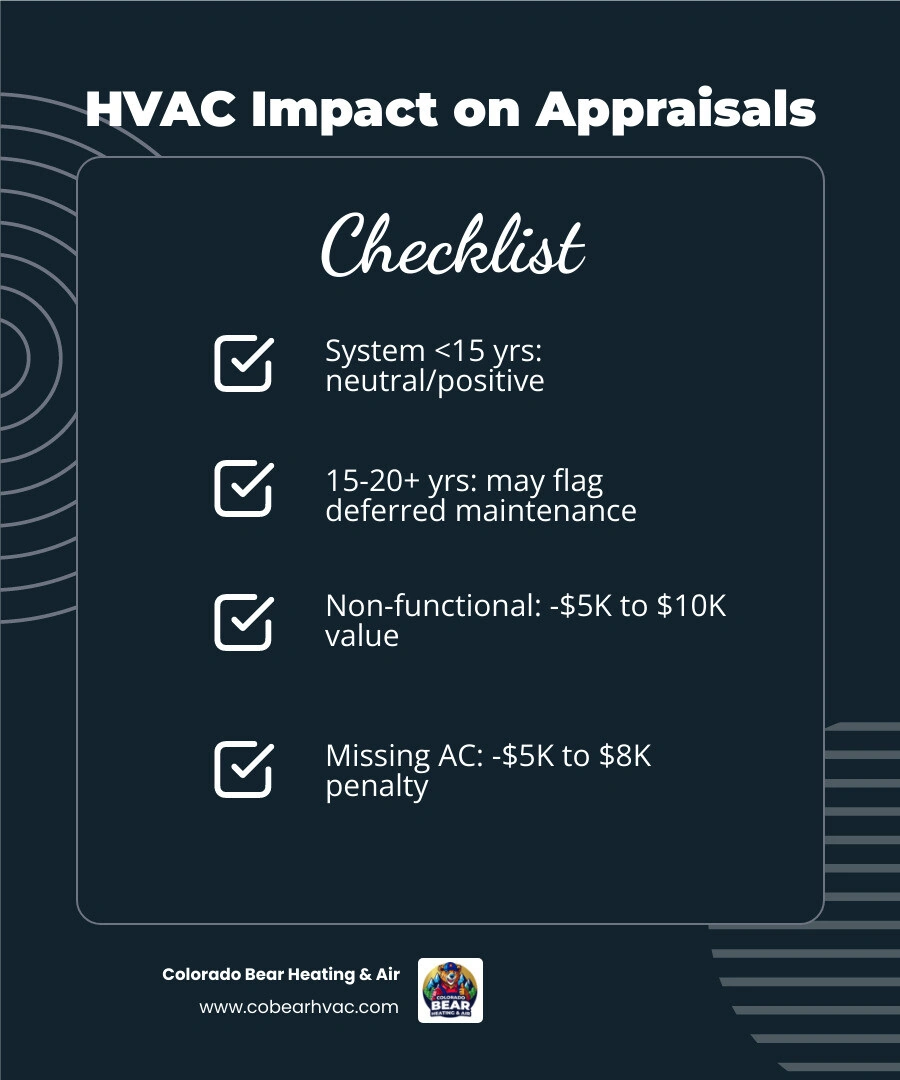
How HVAC Condition Affects Home Appraisals: The Appraiser's Checklist

When an appraiser steps into your home in Littleton or Parker, they are not wearing the hat of a licensed HVAC technician. They won’t pull off panels, measure refrigerant pressures, or analyze combustion gases. Instead, they evaluate your heating and cooling systems under the "Physical Condition" category of the Uniform Standards of Professional Appraisal Practice (USPAP). This places your HVAC on the same critical tier as your roof, foundation, plumbing, and electrical systems.
The appraiser's evaluation relies on a combination of visual inspection and basic functional testing. First, they will conduct a simple functional test by turning on the system via the thermostat. They want to verify a prompt thermostat response and confirm that the system actually blows conditioned air.
Next, they look closely at the physical hardware. They locate the manufacturer labels on both the indoor furnace and the outdoor condenser unit. These labels contain serial numbers that reveal the exact production date, allowing the appraiser to calculate the system's chronological and effective age. If a system is struggling or visually neglected, it heavily influences the property's overall condition rating. Knowing When to Repair vs Replace Your HVAC System before the appraiser schedules their visit can prevent a negative mark on this crucial checklist.
How HVAC Condition Affects Home Appraisals During Visual Inspections
During the walkthrough, the appraiser is highly sensitive to visual cues that suggest a lack of maintenance. They will examine the outdoor condenser unit for:
- Significant rust, corrosion, or physical damage to the cabinet and coils.
- Debris, weeds, or heavy foliage choking the unit, which restricts airflow and forces the compressor to run hot.
- An uneven or sinking concrete pad underneath the condenser, which can stress refrigerant lines.
Indoors, they look for water stains around the furnace or evaporator coil, which could point to a clogged condensate line or a cracked drain pan. They will also note excessive noise, screeching blower motors, or a visibly clogged air filter. While a dirty filter is a simple fix, to an appraiser, it serves as a "canary in the coal mine"—suggesting that the homeowner may have neglected deeper, more expensive maintenance tasks throughout the property.
How HVAC Condition Affects Home Appraisals for Government-Backed Loans
If your buyer is utilizing a government-backed mortgage—such as an FHA, VA, or USDA loan—the appraisal standards become significantly stricter. These programs require the appraiser to verify that the home is safe, sound, and secure.
For these loans, a fully functional heat source is a non-negotiable requirement. In our local Colorado service areas like Monument, Elizabeth, and Larkspur, winter temperatures regularly drop below freezing. If the furnace does not turn on or cannot maintain a safe habitable temperature (typically at least 50 degrees Fahrenheit in all living areas) during the appraisal, the loan will be put on hold. The appraiser will flag this as a safety hazard and a structural deficiency. The home will fail the initial appraisal, and the loan cannot fund until the system is professionally repaired or replaced, followed by a paid re-inspection.
HVAC Red Flags That Can Lower Your Home's Appraised Value
An outdated or failing climate control system is one of the fastest ways to drag down a home's valuation. When appraisers evaluate comparable sales (comps) in neighborhoods like Centennial or Aurora, they make dollar-for-dollar downward adjustments if your home's mechanical systems are vastly inferior to recently sold homes nearby.
If your system is showing Signs Furnace Needs Immediate Replacement, leaving it for the next owner to handle will almost certainly cost you more in appraisal value and negotiating power than addressing it upfront.
Equipment Age and Remaining Useful Life
Appraisers look at both actual age and "effective age." A system that is 18 years old but has been meticulously maintained might have an effective age of 12. However, standard residential HVAC equipment has a typical lifespan of 15 to 20 years.
Once a furnace or air conditioner crosses this threshold, appraisers flag it as an imminent capital expense. They know that a buyer will likely have to replace the system shortly after moving in. If you are operating a system nearing two decades of service, it is highly beneficial to understand When to Consider Furnace Replacement. Proactively replacing an aging unit removes a massive hurdle for both the appraiser and potential buyers. Keep an eye out for the Top Signs You Need Furnace Replacement to ensure you aren't caught off guard right before your home goes on the market.
Additionally, older air conditioning units manufactured before 2010 likely run on R-22 refrigerant (Freon). Because the EPA has completely phased out R-22, servicing these units is incredibly expensive. Appraisers are fully aware of these regulatory shifts. In 2026, we are also navigating the transition away from R-410A toward newer, more environmentally friendly refrigerants like R-454B. An old R-22 system is viewed as a ticking financial clock, leading to immediate downward value adjustments.
Missing Central Air and Functional Obsolescence
In real estate, "functional obsolescence" refers to a feature (or lack thereof) that diminishes the usefulness or desirability of a property compared to current market expectations.
While heating is a survival necessity in Colorado, central air conditioning has rapidly transitioned from a luxury to a baseline expectation. In areas like Highlands Ranch, Lone Tree, and Castle Pines, almost all modern homes are equipped with central cooling. If your home relies on window units or has no cooling system at all in a neighborhood where central air is the standard, the appraiser will penalize the property. This missing feature typically triggers a functional obsolescence penalty of $5,000 to $8,000, as it limits the pool of qualified buyers and represents an immediate post-purchase project for the new owner.
The Financial Impact: Value Protection vs. Value Creation
It is crucial to understand that maintaining your HVAC system is primarily an act of value protection, while upgrading to premium equipment is an act of value creation.
A functional, clean, mid-range HVAC system does not necessarily add a massive premium to your appraisal; rather, it protects your home from losing value. It ensures your property meets the baseline standard for your neighborhood. However, replacing an old, broken system with a modern, high-efficiency setup can yield a substantial return on investment (ROI).
According to real estate data, a standard HVAC replacement typically recoups 40% to 70% of its cost in direct added appraisal value. Furthermore, homes with brand-new heating and cooling systems sell up to 10% to 15% faster because they offer buyers complete peace of mind. To see how these upgrades affect your home's performance and marketability, consider How Furnace Replacement Improves Home's Efficiency and review the Benefits of Efficient Furnace Installation.
| System Type | Average Appraisal Value Impact | Estimated Resale ROI | Buyer Appeal Factor |
|---|---|---|---|
| Outdated / Failing System (18+ Years) | -$5,000 to -$10,000+ penalty | N/A (Immediate loss of equity) | Very Low (Triggers repair negotiations) |
| Standard Replacement (SEER2 14, AFUE 80%) | Baseline value restored (No penalties) | 40% - 60% | Medium (Relief from immediate replacement costs) |
| High-Efficiency System (SEER2 16+, AFUE 95%+) | +$1,000 to +$2,000 above standard | 50% - 80% | High (Lower utility bills, quiet operation) |
Energy Efficiency Ratings and Appraisal Adjustments
Appraisers are increasingly trained to recognize green and energy-efficient features. If you upgrade to a system with a high SEER2 (Seasonal Energy Efficiency Ratio) rating or an AFUE (Annual Fuel Utilization Efficiency) rating of 95% or higher, make sure the appraiser knows.
These high-efficiency systems can add an extra $1,000 to $2,000 in value above a standard, baseline replacement. They also lower monthly operating costs by 10% to 30%, which is a major selling point for modern, budget-conscious buyers. To secure these valuation benefits, working with factory-certified professionals is essential. You can learn more about Why Proper Furnace Installation is Crucial to protect your investment, and see how a professional Furnace Installation Enhances Home Comfort for you and future owners alike.
Sales, Refinances, and HELOC Appraisals
How an HVAC's condition affects your appraisal can vary slightly depending on your financial goals:
- Home Sales: A bad HVAC system can derail a sale entirely. Buyers using traditional financing may find their lenders refusing to approve the mortgage until the system is functional.
- Refinancing: During a refinance, you are trying to maximize your home's value to secure a lower interest rate or eliminate private mortgage insurance (PMI). A $10,000 reduction in your appraisal due to a failing furnace can keep you locked into a higher-cost loan.
- HELOCs (Home Equity Lines of Credit): HELOC borrowing limits are strictly tied to your available equity. If a neglected HVAC system drops your appraisal by several thousand dollars, it directly shrinks your borrowing power, limiting your ability to access cash for other home improvements or financial needs.
How to Prepare Your HVAC System Before an Appraisal
Just as you would deep-clean your kitchen and manicured your lawn before an appraiser visits, you should spend a little time preparing your HVAC system. A small amount of preparation can prevent unwarranted value deductions.
Follow this quick preparation checklist:
- Replace the Air Filter: Put in a fresh, clean air filter. This is a cheap, immediate way to show the appraiser that you care about routine maintenance. It also ensures maximum airflow when they test the system.
- Clear the Outdoor Unit: Cut back weeds, trim bushes, and remove leaves or branches within a two-foot radius of your outdoor condenser unit. Clean off any dirt or grass clippings from the metal fins.
- Clean the Indoor Utility Area: Ensure the appraiser has clear, unhindered access to your indoor furnace or air handler. Clear away clutter, storage boxes, and dust from the immediate area.
- Gather Your Paperwork: Create an "HVAC Portfolio" to hand directly to the appraiser. Include:
- Invoices for recent installations, repairs, or professional tune-ups.
- Proof of transferable warranties.
- Permits pulled for system installations (appraisers check for unpermitted work!).
- Manufacturer brochures highlighting high SEER2 or AFUE ratings.
If you are on the fence about whether to make a move before the appraiser arrives, read our guide on Deciding on Furnace Repair and Replacement to weigh your options. There are several compelling Reasons to Consider Furnace Replacement that go far beyond simply raising your home's appraisal.
Frequently Asked Questions About HVAC and Appraisals
Does a new HVAC system increase home value?
Yes, a new HVAC system increases home value by eliminating deferred maintenance penalties, improving the home's overall condition rating, and increasing marketability. While you may not recover 100% of the installation cost in the appraisal alone, the combination of added home value, faster sales times, and lower monthly utility bills makes it an incredibly sound investment.
How do appraisers verify the age of an HVAC system?
Appraisers verify system age by inspecting the manufacturer's data plate on the indoor and outdoor units. They record the brand, model number, and serial number. They then use industry databases to decode the serial number, which reveals the exact year and month the equipment was manufactured. They may also cross-reference this with local municipal permit records.
Can a dirty filter cause an appraisal issue?
While a dirty filter won't cause a direct, automated dollar deduction, it acts as a red flag. It suggests to the appraiser that the home is not being regularly maintained. Furthermore, an extremely clogged filter can restrict airflow so severely that the system short-cycles or fails to blow cold air during the appraiser's functional test, which will result in a negative mark on the appraisal report.
Conclusion
Your heating and cooling systems are the silent workhorses of your home. While they might not have the visual appeal of a newly remodeled kitchen, their operational health plays a massive role in how hvac condition affects home appraisals. Protecting your equity, securing your loan, and ensuring a hassle-free home sale all start with a well-maintained, efficient HVAC system.
At Colorado Bear Heating & Air, we bring over 20 years of honest, reliable experience to homeowners across Castle Rock, Littleton, Highlands Ranch, Centennial, and the surrounding Denver Metro communities. Whether you need a pre-appraisal system tune-up, a quick repair, or a complete high-efficiency system replacement to maximize your home's equity, we are here to help. We pride ourselves on transparent communication and honest work done right the first time.
Don't let an outdated or neglected HVAC system hurt your home's valuation. Book your professional HVAC service with Colorado Bear Heating & Air to schedule your inspection and ensure your home is ready for a flawless appraisal.