Latest Blogs
Stay updated with our latest blog posts.



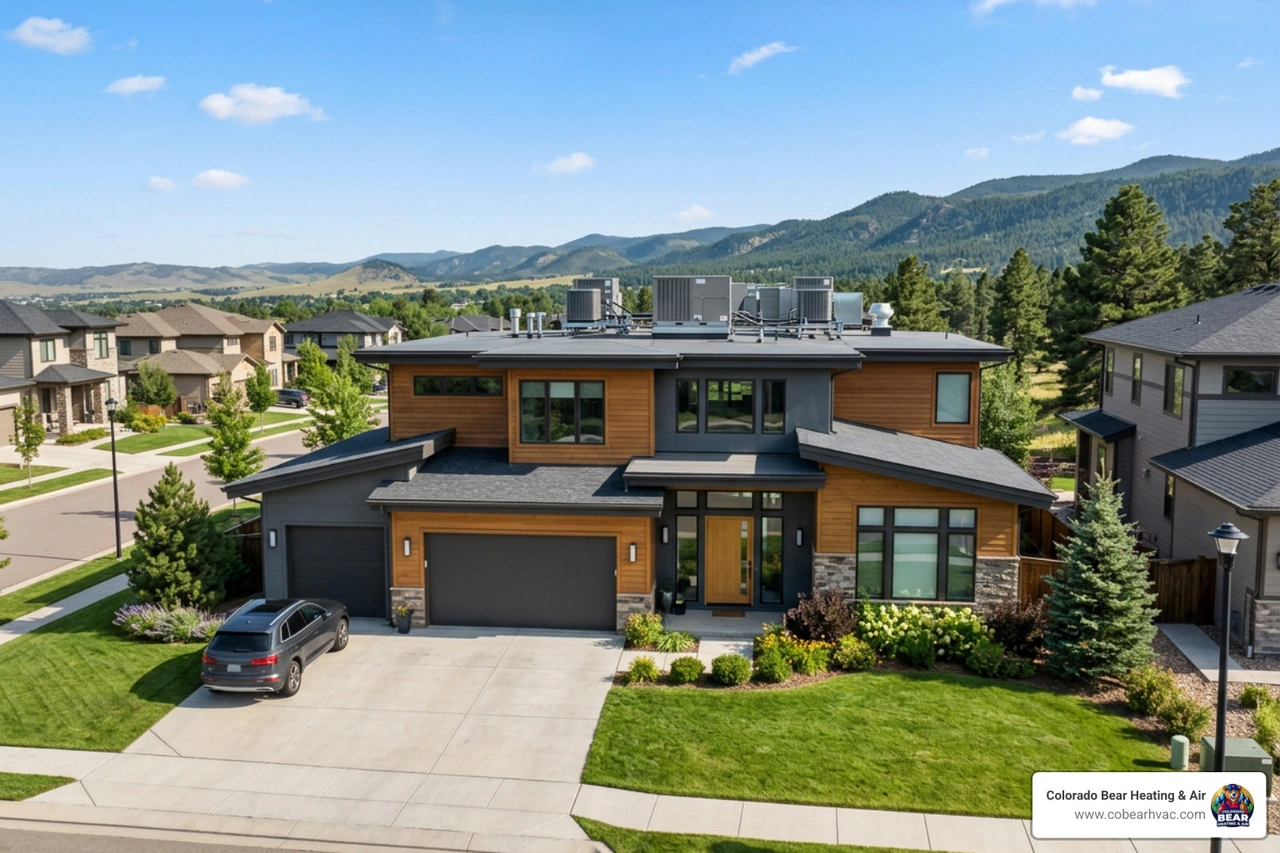

HVAC efficiency differences at the Front Range are real, measurable, and directly affect your energy bills, comfort, and equipment lifespan — here is a quick summary before we dive in:
| Factor | Sea Level | Denver (5,280 ft) | Mountain Towns (10,000 ft) |
|---|---|---|---|
| Air density vs. sea level | 100% | ~83% | ~70% |
| Heat pump capacity loss | None | 5–8% | ~30% |
| Duct energy loss (typical) | 20–30% | 20–30% | 20–30% |
| Furnace combustion impact | Baseline | Moderate | Significant — kits often required |
| Best system for efficiency | Any | Cold-climate HP or dual-fuel | Cold-climate HP with oversizing |
Colorado's Front Range is not a typical HVAC environment. Denver sits at 5,280 feet above sea level, and communities like Evergreen, Conifer, and mountain towns push well past 7,000 to 10,000 feet. At those elevations, the air is roughly 17 to 30% thinner than at sea level. That thinner air transfers heat less effectively, reduces how hard your compressor can work, and starves gas furnaces of the oxygen they need for clean combustion — all at the same time.
Add in Colorado's notoriously rapid temperature swings — a 40-degree drop in a single afternoon is not unusual along the Front Range — and it becomes clear why equipment that performs well in Atlanta or Chicago may underperform here.
The good news: once you understand how altitude reshapes HVAC performance, you can choose a system that is properly sized, correctly adjusted, and built to thrive in Colorado's unique climate.
Hvac efficiency differences at the front range terms explained:
When you shop for a new heating or cooling system, the yellow EnergyGuide labels prominently display ratings like SEER2 (Seasonal Energy Efficiency Ratio 2), AFUE (Annual Fuel Utilization Efficiency), and HSPF2 (Heating Seasonal Performance Factor 2). What those labels do not tell you is that these metrics are calculated under laboratory conditions at sea level.
At high elevations, the physics of air changes everything. Because air pressure is lower, the molecules that make up our atmosphere are spread further apart. This "thin air" has a direct impact on heat transfer. Air is the primary medium your HVAC system uses to carry heat into or out of your home. When there are fewer air molecules passing over your air conditioner’s evaporator coil or your furnace’s heat exchanger, the system cannot transfer heat as quickly or as efficiently.
This phenomenon is known as altitude derating. For cooling systems and heat pumps, the thinner air reduces the mass flow rate of air across the indoor and outdoor coils. Since the air cannot carry away as much heat per cubic foot, the compressor has to work harder and run longer to achieve the same indoor temperature.
To learn more about how these forces interact in your home, check out our detailed guide on How Altitude Affects Your HVAC System. Additionally, you can explore the financial side of high-altitude operations in our breakdown of How Does Altitude Affect Your Heating and Cooling Costs.
Heating a home along the Front Range has historically been the job of the natural gas furnace. However, modern cold-climate heat pumps have emerged as a highly efficient alternative. To make the best choice for your home, it helps to understand how high altitude affects both of these technologies.
Gas furnaces rely on a precise mixture of fuel and oxygen to create combustion. At sea level, the atmospheric oxygen level is perfectly suited for standard burner designs. At 5,000 feet and above, the lack of oxygen molecules in a given volume of air disrupts this fuel-to-air ratio. Without proper adjustments, a standard furnace will run "rich," meaning there is too much fuel and too little oxygen. This leads to incomplete combustion, which wastes fuel, produces excess carbon monoxide, and can quickly soot up and damage your heat exchanger.
To prevent this, furnaces installed along the Front Range usually require specialized high-altitude kits. These kits typically include smaller gas orifices to reduce the fuel flow, matching the thinner air, and pressure switch adjustments to ensure the draft inducer motor pulls in the correct volume of air.
For an in-depth look at this process, read our article on How High Altitude Affects Furnace Combustion, and find out how these changes impact your monthly utility bills in our post on How Thin Air Impacts Furnace Efficiency and Fuel Use.
When we adjust a furnace for high altitude, we are essentially reducing its heating capacity (derating it) to keep the combustion safe and clean. Standard rules of thumb dictate a derating factor of approximately 4% for every 1,000 feet of elevation above sea level. This means a furnace installed in Denver (5,280 feet) must be derated by roughly 20%, while a system in a mountain community at 10,000 feet will lose up to 40% of its rated capacity.
While the AFUE rating (the percentage of fuel converted to usable heat) remains relatively stable after proper derating, the actual BTU output of the machine drops. If your home requires an 80,000 BTU heating capacity, a technician cannot simply install an 80,000 BTU furnace out of the box; they must size the equipment larger to account for this altitude loss.
Furthermore, Colorado's environmental standards have evolved. In 2026, state regulations require newly installed gas furnaces to meet strict Ultra-Low NOx emissions limits. These units emit no more than 14 nanograms of nitrogen oxides per joule of useful heat. Ultra-Low NOx furnaces utilize advanced burners and flame sensors that are highly sensitive to airflow and fuel mixtures, making precise high-altitude calibration more critical than ever.
To stay up to date on these local regulations, take a look at our Colorado Climate HVAC Guide 2026.
Heat pumps do not rely on combustion, which makes them immune to oxygen-starvation issues. Instead, they use a refrigerant cycle to extract heat from the outdoor air and move it indoors. Because they transfer heat rather than generate it, heat pumps can operate at efficiencies of 200% to 400% (meaning they deliver up to four times more heat energy than they consume in electricity).
However, heat pumps are still subject to the laws of thermodynamics in thin air. At Denver’s elevation of 5,280 feet, the reduced density of the outdoor air decreases a heat pump's heating capacity by approximately 5% to 8% compared to sea-level ratings. At 10,000 feet, where the air density is reduced by nearly 30%, the capacity loss is much more severe, requiring careful system oversizing during the design phase.
Fortunately, modern cold-climate heat pumps are engineered with advanced variable-speed inverter compressors and enhanced vapor injection technology. Brands like Daikin, Mitsubishi, and Bosch design systems that can maintain 70% to 85% of their heating capacity down to Denver's typical winter lows of -3°F, with some models operating efficiently all the way down to -22°F.
Curious about how these systems hold up when the snow starts falling? Read our guide on Are Heat Pumps Efficient in High Altitude Climates, and see how specific manufacturers handle our weather in our article on How Daikin Systems Perform in Colorado Climate.
When summer arrives on the Front Range, cooling becomes the priority. While our climate is generally dry, high-altitude cooling presents its own set of thermodynamic challenges.
Air conditioning relies on two types of cooling: sensible cooling (lowering the actual air temperature) and latent cooling (removing moisture or humidity from the air). Because Colorado has a hot, dry summer climate, our air conditioners perform almost entirely sensible cooling. While this sounds ideal, the thinner air at higher elevations reduces the rate of heat dissipation from the outdoor condenser coil.
Standard air conditioners designed for sea level can experience compressor strain and reduced cooling capacity because the thin air cannot carry heat away from the refrigerant coils quickly enough. To compensate, specialized high-altitude cooling designs utilize larger condenser coils, variable-speed fan motors, and altitude-specific refrigerant charges.
To understand how these altitude factors influence your cooling selection and budget, read Does Altitude Make Cooling More Expensive and explore our advice on What SEER2 Rating Should I Buy in Colorado.
Below is a comparison of how traditional central AC systems and ductless mini-splits perform under Front Range conditions:
| Feature | Central Air Conditioning | Ductless Mini-Split Systems |
|---|---|---|
| Average SEER2 Rating | Typically 13.4 to 26 SEER2 | 18 to 38+ SEER2 |
| Ductwork Energy Loss | 20% to 30% loss through leaks | 0% loss (ductless delivery) |
| Zoning Capability | Limited (unless complex dampers are used) | Excellent (individual room control) |
| High-Altitude Heat Transfer | Moderate (reliant on high duct airflow volume) | High (direct localized heat exchange) |
| Aesthetic Impact | Hidden behind walls and registers | Small indoor wall or ceiling units |
One of the most significant contributors to energy waste in traditional central HVAC systems is the ductwork. According to the U.S. Department of Energy, typical residential duct systems lose 20% to 30% of their conditioned air through leaks, loose connections, and poor insulation.
Along the Front Range, this problem is amplified. Many homes have ductwork running through unconditioned spaces like vented attics or crawlspaces, where summer temperatures can soar and winter temperatures plummet. When 20% to 30% of your expensive heated or cooled air escapes into these spaces, your system has to run significantly longer to keep your living areas comfortable.
Ductless mini-splits completely eliminate this source of energy waste. By delivering conditioned air directly into individual rooms via small refrigerant lines, they bypass the need for ductwork entirely. Furthermore, mini-splits utilize advanced inverter technology, allowing them to run continuously at ultra-low speeds to maintain a steady temperature rather than cycling on and off.
If you are wondering whether investing in a higher efficiency rating is practical for your budget, check out our analysis on Is a Higher SEER Rating Worth the Extra Cost.
If you have lived along the Front Range for any length of time, you know that our weather is incredibly dynamic. It is entirely possible to start the morning in a light jacket, switch to shorts by lunchtime, and find yourself turning on the heater by sunset as a cold front rushes over the Rocky Mountains.
These rapid 40-degree temperature swings place an immense amount of stress on standard, single-stage HVAC systems. A single-stage system operates like a light switch: it is either 100% on or 100% off. When a sudden cold front hits, a single-stage furnace will blast hot air into the home, overshoot the thermostat setting, turn off, and then turn back on a few minutes later when the temperature drops again. This constant cycling wastes energy and causes significant wear and tear on the system's components.
Variable-speed, inverter-driven systems solve this problem. Instead of running at full capacity or nothing at all, an inverter compressor can adjust its output in tiny increments (often between 17% and 100% capacity). During a mild afternoon, the system might run quietly at just 20% capacity, consuming a fraction of the electricity. As the outdoor temperature plummets, the system automatically ramps up to match the heating demand, keeping your indoor temperature perfectly stable.
To learn how to protect your equipment from these wild weather patterns, read How Altitude and Temperature Swings Affect Your System. To plan the ultimate system for your home, take a look at our guide on the Best HVAC Setup for Colorado Weather.
As of July 2026, Colorado homeowners must navigate new high-efficiency standards and environmental regulations. With the state's transition to Ultra-Low NOx combustion requirements for gas furnaces, the upfront cost of traditional gas heating equipment has risen by approximately 30% to 40%. This regulatory shift has made high-efficiency electric heat pumps and dual-fuel hybrid systems far more financially attractive.
To maximize efficiency and ensure long-term reliability at high elevations, proper system sizing is critical. HVAC systems must be sized using precise Manual J load calculations that are adjusted for our local 17% to 30% air density reduction. Sizing a system solely based on square footage is a recipe for high energy bills and premature equipment failure.
Additionally, our dry, high-altitude climate requires a thoughtful approach to ventilation and indoor air quality:
For more high-altitude home care strategies, read our HVAC Tips for Homes Above 5000 Feet, and check out our advice on Choosing the Right HVAC Brand for Colorado.
The official ratings stamped on the manufacturer's label do not change, as they are based on standardized laboratory testing at sea level. However, the real-world operating capacity and efficiency of the system will be lower at high altitudes. Thinner air reduces heat transfer and furnace oxygen levels, meaning a system rated for 16 SEER2 or 96% AFUE may perform closer to a 14 SEER2 or 92% AFUE equivalent if it is not specifically calibrated or adjusted for high-altitude use. To learn more about how these ratings are calculated, read our guide on Understanding SEER2 Ratings and AC Efficiency.
For most homes in the Denver Metro area, a properly sized, modern cold-climate heat pump can serve as the sole source of heating and cooling without requiring a backup furnace. However, many Front Range homeowners choose a "dual-fuel" hybrid system. This setup pairs an electric heat pump with a high-efficiency gas furnace. The heat pump handles the heating during our many mild, sunny winter days, while the furnace kicks in as an efficient backup only during extreme sub-zero cold snaps. This hybrid approach allows you to take advantage of local utility rebates and low operational costs year-round.
Because thin air is naturally drier and less dense, natural ventilation (air leaking in through windows and doors) is less effective at exchanging indoor air. This can lead to a buildup of indoor air pollutants, dust, and pet dander. To maintain healthy indoor air quality, we recommend installing a balanced mechanical ventilation system, such as an ERV, paired with a whole-home humidifier and high-efficiency MERV air filters. This setup keeps your air fresh, clean, and comfortable without wasting energy.
Navigating the unique hvac efficiency differences at the front range requires more than just picking a system out of a catalog. From altitude derating and combustion adjustments to managing Colorado's extreme temperature swings, your home comfort system must be custom-tailored to our high-altitude environment.
At Colorado Bear Heating & Air, we bring more than 20 years of local experience to every job. Based in Castle Rock, we proudly serve homeowners across the Denver Metro Area, Highlands Ranch, Littleton, Centennial, and surrounding communities. We believe in honest work, transparent communication, and doing the job right the first time. Whether you are looking to upgrade to a high-efficiency cold-climate heat pump, install a ductless mini-split, or ensure your furnace is safely calibrated for high altitude, our licensed and certified technicians are here to help.
Ready to lower your energy bills and maximize your year-round comfort? Read our guide on How to Lower AC Bills During Colorado Summer, or contact us today.
Contact us today to experience fast, reliable comfort service from the local experts at Colorado Bear Heating & Air!

Get a decision in seconds with no impact to your credit score.


Colorado Bear HVAC is truly the best contractors I have experienced since I moved into my house 30 years ago. I have been dealing with Joe and his crew for over 11 years now. They are a trustworthy, respectful, experienced crew who works with you and gives you a fair value. They just completed a big job replacing my A/C, gas furnace and condenser. They did an excellent job, no short cuts, made sure everything was functional, and cleaned up the area nicely before they left. No pressure to perform unnecessary service. You know when the job is done, you have received top notch professional service at a fair price.


I used Colorado Bear Heating and Air to replace two furnaces in my home. Nate was exceptional to work with. His team did a great job educating me along the way. He provided competitive pricing with 10 year warranties. They installed quickly and were just super great to work with. I’d highly recommend them.

Nate and Sam have been great to work with getting my home humidifier installed in a difficult space in my 1940s house. Their prices were very fair and I would heartily recommend Colorado Bear to anyone looking for a solid HVAC company.
.avif)
Thank you Nate for the promptness you guys gave my parent. They are 93 and can't get around and always getting cold, and I was at work called Nate and he had one of his guys there in like 2 hours which was outstanding my dad was very impressed with the professional and how quick he had it fixed. These guys are great all my family said we found us a new heating and ac company. Colorado Bear Heating & Air you have customers for life!!!! Thank You Again
Carla and the Barnes Family
.avif)
Colorado Bear Heating & Air saved the day! This morning my family and I woke up to frigid outside temperatures(1 degree F)…and no heat! Nate was great over the phone to help me check our furnace, then he sent Sam over to help get us back to warmer temps. They were so quick and helpful. Fortunately I did not have to keep my toddlers inside the house wearing snow suits all day. We are warm now, and so thankful!
.avif)

If you’re in Colorado Springs, The Mountains, or nearby areas, call us to confirm availability for installations.
.avif)