Latest Blogs
Stay updated with our latest blog posts.




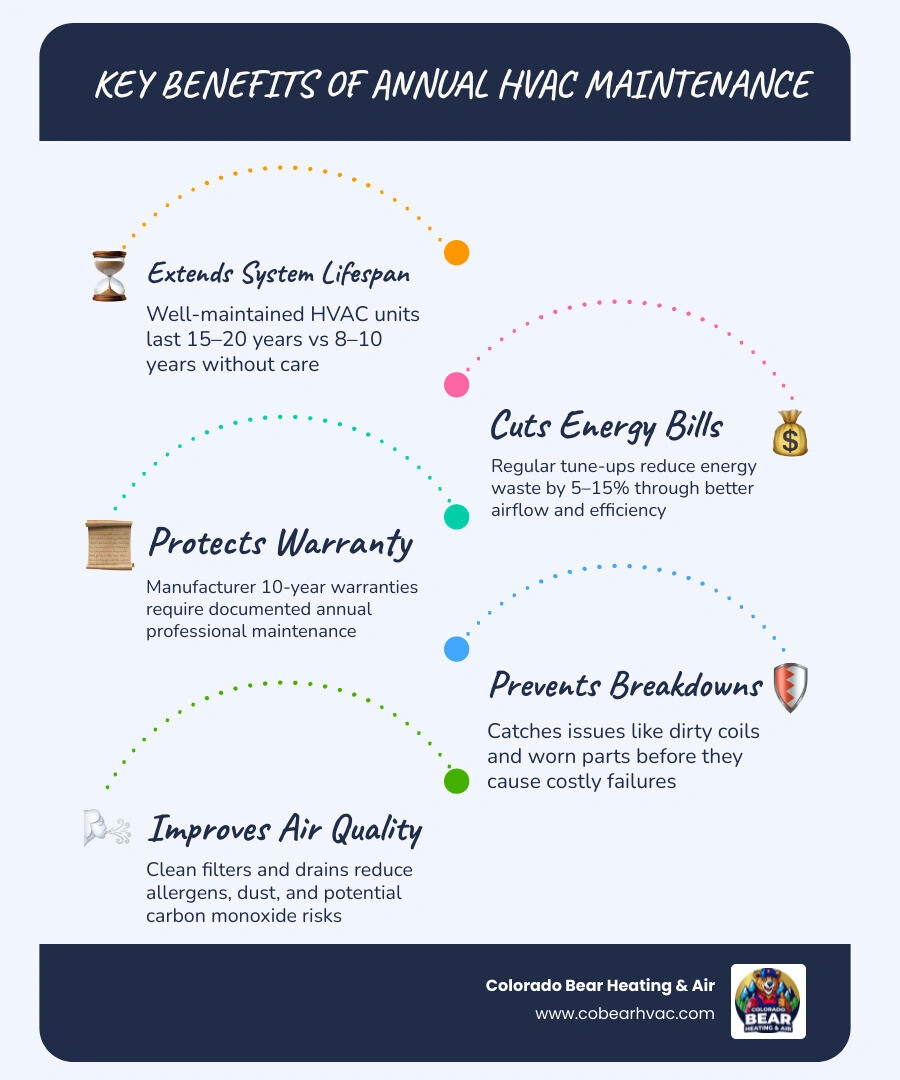
Annual HVAC maintenance is it worth it for most Colorado homeowners — and the evidence is hard to argue with. A well-maintained system lasts 15–20 years. A neglected one may struggle to reach 10. That gap alone can mean thousands of dollars in premature replacement costs.
Here's a quick summary before we dive deeper:
Annual HVAC Maintenance: Worth It or Not?
| Your Situation | Is It Worth It? |
|---|---|
| System is 5+ years old | Yes — high value |
| System is under warranty | Yes — required to keep warranty valid |
| You want lower energy bills | Yes — maintenance can cut energy waste by 5–15% |
| System is brand new (under 3 years) | Yes, but basic DIY may be enough short-term |
| You're selling your home soon | Maybe — but records help resale value |
Most HVAC manufacturers require documented annual professional maintenance to keep your 10-year parts warranty valid. Skip a visit, and a warranty claim could be denied — leaving you on the hook for an expensive repair.
There's also the safety angle. A routine furnace tune-up checks your heat exchanger, gas valve, and flue exhaust — the kind of inspection that can catch a carbon monoxide risk before it becomes a crisis. That's not something a filter change covers.
And then there's comfort. Colorado's climate swings hard — from freezing winters in Castle Rock to sweltering summer heat along the Front Range. Your HVAC system works overtime here. Without regular care, that wear adds up fast.
The bottom line: annual maintenance is one of the highest-return investments you can make in your home's comfort and safety.
Think of an HVAC maintenance plan as a personal health plan for your heating and cooling systems. Just like you wouldn't drive your car for years without changing the oil or checking the brakes, you shouldn't expect your home’s climate control systems to run flawlessly without professional oversight. An HVAC maintenance plan is a structured service agreement where professional technicians perform comprehensive, proactive inspections and cleanings to keep your system in peak condition.
When we perform a professional tune-up, we don't just kick the metal casing, change a filter, and call it a day. A thorough maintenance visit is a highly technical, multi-point inspection designed to catch microscopic issues before they cascade into catastrophic failures.
A standard professional maintenance checklist includes:
By staying ahead of these small mechanical details, you prevent minor wear from turning into a late-night emergency. To understand how these proactive steps keep your family safe and comfortable, read our guide on How to Prevent HVAC Emergencies with Maintenance.
When evaluating whether annual hvac maintenance is it worth it, it helps to look at the hard data. Proactive home maintenance is essentially a form of loss prevention. You are investing a small amount of effort and resources upfront to avoid massive, unexpected expenses down the road.
Let's break down the core areas where routine service delivers a massive return on investment:
As your system runs, it naturally collects dust, pet dander, and outdoor pollen. Dust on your air conditioner's coils acts like a thick winter coat, forcing the system to work twice as hard to transfer heat. This extra effort translates directly into higher utility bills. According to the U.S. Department of Energy, regular maintenance can help you recover lost efficiency, reducing your monthly energy consumption by 5% to 15%.
An HVAC system is a major financial investment for any homeowner. A system that receives regular care runs smoothly with minimal friction, allowing it to easily last its full expected lifespan. On the other hand, a neglected system works in a constant state of strain, which wears out the compressor, blower motor, and heat exchanger years ahead of schedule.
Statistics show that up to 95% of emergency heating and cooling repairs could have been prevented with regular maintenance. During a routine check, a technician can spot a weak capacitor or a slightly worn belt and replace it on the spot. If left alone, that weak capacitor will eventually fail on the hottest weekend of July, leading to an emergency service call and potential secondary damage to the compressor.
Your HVAC system functions as the lungs of your home. It pulls air from your living spaces, conditions it, and pushes it back out. If the internal components of your system are coated in dust, mold, or bacterial buildup, those contaminants are continuously recirculated throughout your home. Professional cleaning helps clear these pathways, ensuring your family breathes clean, healthy air.
Most homeowners don't realize that their manufacturer’s warranty comes with strings attached. If your compressor fails five years into its life, the manufacturer will likely require proof of documented annual professional maintenance before they honor the warranty and ship a replacement part. Without those service records, your coverage could be voided.
To explore these advantages in greater detail, check out our articles on AC Maintenance Key Benefits and how Consistent AC Maintenance Extend Lifespan.
| Feature | Maintained HVAC System | Neglected HVAC System |
|---|---|---|
| Average Lifespan | 15 to 20 years | 8 to 10 years |
| Energy Efficiency | High (runs at peak manufacturer specs) | Drops by roughly 5% each year without care |
| Risk of Major Failure | Extremely low (potential issues caught early) | 40% higher chance of major component failure |
| Warranty Status | Fully protected with documented service | At risk of being voided due to lack of professional care |
| Indoor Air Quality | Clean, filtered, and well-circulated | Higher levels of dust, allergens, and potential mold |
| Safety Risks | Negligible (monitored for gas/CO leaks) | Elevated risk of cracked heat exchangers or electrical shorts |
Many homeowners wonder if they can simply handle HVAC maintenance themselves to save time and effort. While we highly encourage homeowners to take an active role in caring for their systems, there is a clear boundary between basic homeowner upkeep and the advanced technical service that a professional provides.
There are a few simple, non-technical tasks that you can perform to keep your system running smoothly between professional visits. These tasks don't require opening up the units or handling sensitive components:
For more simple strategies to keep your system happy, read our Preventive AC Maintenance Tips.
While changing a filter is easy, the core of preventative maintenance requires specialized diagnostic tools, safety training, and technical expertise. Here is what a professional technician handles that simply cannot be done as a DIY project:
Over time, every mechanical system experiences wear and tear. In Colorado, our systems face extreme operational demands. We experience freezing winters that require furnaces to run around the clock, followed by hot summer afternoons where air conditioners work overtime.
Without regular lubrication, cleaning, and calibration, this heavy usage causes components to wear down rapidly. A well-maintained system operates with minimal friction, which directly translates to a longer operational life. To learn more about what to expect from your system's timeline in our local climate, read about the Average Lifespan of an HVAC System in Colorado.
If your system is already getting up there in years and you are trying to decide if it's worth servicing or if you should start planning for an upgrade, consult our detailed guide on When to Repair vs Replace Your HVAC System.
When your HVAC system is dirty or out of calibration, it has to work much harder to achieve your desired indoor temperature. For example, dust buildup on the indoor blower wheel reduces airflow, meaning the motor must spin longer and consume more electricity to push conditioned air through your home.
By cleaning the coils, calibrating the thermostat, and ensuring perfect system airflow, we eliminate this wasted energy. This keeps your utility bills as low as possible throughout the peak heating and cooling seasons. Discover how keeping your system tuned up benefits your household finances in our post on how Routine HVAC Repair Saves Money Long-Term.
For standard split systems (a separate furnace and air conditioner), we recommend a bi-annual schedule: once in the spring to prepare your air conditioner for the summer heat, and once in the fall to ensure your furnace is ready to handle the freezing winter temperatures.
If you heat and cool your home using a heat pump, which operates year-round to provide both heating and cooling, a bi-annual professional check-up is highly recommended to maintain year-round comfort and system efficiency. This consistent care ensures that your home remains a reliable sanctuary of comfort, no matter how extreme the weather gets outside.
When you look at the facts, the answer to the question "annual hvac maintenance is it worth it" is a resounding yes. From protecting your manufacturer's warranty and slashing your monthly utility bills to extending your system's life and keeping your family safe from carbon monoxide leaks, routine maintenance is one of the smartest investments you can make as a homeowner.
At Colorado Bear Heating & Air, we bring over 20 years of hands-on experience, licensed and factory-certified technicians, and a strict customer-first philosophy to every home we service. We believe in honest work done right the first time, backed by transparent, clear communication. We proudly serve Castle Rock, Littleton, Highlands Ranch, Centennial, and the surrounding Denver Metro communities, ensuring your home stays perfectly comfortable through every season.
Don't wait for a system breakdown to think about your comfort. Protect your home and your investment today. For fast, reliable, and honest comfort service, learn more about our HVAC Maintenance Castle Rock CO options to schedule your comprehensive seasonal tune-up!

Get a decision in seconds with no impact to your credit score.


Colorado Bear HVAC is truly the best contractors I have experienced since I moved into my house 30 years ago. I have been dealing with Joe and his crew for over 11 years now. They are a trustworthy, respectful, experienced crew who works with you and gives you a fair value. They just completed a big job replacing my A/C, gas furnace and condenser. They did an excellent job, no short cuts, made sure everything was functional, and cleaned up the area nicely before they left. No pressure to perform unnecessary service. You know when the job is done, you have received top notch professional service at a fair price.


I used Colorado Bear Heating and Air to replace two furnaces in my home. Nate was exceptional to work with. His team did a great job educating me along the way. He provided competitive pricing with 10 year warranties. They installed quickly and were just super great to work with. I’d highly recommend them.

Nate and Sam have been great to work with getting my home humidifier installed in a difficult space in my 1940s house. Their prices were very fair and I would heartily recommend Colorado Bear to anyone looking for a solid HVAC company.
.avif)
Thank you Nate for the promptness you guys gave my parent. They are 93 and can't get around and always getting cold, and I was at work called Nate and he had one of his guys there in like 2 hours which was outstanding my dad was very impressed with the professional and how quick he had it fixed. These guys are great all my family said we found us a new heating and ac company. Colorado Bear Heating & Air you have customers for life!!!! Thank You Again
Carla and the Barnes Family
.avif)
Colorado Bear Heating & Air saved the day! This morning my family and I woke up to frigid outside temperatures(1 degree F)…and no heat! Nate was great over the phone to help me check our furnace, then he sent Sam over to help get us back to warmer temps. They were so quick and helpful. Fortunately I did not have to keep my toddlers inside the house wearing snow suits all day. We are warm now, and so thankful!
.avif)

If you’re in Colorado Springs, The Mountains, or nearby areas, call us to confirm availability for installations.
.avif)