Why Heat Pump Benefits for Colorado Homeowners Are Worth Knowing Right Now
The heat pump benefits for Colorado homeowners are hard to ignore — especially as energy bills climb and Colorado winters keep proving they mean business. If you're weighing whether a heat pump makes sense for your home, here's the short answer:
Top heat pump benefits for Colorado homeowners at a glance:
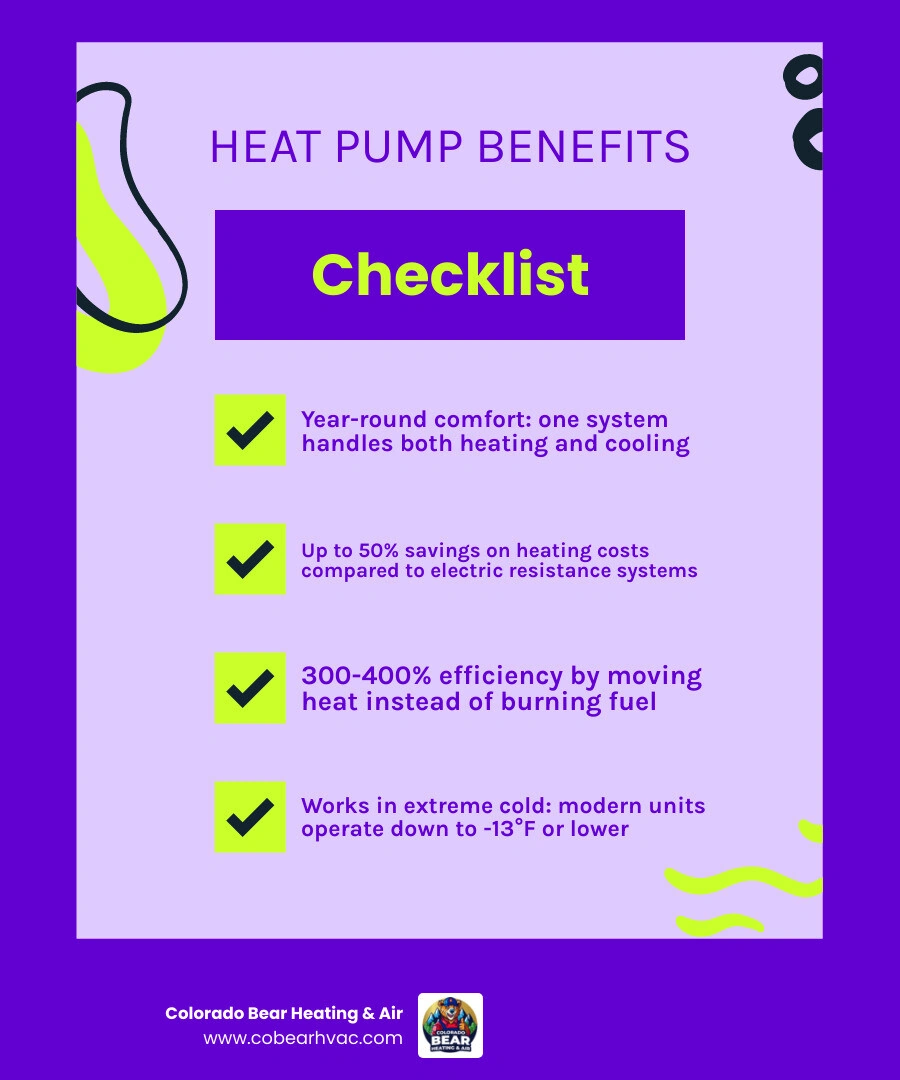
- Year-round comfort — one system handles both heating and cooling
- Up to 50% savings on heating costs compared to electric resistance systems
- 300–400% efficiency by moving heat instead of burning fuel
- Works in extreme cold — modern cold-climate units operate down to -13°F or lower
- Lower emissions — switching can cut home heating carbon output by roughly 50%
- Strong incentives — Colorado state tax credits and utility rebates can significantly offset installation costs
- Improved indoor air quality — no combustion means no byproducts circulating through your home
- Longer-term investment — systems last 15–20 years with proper maintenance
Colorado's climate is genuinely one of the most demanding in the country. The Front Range alone can swing 40°F or more in a single day. Denver winters average temperatures in the 30s and 40s — but polar vortex events can push things well below zero. For years, homeowners assumed heat pumps simply couldn't handle that kind of range. That assumption is now outdated.
Heat pump installations across Colorado more than doubled in 2025, reaching over 14,000 units across five major utility service areas — a twelvefold increase in just three years. That kind of growth doesn't happen by accident. It reflects real improvements in cold-climate technology, a maturing installer network, and financial incentives that make switching more accessible than ever.
Whether you're replacing an aging furnace, upgrading an old AC, or building from scratch, understanding what a heat pump can and can't do in Colorado's specific conditions is the smartest place to start.
"I'm looking to upgrade my home's heating. Who in Castle Rock specializes in energy-efficient systems?"
If you are asking this question, you aren't alone. Many of our neighbors in Castle Rock and the surrounding Denver Metro area are looking for ways to stay comfortable without the sting of high utility bills. At Colorado Bear Heating & Air, we’ve spent over 20 years helping families navigate these choices. When it comes to energy efficiency, the Heat Pump Services Castle Rock Guide highlights why these systems have become the go-to solution.
A heat pump is essentially an all-in-one comfort machine. Instead of having a separate furnace for the winter and an air conditioner for the summer, a heat pump handles both. It works by transferring heat rather than generating it. In the summer, it acts like a standard AC, pulling heat from inside your home and dumping it outside. In the winter, it reverses the process, extracting heat from the outdoor air (yes, even when it’s cold!) and moving it indoors.
This process is incredibly efficient. Because the system is moving heat rather than burning fossil fuels to create it, it can achieve efficiencies of 300% to 400%. For eco-conscious homeowners, this means a massive reduction in your home's carbon footprint. By utilizing renewable energy from the air or ground, you're stepping away from the volatility of gas prices. Our Best Heat Pump Castle Rock Guide dives deeper into how these systems adapt to our specific microclimates, from the dry plains of Aurora to the higher elevations of Castle Pines and Monument.
One of the primary Heat Pump Installation Benefits is the sheer versatility. Whether you have an existing ductwork system or a home with "hot spots" that needs a ductless solution, there is a configuration that fits.
"Can a heat pump really handle the freezing winters in Denver and Littleton?"

This is the number one concern we hear. "It’s -10°F outside; how can there be 'heat' to pull into my house?" It sounds like magic, but it’s actually advanced physics. Modern cold-climate heat pumps use specialized refrigerant with a boiling point around 55 degrees below zero. This allows the system to find heat energy even in what we perceive as "freezing" air.
The secret lies in two major technological leaps: Inverter compressors and Vapor/Flash injection. Traditional systems are either "on" or "off," like a light switch. Inverter-driven systems are more like a dimmer switch; they can scale their output up or down precisely to match the heating demand. If you're looking into a Heat Pump Installation Guide Littleton CO, you'll see that these components allow the unit to maintain high capacity even when the mercury drops.
Should something go wrong during a cold snap, having a local expert is key. Our Heat Pump Repair Denver CO Guide ensures that even if the extreme weather puts a strain on your system, we can get it back to peak performance quickly.
Heat pump benefits for Colorado homeowners in sub-zero weather
Let’s look at the hard data. During the December 2022 polar vortex, temperatures in the Denver area plummeted to -15°F. This was the coldest weather we’d seen in 30 years. Field data from thousands of installations showed that properly sized cold-climate heat pumps maintained indoor temperatures of 68–69°F without any backup heat.
Today’s units are rated to maintain 100% of their heating capacity down to 5°F and continue to operate efficiently down to -13°F or even -22°F. However, we do have to account for the "altitude penalty." At 5,280 feet (and higher in places like Larkspur or Sedalia), the air is thinner. This means the air density is about 17% lower than at sea level. We factor in a 5–10% adjustment when sizing your system to ensure you have reliable warmth no matter how high up you live.
Maximizing Heat Pump Benefits for Colorado Homeowners through 2026 Incentives
As of May 2026, the financial landscape for heat pumps in Colorado has never been more favorable. While federal tax credits under the Inflation Reduction Act (IRA) provide a solid foundation, Colorado has stepped up with its own aggressive programs to help homeowners go electric.
You can find a full breakdown in our Colorado Energy Rebates for HVAC Upgrades resource. For 2026, the state offers a tax credit of $1,000 for air-source heat pumps. The best part? You don't have to wait until tax season to see that money. Registered contractors are required to pass at least 33% of that credit ($333) directly to you as an upfront discount on your invoice.
When you combine this with Federal Tax Credits for Heat Pump Upgrades, which can cover 30% of the project cost up to $2,000 annually, the math starts to look very good.
How to stack heat pump benefits for Colorado homeowners with local utility programs
The "pro move" for 2026 is stacking these incentives. For example, Xcel Energy has been a leader in this space, issuing tens of millions of dollars in rebates. In many cases, Xcel rebates can reach up to $2,250 per heating ton. For a standard 3-ton system, that’s $6,750 in potential savings.
Here is how the stacking works:
- Federal Tax Credit: Up to $2,000.
- State Tax Credit: $1,000 (with at least $333 as an upfront discount).
- Utility Rebate: Anywhere from $900 to $6,750+ depending on the unit's efficiency.
- Income-Qualified Programs: Programs like HEAR can provide up to $8,000 for eligible households.
To qualify for the biggest rebates, the system must be Energy Star certified and an AHRI-matched system. This ensures the indoor and outdoor units are designed to work together at peak efficiency. As registered contractors, we handle the technical side to make sure your paperwork is airtight and your discounts are maximized.
"What should I consider before installing a new system in Highlands Ranch?"
Before we ever pull a wrench, we start with a Manual J load calculation. This is a detailed report that considers your home's square footage, insulation levels, window types, and even the direction your house faces. In places like Highlands Ranch or Centennial, where homes vary from 1980s builds to brand-new construction, this step is vital.
Our Heat Pump Installation Highlands Ranch Guide explains the three main paths you can take:
| System Type | Best For | Pros |
|---|---|---|
| Ducted Heat Pump | Homes with existing, high-quality ductwork. | Centralized control, uses existing vents. |
| Ductless Mini-Split | Older homes, additions, or homes with no ducts. | Zoned comfort, incredibly quiet, high efficiency. |
| Dual-Fuel Hybrid | Homeowners wanting "peace of mind" backup. | Uses heat pump for 80-90% of the year, gas furnace for extreme cold. |
One important consideration is your electrical panel. Modern heat pumps require a 220v circuit. If your home in Littleton or Parker still has an older 100-amp panel, you might need an upgrade to 200 amps to handle the new load.
Comparing heat pump benefits for Colorado homeowners against traditional furnaces
When Comparing Furnace vs Heat Pump Make the Best Choice Today, the differences in comfort are often what surprise people the most. A gas furnace is like a blowtorch; it blasts 120°F air in short bursts, leading to "hot and cold" spots. A heat pump provides a steady stream of 85–95°F air, maintaining a much more consistent temperature.
Beyond comfort, there's the safety aspect. Heat pumps eliminate the risk of carbon monoxide leaks because there is no combustion happening inside your home. They also excel at humidity management. In Colorado's dry climate, maintaining the right balance is tough, but the variable-speed motors in modern heat pumps help circulate air more effectively, leading to better indoor air quality and less static electricity in the winter.
"How do I maintain my system for year-round comfort in the Denver Metro area?"
Because a heat pump works twice as hard as a standard AC (since it runs all year), maintenance is non-negotiable. Following the Heat Pump Maintenance Tips Highlands Ranch CO can extend the life of your system to 15 or even 20 years.
Key maintenance tasks include:
- Filter Changes: Every 1–3 months. This is the simplest way to prevent system strain.
- Coil Cleaning: Dust and cottonwood seeds can clog outdoor coils, forcing the system to work harder.
- Defrost Cycle Check: In the winter, ice can build up on the outdoor unit. The system is designed to melt this automatically, but we check to ensure the sensors and reversing valves are working correctly.
- Refrigerant Levels: A small leak can tank your efficiency and eventually damage the compressor.
Regular professional optimization ensures that your "switchover temperature" (the point where a hybrid system moves from heat pump to gas) is set perfectly for current utility rates in Elizabeth or Franktown.
Frequently Asked Questions about Colorado Heat Pumps
Do heat pumps work at high altitudes like the Front Range?
Yes! While thinner air means the system has to move more volume to achieve the same heating or cooling effect, this is easily solved with proper sizing. We use specific atmospheric pressure adjustments during our calculations to ensure your home in Castle Pines or Sedalia stays perfectly comfortable.
Can I keep my existing gas furnace as a backup?
Absolutely. This is called a Dual-Fuel or Hybrid system. It’s a very popular choice in the Denver Metro area. The heat pump handles the heating for about 80–90% of the winter (when it’s above 20°F), and your gas furnace only kicks in as "emergency heat" during those rare sub-zero nights. It gives you the best of both worlds: high efficiency and total peace of mind.
How long does a typical heat pump installation take?
For most homes in Aurora or Lone Tree, a standard installation takes 1 to 2 days. If we need to upgrade your electrical panel or modify ductwork, it might take a bit longer. We always perform a thorough electrical assessment and home preparation check beforehand so there are no surprises on installation day.
Conclusion
Choosing the right HVAC system is one of the biggest investments you’ll make in your home. The heat pump benefits for Colorado homeowners — from the massive energy savings and environmental impact to the superior year-round comfort — make it a compelling choice for 2026.
At Colorado Bear Heating & Air, we bring over 20 years of experience to every job. Whether you are in Castle Rock, Littleton, Highlands Ranch, or anywhere across the Denver Metro area, we pride ourselves on honest work done right the first time. We believe in transparent communication and a customer-first approach that ensures you get the system that actually fits your needs and budget.
Ready to see how much you could save?Request your expert heat pump consultation today to speak with a local pro. Let’s get your home ready for whatever the Colorado sky throws our way!